
Last verified: October 2026. Figures and rules below were checked against the official sources listed at the end of the article.
US only. This article explains health insurance in the United States. Other countries run very different systems, so the plan rules, limits and dates here do not apply outside the US.
Health insurance is a contract: you pay a monthly price, and in return the plan pays part of your medical bills. What you actually spend in a year depends on five numbers: the premium, the deductible, any copayments, your coinsurance, and the out-of-pocket maximum. Most people look only at the premium, then get surprised by the rest. Once you know how the five fit together, comparing plans gets much easier.
This guide explains each term, shows the 2026 and 2027 limits, walks through a worked example with made-up plans, and covers the Marketplace metal levels, network types, enrollment dates and a few protections worth knowing.
Key takeaways
- Premium is the monthly price. Deductible is what you pay first. Copayment is a fixed fee and coinsurance is a percentage. The out-of-pocket maximum caps what you can owe for covered care in a year.
- The 2026 legal cap on out-of-pocket costs for Marketplace plans is $10,600 for one person and $21,200 for a family. For 2027 it rises to $12,000 and $24,000.
- Premiums do not count toward the cap, and neither do out-of-network care or services your plan does not cover.
- A cheaper premium can cost more over a year, if you need care. Compare total yearly cost, not just the monthly price.
- Open enrollment for 2027 coverage runs from November 1, 2026 to January 15, 2027 for HealthCare.gov plans. Enrolling by December 15 gets coverage from January 1.

The five terms that decide your cost
Premium
The premium is the amount you pay every month to keep your insurance, whether or not you use any care. HealthCare.gov notes that on top of the premium you usually pay a deductible, copayments and coinsurance. A premium tax credit may lower the premium for some Marketplace plans (more on that below).
Deductible
The deductible is the amount you pay for covered services before your plan starts to pay its share. HealthCare.gov’s example: with a $2,000 deductible, you pay the first $2,000 of covered services yourself. Some services, such as preventive care, are covered before you meet it.
Copayment
A copayment (copay) is a fixed amount you pay for a covered service, like $30 for a doctor visit. Whether copays apply before or after the deductible depends on the plan, so read the plan summary.
Coinsurance
Coinsurance is a percentage of the cost that you pay for a covered service, like 20%. It usually applies after you meet the deductible. With 20% coinsurance, the plan pays the other 80%.
Out-of-pocket maximum
This is the most you have to pay for covered services in a plan year. After you reach it, the plan pays 100% of covered, in-network costs for the rest of the year. Federal rules set a ceiling. For Marketplace plans:
- 2026: no more than $10,600 for an individual or $21,200 for a family
- 2027: no more than $12,000 for an individual or $24,000 for a family
Your plan may set a lower maximum. The cap does not include your monthly premiums, anything your plan does not cover, out-of-network care, or amounts above the allowed amount that a provider may charge.
A worked example: two made-up plans
Here is an illustration with invented plans, not real products. Plan X has a low premium and a high deductible. Plan Y has a higher premium and lower cost-sharing. Both assume all care is covered and in-network.
| Plan X | Plan Y | |
|---|---|---|
| Premium | $300 a month ($3,600 a year) | $500 a month ($6,000 a year) |
| Deductible | $6,000 | $1,500 |
| Coinsurance | 30% | 20% |
| Out-of-pocket maximum | $10,600 | $7,000 |
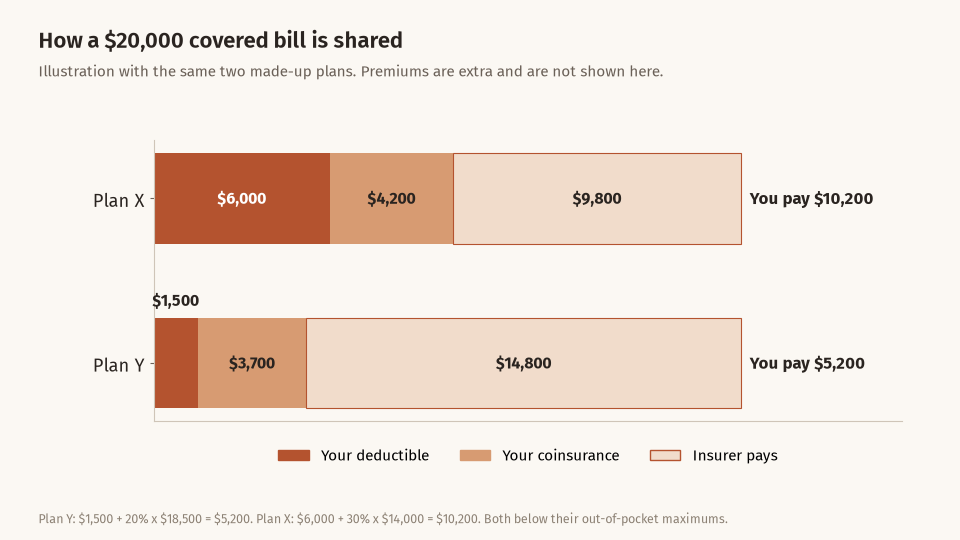
Suppose you have $20,000 of covered medical bills in the year.
- Plan X: you pay the $6,000 deductible, then 30% of the remaining $14,000, which is $4,200. Your care costs $10,200 (below the $10,600 cap). Add $3,600 of premiums and the year costs $13,800.
- Plan Y: you pay the $1,500 deductible, then 20% of the remaining $18,500, which is $3,700. Your care costs $5,200. Add $6,000 of premiums and the year costs $11,200.
But change the year and the answer changes. With no care at all, Plan X costs only $3,600 against $6,000 for Plan Y. With $3,000 of care, Plan X costs $6,600 ($3,000 + $3,600) and Plan Y costs $7,800 ($1,500 + 20% of $1,500 = $1,800, plus $6,000). With $50,000 of care, both plans hit their out-of-pocket maximum: Plan X costs $10,600 + $3,600 = $14,200 and Plan Y costs $7,000 + $6,000 = $13,000.
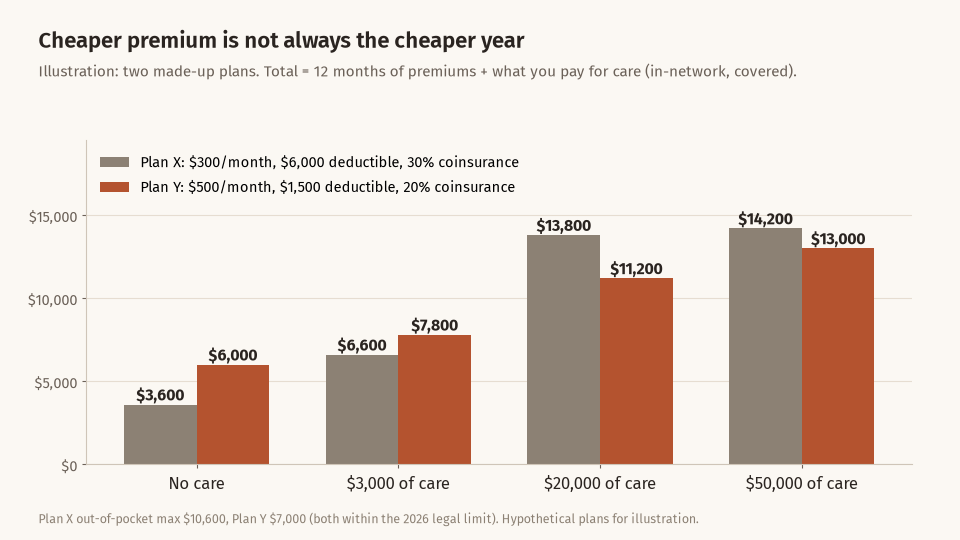
The lesson: the low-premium plan wins in a healthy year and loses in an expensive one. If you expect little care, a high-deductible plan can be cheaper. If you have ongoing treatment or a planned procedure, a plan with a lower deductible may cost less overall. This is why HealthCare.gov tells shoppers to think about total spending on health care, not just the premium.
Metal levels on the Marketplace
Plans sold on the Health Insurance Marketplace are grouped into four categories: Bronze, Silver, Gold and Platinum. HealthCare.gov says the categories have nothing to do with the quality of care. They describe how costs are split between you and the plan, on average, for covered services.
| Category | Plan pays | You pay | Deductible is generally |
|---|---|---|---|
| Bronze | 60% | 40% | High |
| Silver | 70% | 30% | Moderate |
| Silver with extra savings | 73% to 94% | 6% to 27% | Low |
| Gold | 80% | 20% | Low |
| Platinum | 90% | 10% | Low |
Two points stand out. First, if your income qualifies for extra savings (cost-sharing reductions), you only get them in a Silver plan. Second, catastrophic plans are a fifth category, available if you are under 30 or qualify for a hardship or affordability exemption. Bronze and catastrophic plans work with Health Savings Accounts.
Lowering the premium: the premium tax credit
The premium tax credit lowers your monthly Marketplace premium. Under the current rules on HealthCare.gov, you qualify if your income is between 100% and 400% of the federal poverty level. The amount depends on your household size and your estimated income. You can take it in advance each month, take some of it or none. If you take more than you end up qualifying for, you repay the difference when you file your taxes, and if you take less, you get the difference as a refund. Subsidy rules have changed in recent years, so use the Marketplace application to see what you qualify for rather than relying on an old figure.
Network types: HMO, PPO, EPO and POS
Your plan type decides which doctors you can see, and what happens if you step outside the network.
- HMO: usually limits coverage to doctors who work for or contract with the plan, and generally covers out-of-network care only in an emergency.
- PPO: you pay less in network, but you can go out of network without a referral, for an additional cost.
- EPO: services are covered only in network, except in an emergency.
- POS: you pay less in network and need a referral from your primary care doctor to see a specialist.
Before you pick a plan, check that your doctors, hospital and prescriptions are covered. A great premium is no help if your specialist is out of network.
HSAs and high-deductible plans
If you choose a high-deductible health plan (HDHP), you may be able to pair it with a Health Savings Account (HSA), which lets you save pre-tax money for medical costs. For 2026, the IRS says the HSA contribution limit is $4,400 for self-only coverage and $8,750 for family coverage. To qualify as an HDHP, a plan must have a deductible of at least $1,700 (self-only) or $3,400 (family), and an out-of-pocket maximum no higher than $8,500 or $17,000. Our guide on HSA vs FSA compares the two accounts.

Protections worth knowing
- Free preventive care. Most health plans must cover a set of preventive services, such as immunizations and screening tests, at no cost to you when you use an in-network provider, even before you meet your deductible. HealthCare.gov notes that $0 is not guaranteed in every case.
- The No Surprises Act. This federal law, in effect since January 1, 2022, protects you from unexpected out-of-network bills for emergency room visits, for some non-emergency care at an in-network hospital or surgical center, and for air ambulance services. If you do not use insurance, providers usually must give you a good faith estimate if you ask or schedule care at least three business days ahead. You may be able to dispute a bill that is at least $400 more than the estimate.
- Medicaid and CHIP. Free or low-cost coverage is available through Medicaid and the Children’s Health Insurance Program if you qualify, and HealthCare.gov will tell you when you apply.
If a bill lands that looks wrong, our guide to how to negotiate medical bills walks through the steps.
When you can enroll
For plans bought on HealthCare.gov, here are the dates for 2027 coverage:
| Date | What happens |
|---|---|
| November 1, 2026 | Open enrollment starts |
| December 15, 2026 | Last day to enroll or change plans for coverage starting January 1, 2027 |
| January 15, 2027 | Open enrollment ends |
| February 1, 2027 | Coverage starts for those who enroll from December 16 to January 15 and pay their first premium |
After open enrollment you can only join or change plans if you qualify for a Special Enrollment Period, which a life event such as moving, losing other coverage, getting married or having a baby can trigger. Some state-run marketplaces set their own dates, so check yours.
Common mistakes
- Choosing on premium alone. As the example shows, the cheapest premium can be the most expensive year.
- Forgetting that the deductible comes first. A plan that says it pays 80% still makes you pay the whole deductible before it pays anything, apart from services covered earlier, like preventive care.
- Going out of network by accident. Out-of-network costs may not count toward your out-of-pocket maximum.
- Not checking the drug list and doctors. Confirm they are covered before you enroll.
- Having no cash for the deductible. An emergency fund makes a high-deductible plan safer to hold.
- Missing the enrollment deadline. Outside open enrollment you may be locked out until the next year unless you qualify for a Special Enrollment Period.
Frequently asked questions
What is the difference between a copay and coinsurance?
A copay is a fixed dollar amount, like $30 for a visit. Coinsurance is a percentage of the cost, like 20%. Plans can use either or both, and they usually count toward your out-of-pocket maximum.
Does the premium count toward the out-of-pocket maximum?
No. HealthCare.gov says the out-of-pocket limit does not include your monthly premiums, services your plan does not cover, out-of-network care, or costs above the allowed amount.
Is a Gold plan better than a Bronze plan?
Not in quality. Gold plans pay a larger share of costs on average, with a higher premium, while Bronze plans have lower premiums and higher deductibles. Which is cheaper depends on how much care you use.
What is the 2026 out-of-pocket maximum?
For Marketplace plans, no more than $10,600 for an individual and $21,200 for a family. Your plan might have a lower limit. For 2027 the limits are $12,000 and $24,000.
Can I buy a plan after open enrollment ends?
Only if you qualify for a Special Enrollment Period, for example after losing other coverage, moving, marrying or having a baby. Medicaid and CHIP enrollment is available all year if you qualify.
What if I get a surprise bill after an emergency?
The No Surprises Act protects most people with insurance from unexpected out-of-network bills for emergency room care. If you think you were billed wrongly, CMS has a tool to find an action plan.
This article is general information, not financial advice. Rules, limits and rates change, and your circumstances are your own. Check the official sources below, and consider speaking to a qualified adviser before making decisions. See our Editorial Policy and Disclaimer pages. Last verified: October 2026.
Sources
- HealthCare.gov: Health plan categories: Bronze, Silver, Gold & Platinum
- HealthCare.gov glossary: Premium
- HealthCare.gov glossary: Deductible
- HealthCare.gov glossary: Out-of-pocket maximum/limit
- HealthCare.gov: Health insurance plan and network types: HMOs, PPOs, and more
- HealthCare.gov: When can you get health insurance? (dates and deadlines)
- HealthCare.gov glossary: Premium tax credit
- HealthCare.gov: Preventive health services
- CMS: Medical bill rights and the No Surprises Act
- IRS: Revenue Procedure 2025-19 (2026 HSA and HDHP limits)