
Last verified: October 2026. Figures and limits below were checked against the official sources listed at the end of the article.
An emergency fund is cash you keep set aside for bills you did not plan for, such as a car repair, a medical bill or a gap between jobs. The most common official guidance is three months of essential spending, with up to six months if your income is less steady. If that sounds out of reach, start with one month of essentials, or even a few hundred dollars, and build up from there. A small fund that exists beats a perfect one that does not.
This guide shows you how to work out your own number, how long it will take to build, where to keep the money in the US, UK, EU and Australia, and what to do when you need to spend it.
Key takeaways
- Aim for three to six months of essential costs. Add up only what you must pay (housing, food, utilities, transport, insurance, minimum debt payments), not your whole lifestyle.
- Do not wait until you reach the full amount to feel protected. One month of essentials is a sensible first milestone.
- Keep it in an insured, easy-access savings account, separate from your day-to-day money. Never in shares or crypto.
- Automate the saving. A fixed transfer on payday beats good intentions.
- Use it for real emergencies, then refill it. Having to dip in is the fund doing its job.

Why an emergency fund matters
A surprise bill is not really the problem. The problem is what happens next. The US Consumer Financial Protection Bureau (CFPB) notes that people with little savings tend to lean on credit cards or loans after a shock, and that debt is generally harder to pay off, while some also pull money out of retirement savings. A one-off bill then keeps costing you for months through interest and fees.
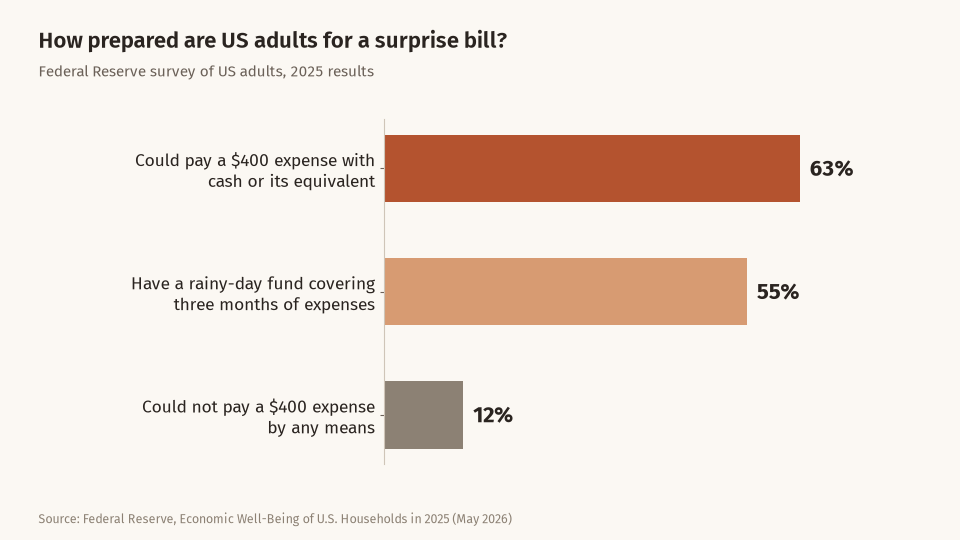
The numbers show how common that gap is. In the Federal Reserve’s 2025 survey of US households, 63% of adults said they could cover a $400 emergency using cash, savings or a credit card paid off at the next statement. That leaves 37% who would borrow, sell something or go without, and 12% said they could not pay it by any means. Only 55% had a rainy-day fund covering three months of expenses.
One more finding from the same report is worth noticing: 86% of adults who said they always had money left over at the end of the month had three months of savings, compared with 13% of those who never did. An emergency fund is partly a result of how your monthly cash flow works, which is why it pairs well with a working budget. If you have not built one yet, our guide on how to make a budget that sticks is a good place to start.
How much do you need?
Official guidance is consistent on the basic rule, and a little vague on the details, which is honest because households differ:
- UK (MoneyHelper): three to six months of essential outgoings in an instant-access savings account. Its example: if you spend £1,000 a month on housing, food, heating and other must-pay costs, aim for £3,000 to £6,000.
- Australia (Moneysmart): a good target is enough to cover three months of expenses, and a bit more if you are thinking longer term, for example if you might need time out of work to care for a family member.
- US (CFPB): the right amount depends on your situation. It suggests thinking about the most common unexpected costs you have had in the past and what they cost, and says even a small amount helps.
Step 1: add up your essentials
Your target is based on what you would have to pay if your income stopped, not on what you spend in a normal month. Count:
- Rent or mortgage, plus property taxes or council tax where they apply
- Utilities, internet and a phone plan
- Groceries (the basic version)
- Transport you need for work or caring duties, including fuel and insurance
- Insurance premiums and essential healthcare costs
- Childcare or dependants’ costs
- Minimum payments on any debts
Leave out dining out, streaming, holidays and other spending you could pause. Your budget history will help here. Looking back at three months of bank statements is more reliable than guessing.
Step 2: multiply
Suppose your essentials come to $2,400 a month (this is a made-up household, not an average). Here is what each target means:
| Target | Calculation | Amount |
|---|---|---|
| 1 month (first milestone) | $2,400 × 1 | $2,400 |
| 3 months (common target) | $2,400 × 3 | $7,200 |
| 6 months (steadier cushion for variable income) | $2,400 × 6 | $14,400 |
Step 3: adjust for your situation
The 3 to 6 month range is a rule of thumb, not a law. These are judgement calls, not official rules, but they are the factors that usually push the number up or down:
- Aim higher (closer to six months or more) if your income is irregular (freelance, commission, seasonal work), you are the only earner, you work in an industry where hiring slows down sharply, or you have dependants or health costs.
- Three months may be plenty if you have two stable incomes, strong job security, low fixed costs, or other accessible resources such as flexible insurance or a family safety net.
- Start smaller if you also carry expensive debt. The CFPB warns that putting an emergency on a credit card or loan can make a one-off expense grow much larger than the original bill through interest and fees, so a small buffer is still worth having.
How long will it take?
Here is the part most guides skip. A three-month fund for the household above is $7,200. Without interest or windfalls, here is how long different monthly amounts take:
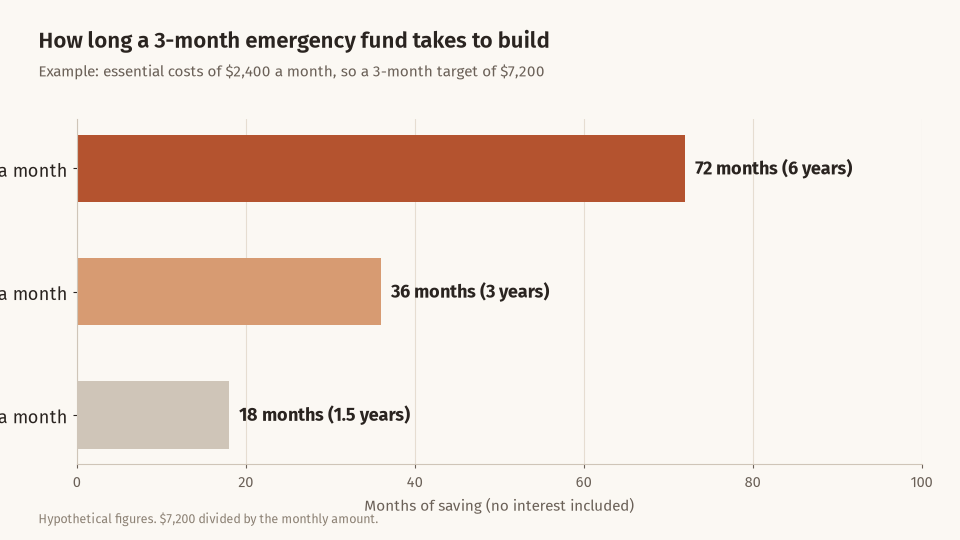
At $200 a month the fund takes 36 months. If you also put a $1,000 tax refund or bonus into it, the remaining $6,200 takes 31 months. The first month’s worth of expenses ($2,400) arrives in 12 months at $200 a month, or six months at $400.
Small amounts add up faster than people expect. Moneysmart points out that $20 a week into savings gives you over $1,000 in a year. Checking that sum: $20 × 52 weeks is $1,040.
Where to keep your emergency fund
Three tests decide where the money belongs. It should be safe (you will not lose it if markets fall or a bank fails), accessible (you can reach it within a day or two), and a little bit awkward to spend on non-emergencies. A separate account, not your everyday current or checking account, helps with the last one. Moneysmart makes this point directly: a separate account means you are less tempted to dip into it for everyday spending.
Keep emergency money out of shares, funds and crypto. These can fall in value just when you need the cash, and deposit protection schemes generally do not cover them. See our beginner’s guide to how to start investing for what belongs in a longer-term pot instead.
Check the deposit protection limit
If your bank fails, a government-backed scheme should return your money up to a limit. These limits are different in each region, so check yours:
| Region | Scheme | Standard limit |
|---|---|---|
| United States | FDIC deposit insurance | $250,000 per depositor, per insured bank, per ownership category |
| United Kingdom | FSCS | £120,000 per eligible person, per bank (failures after 30 Nov 2025) |
| Euro area / EU | National deposit guarantee schemes | €100,000 per depositor, per bank |
| Australia | Financial Claims Scheme | A$250,000 per account holder, per authorised bank or similar institution |
United States
A savings account or money market deposit account at an FDIC-insured bank is the usual home. The FDIC insures deposits up to $250,000 per depositor, per insured bank, for each account ownership category. That covers checking, savings, money market deposit accounts and CDs. It does not cover stocks, bonds, mutual funds, crypto, or U.S. Treasury bills, bonds or notes. You can confirm whether a bank is insured with the FDIC’s BankFind tool. If you use a certificate of deposit, check the terms for what happens if you need the money early. For a deeper comparison, see our guide to savings accounts, money market accounts and CDs.
United Kingdom
Instant-access savings accounts are the standard choice; MoneyHelper specifically says three to six months of essentials in an instant-access account. A cash ISA is also an option, because you do not pay tax on interest on cash in an ISA. You can currently put up to £20,000 a year across all ISAs. For protection, the Financial Services Compensation Scheme (FSCS) covers up to £120,000 per eligible person, per bank, building society or credit union if the firm failed after 30 November 2025 (it was £85,000 before that date). Banks that share a licence count as one for this limit, so spreading savings across brands owned by one banking group may not add protection.
European Union
Rules are set nationally, but under EU law every country must run at least one deposit guarantee scheme that all banks join, and the standard protection is €100,000 per depositor. The exact process, covered account types and timings vary by country, so check the website of your national scheme or your bank’s information sheet. Rates and account types for easy-access savings differ widely between countries and are not covered here.
Australia
Moneysmart suggests a separate, high-interest savings account, or an offset account if you have a home loan, because the offset account lowers your loan interest and you can still access the money quickly. The Financial Claims Scheme protects deposits up to A$250,000 per account holder, per authorised deposit-taking institution. APRA also warns that some banks sell under several brand names, so two accounts that look separate may sit with the same institution and share one limit.
How to build the fund
- Pick a number for the first milestone. One month of essentials is a good first target. If that feels huge, pick a smaller dollar goal you can reach in a few months.
- Open a separate account. A different bank can add friction, which helps, but make sure it is insured.
- Automate it. The CFPB says that setting up recurring transfers from checking to savings is often one of the easiest ways to be consistent. Time it for the day after payday so you never see the money. You can also ask your employer to split your direct deposit between two accounts.
- Use windfalls. Tax refunds, bonuses and gifts can shorten the timeline. The CFPB and Moneysmart both suggest putting some or all of them toward the fund.
- Watch your balance. Make sure you leave enough in your current account so an automatic transfer does not trigger overdraft fees, as the CFPB cautions.
- Raise the transfer when you can. A raise or the end of a debt payment is a natural moment to increase the amount.
If you are struggling to find any spare money, our guide to breaking the paycheck-to-paycheck cycle walks through where to look first.
Emergency fund or debt first?
This is the question people argue about most, and the honest answer is that it depends on what the debt is. MoneyHelper says that if you have credit card debt, an unauthorised overdraft, payday loans, home credit or mortgage arrears, it would be cheaper in the long run to pay these off first, while low-cost debts that are well under control should not stop you from building an emergency fund.
A sensible middle path is a small starter buffer (a few hundred dollars or one month of essentials), so a flat tyre does not go straight on a card at a high rate, followed by a push to clear the expensive debt, followed by filling the fund to three to six months. That order is a judgement call, not an official rule, so adjust it to how secure your income is. For the debt step, see debt payoff: avalanche vs snowball.

When to use it, and when not to
Decide your own rules before you need them. A genuine emergency is usually unexpected, necessary and urgent: a loss of income, an essential car or home repair, an unplanned medical bill, an emergency trip for family. A sale, a holiday or a predictable annual bill is not. Moneysmart’s guidance is that if an expense can wait, save up for a few weeks and pay for it that way instead.
If you do spend from the fund, do not feel guilty. The CFPB says plainly: don’t be afraid to use it, and just work to build it up again. Put refilling it at the top of your budget until it is back to your target.
Common mistakes
- Keeping it in the same account as everyday spending. It gets absorbed without you noticing.
- Setting the target from your lifestyle, not your essentials. This makes the goal larger than it needs to be and the project feels hopeless.
- Investing it. Shares can fall just when you lose your job. An emergency fund is insurance, not an investment.
- Ignoring the protection limit. If your savings are very large, check whether they are all within the limit at one bank or banking group.
- Counting a credit card limit as savings. A card you can clear at the next statement can work as a short-term bridge (the Federal Reserve counts that as “cash or its equivalent”), but a card you would carry a balance on is borrowing, not savings.
- Never topping it back up. After a withdrawal, restart the automatic transfer.
FAQ
Is $1,000 enough for an emergency fund?
It is a reasonable first milestone and will cover many common surprises, like a repair or a medical co-pay. It is unlikely to cover a loss of income. Treat it as step one on the way to three months of essentials.
Should I keep my emergency fund in a savings account or a certificate of deposit?
For most people, an easy-access savings account is simpler because you can withdraw at any time. A CD or fixed-term deposit can pay a set rate but often restricts or charges for early access (check the terms), which defeats the purpose if you need cash quickly. Some people split the fund, keeping one month in instant access and the rest in a slightly less accessible account.
Can my emergency fund be in a mortgage offset account?
In Australia, Moneysmart says yes, an offset account can serve as the emergency fund. It reduces the interest on your home loan and lets you reach the money quickly. APRA says the Financial Claims Scheme covers mortgage offset accounts where the offset is a separate deposit account, up to the limit.
How much should I keep if my income is irregular?
Toward the upper end of the three to six month range, or beyond it. Base the figure on your essential bills and plan around your lowest-earning months. Our guide to building a budget that sticks covers planning with variable income.
Are investments or Treasury bills a good place for emergency money?
Generally no for investments, because their value can drop when you need them. Treasury securities are not covered by FDIC insurance, and the official guides we cite all point to an easy-access deposit account for the fund itself. If you are comfortable with other options, treat them as a layer beyond your essential cushion rather than a replacement for it.
How long does it take to build an emergency fund?
It depends on the amount you save. With the example household here, $200 a month reaches three months of essentials ($7,200) in 36 months, while $400 a month does it in 18 months. A windfall can shorten that.
This article is general information, not financial advice. Rules, limits and rates change, and your circumstances are your own. Check the official sources below, and consider speaking to a qualified adviser for decisions about your own money. See our Editorial Policy and Disclaimer pages for how we research and update articles. Last verified: October 2026.
Sources
- CFPB: An essential guide to building an emergency fund
- Federal Reserve: Report on the Economic Well-Being of U.S. Households in 2025 (Savings and Investments)
- FDIC: Understanding Deposit Insurance
- MoneyHelper: Emergency savings, how much is enough?
- FSCS: Banks, building societies and credit unions
- GOV.UK: How ISAs work
- European Commission: Deposit guarantee schemes
- Moneysmart (ASIC): Save for an emergency fund
- APRA: The Financial Claims Scheme