

Last verified: October 2026. Figures and rules below were checked against the official sources listed at the end of the article. The debts in the worked examples are hypothetical.
The avalanche method pays extra toward the debt with the highest interest rate first. The snowball method pays extra toward the smallest balance first. Avalanche costs the least in interest. Snowball clears debts sooner, which some people find motivating. In both, you pay the minimum on every debt and put every spare dollar on one target, and when it is gone you roll its payment onto the next. On the four example debts below, avalanche finished one month earlier and saved $335.43 in interest. The best method is the one you will keep doing.
Key takeaways
- Both methods start the same way: minimum payments on every debt, all extra money on one debt, and roll the freed-up payment forward.
- The CFPB describes the highest-rate method as the one that can save the most money, and snowball as the one that shows progress quickly. Moneysmart says paying the highest-cost debt first saves more interest over time.
- In our example, paying only the minimums took 65 months and $5,060.99 in interest. Avalanche took 22 months and $1,764.96, and snowball 23 months and $2,100.39.
- The gap between the two methods was much smaller than the gap between either method and doing nothing extra.
- Before choosing, cover priority bills (housing, utilities, tax) and, if you are behind, talk to free debt advice.
- Be careful of anyone who wants an upfront fee to “fix” your debt.

Before you choose a method
1. List every debt
Moneysmart recommends writing down, for each debt: the balance, the current interest rate, the fees (including any penalty for paying a loan off early), the remaining term, and your current monthly repayment. Include buy now pay later, credit cards, loans, unpaid bills and fines. Add up the balances so you can see the total. It can feel confronting, but you cannot plan around numbers you have not looked at.
2. Work out your “debt money”
Moneysmart’s method is simple. Make a budget, subtract what you must spend from what you earn, and the amount left is what you can put toward debt each month. If you have not built a budget yet, see our guide to how to make a budget that sticks. Be realistic: a plan you cannot keep up is worse than a smaller one you can.
3. Cover priority bills first
Some debts carry much harsher consequences than others, and the avalanche and snowball methods only apply to the rest.
- UK: MoneyHelper defines priority debts as those with the most serious consequences if unpaid, and says they do not have to be the biggest or the most expensive. Examples include Council Tax, gas and electricity, mortgage or rent, court fines, TV Licence and tax. It lists credit and store cards, personal loans, overdrafts and payday loans as non-priority debts, which have less serious consequences.
- Australia: Moneysmart lists rent or mortgage, council rates, electricity, gas, water and phone, and car repayments if you rely on the car for work, as higher priorities. If you cannot pay a bill on time, contact the provider and ask for an extension or instalment plan.
- US: the FTC advises calling creditors before a debt collector gets involved, and contacting your mortgage lender straight away if you are behind on your home loan.
4. Think about a small cushion
If you have no savings at all, a surprise bill will land on a card and undo your progress. A small starter buffer before you throw everything at debt is a judgement call, not an official rule, and we cover the trade-off in our guide to how big your emergency fund should be.
The two methods
Avalanche (highest interest rate first)
- Pay the minimum on every debt.
- Put all extra money on the debt with the highest interest rate.
- When it is paid off, add its payment to the extra money and move to the debt with the next highest rate.
The CFPB calls this the highest interest rate method and explains the logic: that debt costs you the most, so paying it off as quickly as possible can save money in the long run. The downside is that if the top-rate debt is large, you may not feel you are making progress for a while.
Snowball (smallest balance first)
- Pay the minimum on every debt.
- Put all extra money on the smallest balance, whatever its rate.
- When it is gone, roll its payment onto the next smallest balance.
The CFPB says snowball lets you see progress quickly as small debts disappear, but that you may pay more in the long run because you are not focusing on the larger or costlier debts.
A worked example: the same debts, two methods
Here are four hypothetical debts. You can pay the minimums ($415 a month in total) plus an extra $300 a month, so your budget is $715 a month until everything is paid. (The figures are for illustration only.)
| Debt | Balance | Interest rate (APR) | Minimum payment |
|---|---|---|---|
| Store card | $900 | 27% | $35 |
| Credit card | $4,500 | 22% | $120 |
| Personal loan | $6,000 | 11.5% | $200 |
| Car or other loan | $2,500 | 6% | $60 |
| Total | $13,900 | $415 a month |
In the first month, interest on these balances adds up to $20.25 + $82.50 + $57.50 + $12.50 = $172.75. That leaves $715 − $172.75 = $542.25 to reduce what you owe. This is why high-rate debt is so costly: a large share of each payment goes to interest.
What each method does
- Avalanche order: store card (27%), credit card (22%), personal loan (11.5%), car loan (6%).
- Snowball order: store card ($900), car loan ($2,500), credit card ($4,500), personal loan ($6,000).
Notice that the store card is first in both. It is the smallest debt and also has the highest rate, so the first three months are identical. The methods only diverge after it is paid off.
| Debt | Avalanche: paid off in month | Snowball: paid off in month |
|---|---|---|
| Store card | 3 | 3 |
| Car or other loan | 22 | 9 |
| Credit card | 14 | 18 |
| Personal loan | 20 | 23 |
Snowball clears the car loan in month 9, so you cross a second debt off the list early. Avalanche instead attacks the 22% credit card, which is why that card is gone in month 14 instead of 18.
The result
| Time to debt-free | Total interest | Total paid | |
|---|---|---|---|
| Avalanche | 22 months | $1,764.96 | $15,664.96 |
| Snowball | 23 months | $2,100.39 | $16,000.39 |
| Minimum payments only | 65 months | $5,060.99 | $18,960.99 |
The difference between avalanche and snowball is $2,100.39 − $1,764.96 = $335.43 and one month. Compared with minimum payments only, avalanche saves $5,060.99 − $1,764.96 = $3,296.03 and snowball saves $5,060.99 − $2,100.39 = $2,960.60.
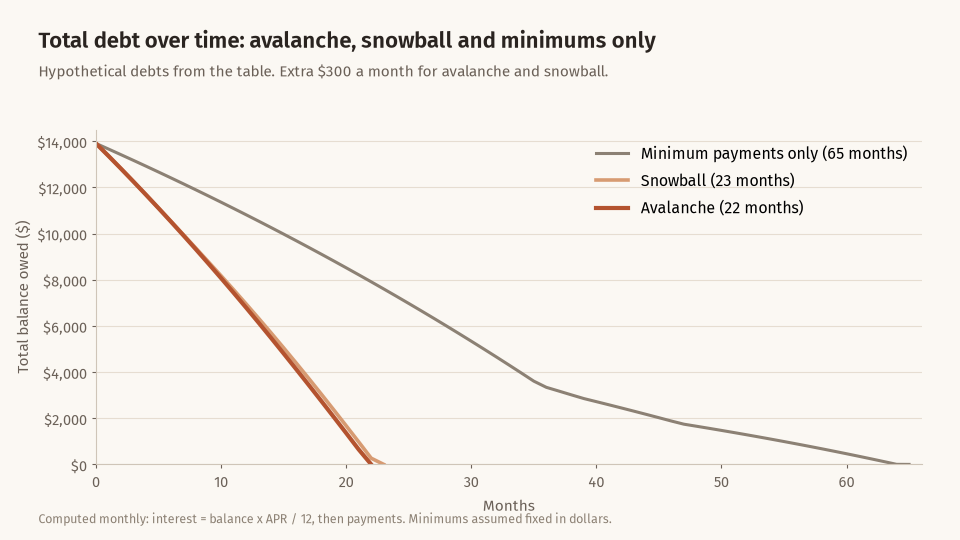
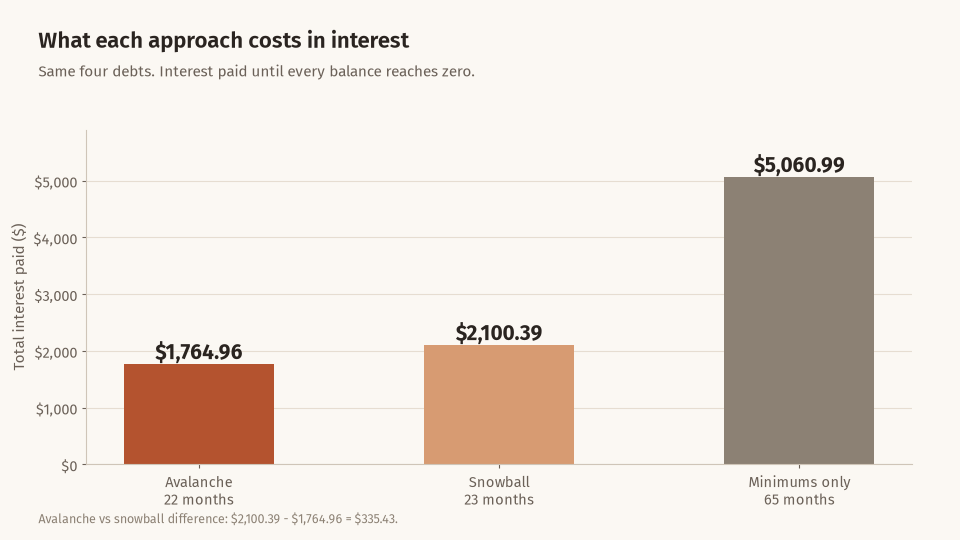
How the minimums-only figure was calculated: each debt is paid at its fixed minimum (which is the first-month minimum, held constant) with no extra and no rolling of freed payments. Real card minimums often change as the balance falls, so your own minimum-only result will differ. The point is the order of magnitude.
What this example shows, and what it does not. Avalanche won, as the CFPB’s description predicts. But the gap was $335.43 over about two years, while extra payments of any kind made a far larger difference. A different set of debts could produce a bigger or smaller gap: the more your balances and rates differ, the more the order matters. Run your own numbers with a spreadsheet or a debt calculator.
Why extra payments matter so much
The same effect shows up on a single card. Take a $3,000 balance at 22% APR with no new purchases:
| Fixed monthly payment | Months to pay off | Total interest |
|---|---|---|
| $90 | 52 | $1,678.83 |
| $150 | 26 | $771.43 |
| $300 | 12 | $344.66 |
The first month’s interest is $3,000 × 0.22 ÷ 12 = $55, so a $90 payment reduces the balance by only $35. At $300 a month, $245 goes toward the balance in month one. Doubling a payment does a lot more than halve the time, because less of the balance sits there earning interest.
For context, the Federal Reserve’s G.19 release for August 2026 reports an average credit card rate of 22.36% on accounts that were charged interest (21.19% across all accounts) and 11.90% for a 24-month personal loan at commercial banks. These are averages, and your own rates will differ, but they show why card debt is usually the first target.
How to choose
Use this as a rough guide. It is editorial judgement, not an official rule.
| If you… | Consider |
|---|---|
| Want the lowest total cost and can stay motivated without quick wins | Avalanche |
| Have given up on plans before and need to see debts disappear | Snowball |
| Have a tiny debt that nags you | Clear it first, then switch to avalanche |
| Have debts with similar rates | Snowball costs little extra, so pick the one that motivates you |
| Have one very high-rate debt that is also small | Both methods agree; start there |
The CFPB puts it this way: if you are motivated by saving the most money, the highest interest rate method might be the right choice, and if you are motivated by seeing progress quickly, you may want to consider snowball. Moneysmart adds that the important thing is to choose the method you can stick with.
Other ways to speed things up
- Ask for a lower rate. The FTC suggests asking your card company to negotiate a lower interest rate and to agree a payment plan you can afford. Keep records of who you spoke to and ask for any agreement in writing.
- Consider consolidation carefully. A consolidation loan combines debts into one payment. The FTC warns that some require you to put up your home, and that most have costs, such as interest and “points”. Moneysmart says to understand the pros and cons so you can decide whether you would actually save money over the long term. See our guide to debt consolidation.
- Look at fees and penalties. Moneysmart lists early repayment penalties among the details to note for each debt. Check yours before sending a big lump sum.

Region by region
United States
The CFPB’s two methods apply here, and the FTC adds help if you are struggling. It says nonprofit credit counselling can help, but that “nonprofit” does not guarantee free, affordable or legitimate. A good counsellor will not promise to fix everything or charge large fees before doing anything. A debt management plan can take 48 months or more and may require you to stop using credit. The FTC says only scammers charge fees before settling any of your debts, and calls debt settlement programmes risky, with possible damage to your credit report and tax consequences. Bankruptcy is generally a last option and stays on your credit report for 10 years.
United Kingdom
MoneyHelper says to deal with priority debts first, and to talk to a free debt adviser before agreeing payments, especially in a debt emergency such as court action, bailiff action, disconnection or eviction. In England and Wales, GOV.UK says the Breathing Space scheme gives up to 60 days of protection from creditors while you get advice: enforcement cannot be taken, creditors cannot contact you about the included debts, and they cannot add interest or charges. You still need to keep up repayments, and you apply through a debt adviser. Only after priority debts are under control does it make sense to use avalanche or snowball on your credit card and loan debt.
European Union
Rules differ by country. The European Commission lists the right to repay credit ahead of time among the consumer credit rights, and says the new Directive (EU) 2023/2225 on credit agreements for consumers, which replaces the 2008 Consumer Credit Directive, applies from 20 November 2026. National laws implement these rules, so check your own contract and national rules for any early repayment charges. The Commission’s 2023 study found that 8.8% of households across the EU were in arrears with key financial commitments in 2020, and its earlier studies concluded that personalised debt advice is one of the most effective tools for over-indebted households. Debt advice services vary widely by country, so look for the one run by your national authority or a recognised charity.
Australia
Moneysmart’s approach matches the avalanche method: pay the minimum on all debts, put extra on the debt with the highest cost (fees and interest rate), and repeat. It says this saves more on interest over time. If you need help, the National Debt Helpline is free and confidential on 1800 007 007 (Monday to Friday, 9:30am to 4:30pm; live chat 9am to 8pm). Moneysmart also warns against quick fixes such as payday loans or raising your card limit.
Common mistakes
- Paying only the minimums. As the example shows, this keeps you in debt for years and costs much more in interest.
- Not rolling the freed-up payment. When a debt is paid off, add its old payment to the next target. That is what makes both methods work.
- Taking on new debt while paying old debt. Every new purchase on a card you are paying down works against you.
- Using only the balance to choose. If you ignore rates, you may pay off a cheap loan while a 22% card grows.
- Forgetting priority bills. Missing a mortgage, rent or utility payment is a far bigger problem than a card balance.
- Missing a minimum. Late fees and credit-score damage can cancel out your progress. Set up automatic minimums.
- Paying someone to “fix” your debt upfront. The FTC says only scammers charge before settling debts or enrolling you in a plan.
Frequently asked questions
Which is better, avalanche or snowball?
Avalanche usually costs less. In our example it saved $335.43 and a month. Snowball can keep you motivated because balances disappear sooner. The CFPB says to choose the one that suits what motivates you. A plan you finish beats a better plan you abandon.
Should I pay off debt or build an emergency fund first?
Many people do both in stages: a small cushion first, then debt, then a fuller fund. That order is a judgement call and depends on how secure your income is. Moneysmart lists building an emergency fund as a step once your debt is under control. We discuss the balance in our emergency fund guide.
Can I mix the two methods?
Yes. A common approach is to clear one very small debt for an early win and then follow the avalanche order. Just keep the core rule: minimums on everything, and extra money on one target at a time.
How long will it take me to pay off my debt?
It depends on your balances, rates and what you can pay. Our example of $13,900 with $715 a month took about 22 to 23 months. You can estimate yours by adding up balances, computing the monthly interest as balance × rate ÷ 12, and seeing how much of your monthly budget is left over for principal.
Is a debt consolidation loan better than these methods?
It depends on the rate and fees. The FTC says consolidation loans can carry points and some use your home as security. Moneysmart says to compare the pros and cons to see whether you would really save money. You can also combine a consolidation loan with the snowball or avalanche approach.
What if I cannot afford even the minimums?
Contact your creditors before you miss payments, and get free debt advice. In the UK, use MoneyHelper to find a free adviser, and in Australia call the National Debt Helpline on 1800 007 007. In the US, the FTC says to look for reputable credit counselling and to be wary of upfront fees.
This article is general information, not financial advice. Rules, limits and rates change, and your circumstances are your own. Check the official sources below, and consider speaking to a qualified adviser or a free debt charity for decisions about your own money. See our Editorial Policy and Disclaimer pages for how we research and update articles. Last verified: October 2026.
Sources
- CFPB: How to reduce your debt
- FTC: How To Get Out of Debt
- Federal Reserve: Consumer Credit, G.19 (August 2026 release)
- MoneyHelper: How to prioritise your debts
- GOV.UK: Breathing Space (Debt Respite Scheme)
- Moneysmart (ASIC): Get debt under control
- European Commission: Consumer protection in financial services