

Last verified: October 2026. Official guidance referenced here was checked against the sources listed at the end of the article.
A budget is a plan for what your income will do before the month starts, so you are not guessing at the end of it. The simplest way to build one is five steps: list your take-home income, list what you spend (use bank statements, not memory), compare the two, set a savings goal, and review it every month. The method you pick on top of that, 50/30/20, zero-based, pay-yourself-first or envelopes, matters less than whether you will actually keep using it.
This guide walks through the five steps, then shows each method with a worked example so you can see the numbers, not just the theory.
Key takeaways
- Start with facts: take-home income and what you really spend, taken from bank or card statements.
- 50/30/20 is a popular rule of thumb, not an official standard. Use it as a starting point, then adjust it to your actual costs.
- Zero-based budgeting gives every dollar a job. It is more work and more control.
- Sinking funds turn annual and irregular bills into small monthly amounts so they stop wrecking your month.
- Variable income? Budget on your lowest typical month and treat anything above it as a bonus.
- A budget that sticks is reviewed often, automated where possible, and forgiving when you slip.
The five steps behind every good budget
Whatever method you choose, official guidance from the CFPB (US), MoneyHelper (UK) and Moneysmart (Australia) follows the same shape.
Step 1: write down your income
List all the money you can count on: wages, benefits, child support, side income. Use take-home pay (after tax and deductions), because that is what lands in your account. The CFPB notes that you may have several sources, from multiple jobs to government benefits, and all of them count. If your income changes from week to week, Moneysmart suggests working out an average. MoneyHelper goes one step more cautious, and we agree with it: budget for your lowest monthly income, so the big costs are always covered, then treat a better month as a chance to save more.
Step 2: see where the money actually goes
This is the heavy lifting, and the CFPB says so. Go through bank and card statements for the last one to three months and put each transaction in a category. If that feels overwhelming, the CFPB suggests starting with one week at a time, or keeping a daily log so the small purchases that add up (a daily coffee or a takeaway lunch) get captured. MoneyHelper makes the same point about accuracy: figures from statements or a banking app are more realistic than estimates.
Step 3: map your bill dates
If you are short at the end of the month, the problem can be timing, not total spending. The CFPB’s advice is to build a bill calendar so you can see which weeks are tight, and to consider asking creditors to adjust due dates where you can. Missing or late payments can also hurt your credit, so this step protects more than your cash flow. Our guide to breaking the paycheck-to-paycheck cycle goes deeper on this.
Step 4: compare and decide
Add up income, add up spending, subtract. The CFPB’s monthly budget tool is literally that: list income, list expenses, subtract total spending from total income. If there is money left, it can go to saving or spending. If you spend more than you earn, look for expenses to cut or bills to renegotiate.
Step 5: review monthly
Update the budget when your income, bills or goals change, and look at it once a month even when nothing has changed. Moneysmart gives these three triggers: income changes, bills increase, goals change.
Method 1: the 50/30/20 rule
The 50/30/20 rule is a popular starting framework: roughly 50% of take-home pay for needs, 30% for wants, and 20% for saving and paying off debt beyond the minimums. It is a rule of thumb that many budgeting guides use. No regulator sets it, and none of the official sources we cite requires it, so treat it as a first draft.
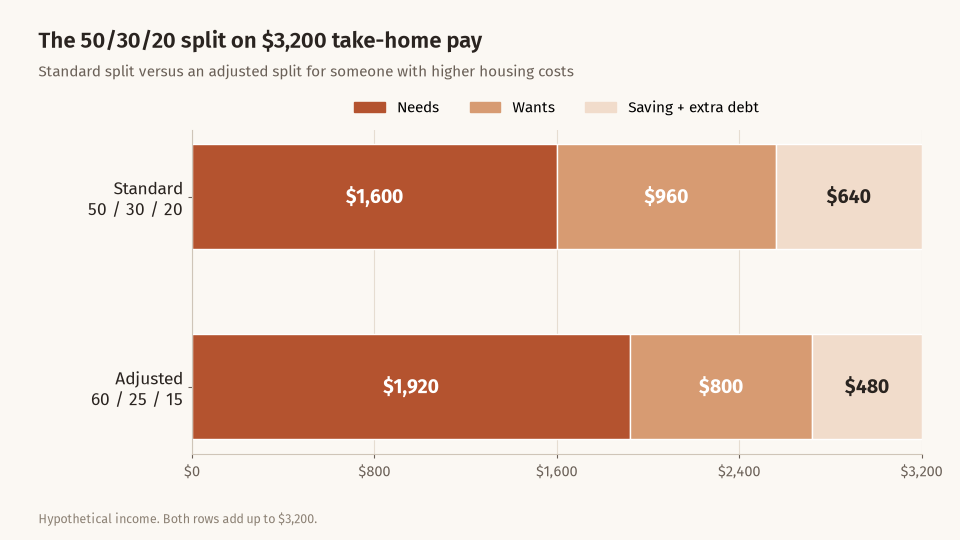
How it works with real numbers. Suppose take-home pay is $3,200 a month (hypothetical):
| Bucket | Share | Calculation | Amount |
|---|---|---|---|
| Needs (housing, utilities, groceries, transport, insurance, minimum debt payments) | 50% | $3,200 × 0.50 | $1,600 |
| Wants (eating out, subscriptions, hobbies, trips) | 30% | $3,200 × 0.30 | $960 |
| Saving and extra debt payments | 20% | $3,200 × 0.20 | $640 |
| Total | 100% | $3,200 |
Now the useful bit: what if your needs are more than 50%? In many cities rent alone makes that impossible. If your honest needs total $1,920, that is $1,920 ÷ $3,200 = 60%. You do not fail the rule, you adjust it. Keep needs at 60%, then split what is left ($1,280) in a way you can live with, for example $800 for wants (25%) and $480 for saving (15%). The chart shows both versions.
Strengths: fast, no tracking required to begin, easy to explain to a partner. Weaknesses: the categories are fuzzy (is a phone a need? is a car a need?), and it does not handle irregular bills well.
Method 2: zero-based budgeting
In a zero-based budget you assign every unit of income to a category until income minus planned spending equals zero. That does not mean you spend everything. Saving and debt payments are categories too. It simply means no money is left unplanned to leak away.
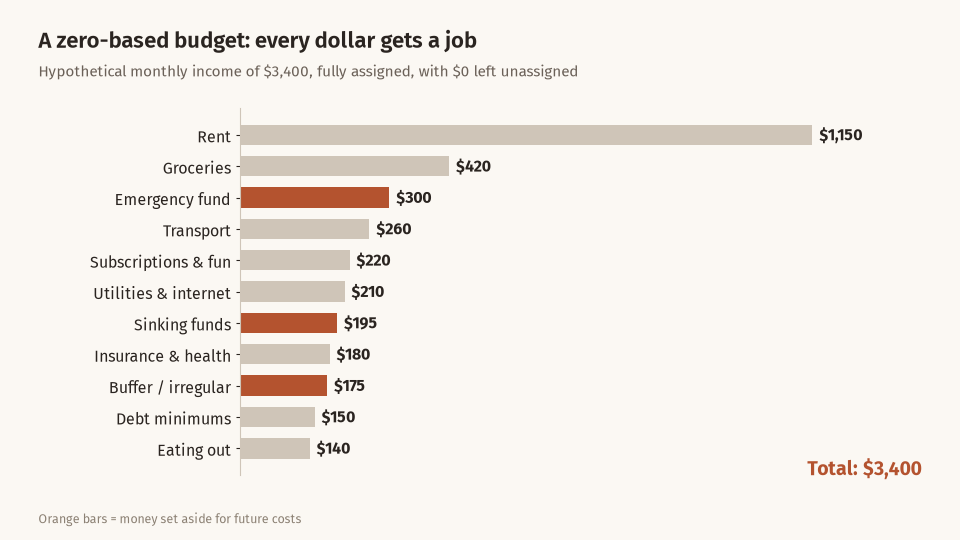
Here is a hypothetical household with $3,400 take-home pay:
| Category | Amount |
|---|---|
| Rent | $1,150 |
| Groceries | $420 |
| Emergency fund | $300 |
| Transport | $260 |
| Subscriptions and fun | $220 |
| Utilities and internet | $210 |
| Sinking funds (annual bills, see below) | $195 |
| Insurance and health | $180 |
| Buffer for irregular costs | $175 |
| Debt minimums | $150 |
| Eating out | $140 |
| Total planned | $3,400 |
Income $3,400 minus planned spending $3,400 leaves $0 unassigned. Notice what this reveals. Group it into buckets and the needs (rent, utilities, groceries, transport, insurance, debt minimums) come to $2,370, which is 69.7% of income. The money set aside (emergency fund, sinking funds, buffer) is $670, or 19.7%, and the wants are $360, or 10.6%. This household would never fit the 50/30/20 split, but it has a clear, workable plan.
Strengths: very clear, handles uneven or tight budgets well, makes trade-offs visible. Weaknesses: takes more effort, and you will have to revise it when real life does not match the plan. Do it once a month, using the previous month’s real numbers.
Method 3: pay yourself first
Decide the amount you want to save, move it out on payday, and spend the rest without guilt. Moneysmart suggests this kind of automation: set up a regular transfer to a savings account on payday, and have bills paid by direct debit on their due dates. It works for people who dislike tracking, provided your fixed costs and debts are covered by the remainder. The risk is that without any tracking, one overspending category can cause a shortfall that you only notice late. If you are saving for a safety net first, see how big an emergency fund should be.
Method 4: envelopes and cash limits
You set a limit for each spending category that tends to run away (groceries, eating out, entertainment) and stop when the envelope is empty. Traditionally that is physical cash. Today many people use separate cards or sub-accounts. It is the most direct way to stop overspending in a few leaky categories, though it is clumsy for bills paid by direct debit. We compare envelopes, cash stuffing and sinking funds in more depth in budgeting methods compared.
Which method should you choose?
| Method | How it works | Often suits you if… |
|---|---|---|
| 50/30/20 | Split take-home pay into needs, wants and saving or extra debt payments | You want a simple starting framework and your costs are fairly steady |
| Zero-based | Give every unit of income a job until nothing is left unassigned | Money feels like it disappears, or you like detail and control |
| Pay yourself first | Move savings out on payday, spend what is left | You dislike tracking but can live on a set amount |
| Envelopes / cash | Set a limit per category and stop at zero | Cards make overspending too easy in one or two categories |
Pick the lightest method you will actually follow. A common path is to start with 50/30/20 for a month to see where you stand, then switch to zero-based if the numbers surprise you, or to pay-yourself-first plus envelopes for one or two problem categories if tracking everything feels like too much. The CFPB’s advice is to create a tool that works for you and to be realistic by looking at one month at a time.
Handle irregular bills with sinking funds
Most budgets break on costs that are not monthly: car insurance, car servicing, gifts, holidays, annual subscriptions. Moneysmart tells you to include irregular or unexpected costs, such as car repairs and services, annual bills and pet costs, and MoneyHelper’s planner lets you enter a yearly amount and it breaks that down into a monthly average. A sinking fund is the same idea in real life: divide the annual cost by 12, and move that amount into a separate pot each month.
Hypothetical annual costs: car insurance $1,080, gifts and holidays $600, car service and tyres $420, annual subscriptions $240. That is $2,340 a year, so $2,340 ÷ 12 = $195 a month. When the car insurance bill arrives, the $1,080 is already there ($90 × 12).

When your situation is not standard
Variable income (freelancers, commission, shift work). MoneyHelper’s tip is to budget for your lowest monthly income so the major costs are always covered. In a good month, raise your budget or put the extra into savings. Our guide to emergency funds explains why this group often needs a larger buffer.
One income, or a single parent. The categories do not change, but the margin for error does. Put childcare and any school or care costs into essentials, check whether you are missing benefits (MoneyHelper has a benefits calculator in the UK; elsewhere, check your national benefits agency), and aim for a small starter emergency fund before aggressive extras.
Couples and households. MoneyHelper advises being consistent about whether you are budgeting for yourself or a whole household. Decide which bills are shared and which money is personal, and write it down.
Paid every two weeks. If you are paid every two weeks you receive 26 paychecks a year, not 24 (two a month times twelve). That means two months a year contain three paychecks. Base your monthly budget on two, and use the extra checks for savings, debt or sinking funds.
Do not automatically cut pension saving. MoneyHelper points out that an employer’s workplace pension contribution is money you do not want to miss out on, and that in the UK the less you pay in, the less government top-up you get. Look at other areas first.
Regional notes
- United States: the CFPB publishes free income and spending trackers, a bill calendar and a budget worksheet. If you are paid biweekly, plan for the two three-paycheck months.
- United Kingdom: MoneyHelper’s Budget planner is free, can be saved, and offers a salary calculator to work out take-home pay after tax, student loans and National Insurance.
- European Union: budgeting principles are the same, but income tax, benefits and how bills are billed (monthly, quarterly, annually) vary by country. Use your national consumer or money-advice service for local tools and rules.
- Australia: Moneysmart’s budget planner separates essentials, debt and irregular costs. It suggests separate accounts, a transaction account for bills, one for spending and a higher-interest savings account, with automatic transfers on payday.
How to make a budget stick
- Automate the boring parts. Savings transfers and bill payments should happen on their own.
- Use separate accounts. One for bills, one for spending, one for savings, as Moneysmart suggests. Seeing a “spending” balance run down is more intuitive than tracking categories.
- Check weekly, not just monthly. The CFPB suggests a way to track in real time, whether that’s a daily journal or a folder for receipts that you review weekly.
- Set a goal and reward progress. A goal with a date and an amount beats “save more”. The CFPB says rewarding yourself in small ways helps you keep going.
- Get support. The CFPB points out that doing it with someone you trust makes it easier, much like sticking to an exercise routine.
- Expect to fail a month. A budget is a draft. Adjust and carry on.
Common mistakes
- Budgeting on gross pay. Use take-home pay.
- Guessing instead of checking. Estimates tend to leave out small, frequent purchases.
- Forgetting annual and irregular bills. Use sinking funds.
- No buffer line. A small “miscellaneous” category prevents one surprise from collapsing the plan.
- Making it too strict. A budget with no fun money tends to get abandoned. Plan some spending you do not have to justify.
- Setting it up once and never reviewing it. Income and bills change. Review monthly.
FAQ
What is the 50/30/20 rule?
It is a popular rule of thumb that puts about half of take-home pay toward needs, 30% toward wants and 20% toward saving and extra debt payments. It is a starting framework, not an official standard, and it often needs adjusting where housing costs are high.
Is zero-based budgeting better than 50/30/20?
Neither is better in general. Zero-based gives more control and shows trade-offs clearly, but takes more effort. 50/30/20 is quicker but rougher. Many people start with the second and move to the first if they want more detail.
How do I budget with an irregular income?
Base your budget on your lowest typical month, as MoneyHelper suggests, cover essentials first, and put anything above that into savings or debt payments. Averaging your income, as Moneysmart advises, helps with planning, but the lowest-month approach is safer.
How much of my income should I save?
There is no official number. 20% in the 50/30/20 rule is a common benchmark, but start with whatever you can sustain and raise it over time. A first target is a small emergency fund, then you can build toward investing for the long term.
Should I pay off debt or save first?
You need at least the minimum payments on all debts. MoneyHelper says that if you are focusing on one debt you must still cover at least the minimum on any credit cards and your required loan payments, and that it usually makes sense to pay the highest-interest debt first. Many people also build a small safety buffer first. See avalanche vs snowball for how to order your debts.
What if I cannot make ends meet even after cutting costs?
That is a signal to look at income, benefits and free debt advice, not a failure of budgeting. MoneyHelper provides a debt advice locator in the UK, and in Australia the free National Debt Helpline (1800 007 007) is listed on Moneysmart.
This article is general information, not financial advice. Figures in worked examples are hypothetical. Rules, limits and rates change, and your circumstances are your own. Check the official sources below, and consider speaking to a qualified adviser for decisions about your own money. See our Editorial Policy and Disclaimer pages for how we research and update articles. Last verified: October 2026.
Sources
- CFPB: Budgeting: How to create a budget and stick with it
- CFPB: Monthly budget tool (PDF)
- Moneysmart (ASIC): How to do a budget
- MoneyHelper: Budget planner
- MoneyHelper: Managing your money
- Moneysmart (ASIC): Get debt under control