Last verified: October 2026. Budgeting steps come from the US Consumer Financial Protection Bureau (CFPB), Australia’s Moneysmart and the UK’s MoneyHelper. The methods are general approaches, not official standards, and the example figures are illustrations.
There is no single best way to budget. The method that works is the one you will actually keep using. Zero-based budgets give every dollar a job, envelopes and cash stuffing add a hard spending limit, 50/30/20 is a quick rule of thumb, and sinking funds turn irregular bills into a steady monthly amount. Most people end up combining two or three.
This guide uses US dollars in its examples, but every method works in any currency. The official budgeting tools it points to are from the US, UK and Australia, and the approach is the same in the EU, where you can use your national money advice service.
Key takeaways
- Start with facts. The CFPB, Moneysmart and MoneyHelper all begin the same way: record your income and your actual spending before you set limits.
- A zero-based budget assigns every dollar of income to a job, including savings and debt payments.
- The envelope method and cash stuffing limit each category to a set amount of money. They work best for categories where you overspend, such as eating out.
- Sinking funds save a little each month for expenses you know are coming, such as annual bills and car repairs.
- Review monthly. Moneysmart says to update your budget when your income, bills or goals change.

Start with the basics: income, spending and bills
Every method needs the same raw material. The CFPB lays out four steps: record where your money comes from, log where it goes, list your bills and when they are due, then build a working budget. Moneysmart’s version is five steps: add your income, list your expenses, compare the two, set a savings goal, then review and adjust.
A few practical points from the official guides:
- Use real numbers. MoneyHelper says to use payslips, bank statements and your banking app so the figures are realistic.
- If your income varies, MoneyHelper suggests budgeting for your lowest monthly income, so major costs are always covered. If you have a good month, you can put the extra into savings. Our side hustle guide covers variable income in more detail.
- Track timing, not just totals. The CFPB points out that if you are short at the end of the month, the timing of bills and income might not match. A bill calendar helps.
The main budgeting methods compared
| Method | How it works | Good for | Watch out for |
|---|---|---|---|
| Zero-based | Every dollar gets a job | Full control | Plans that are too tight |
| Envelope | Fixed amount per category | Overspending categories | Fixed bills |
| Cash stuffing | Envelopes using physical cash | Everyday spending | Loss, theft, no deposit cover |
| 50/30/20 | Needs, wants, savings split | A quick benchmark | Costs that do not fit it |
| Sinking funds | Save monthly for known costs | Annual bills, repairs | Raiding the fund |
Zero-based budget
You assign every dollar of take-home pay to a category until income minus planned spending equals zero. Savings and debt payments count as spending. This is the method behind most budget planners, including the CFPB worksheet and the Moneysmart and MoneyHelper tools, which add up income and outgoings and show what is left.
Good for: people who want a clear plan and are comfortable tracking. Watch out for: an unrealistic plan that you abandon after one month. Build in a small buffer line.
Envelope method
Each spending category gets an “envelope” with a fixed amount for the month. When it is empty, spending in that category stops, or you deliberately move money from another envelope. Traditionally the envelopes are real cash, but you can use separate accounts or card controls.
Good for: categories that tend to overrun, such as groceries, eating out and entertainment. Watch out for: envelopes for fixed bills, which are better paid by direct debit.
Cash stuffing
Cash stuffing is the envelope method done with physical cash: on payday you withdraw money for chosen categories and put each amount in its own envelope or labelled pocket. It makes spending feel real and gives you a hard stop.
Be aware of the trade-offs:
- Cash at home is not a bank deposit. The FDIC explains that it insures money held in deposit accounts at FDIC-insured banks, such as checking, savings and CDs. Cash in an envelope is not a deposit account, so keep amounts small.
- Online bills and subscriptions cannot be paid in cash.
- Cash can be lost or stolen, so withdraw only what you plan to spend.
The 50/30/20 rule of thumb
This popular rule suggests putting about 50% of after-tax income towards needs, 30% towards wants and 20% towards savings and extra debt payments. It is a starting point and not an official standard. In places with high housing costs, needs may take more than 50%, so adjust the split to your own numbers.
Good for: beginners who want a simple benchmark. Watch out for: treating it as a rule when your costs do not fit it.
Sinking funds
A sinking fund is a pot of money you build up for a known future expense. Instead of facing a $1,200 car insurance bill in one go, you set aside $100 a month. Moneysmart tells budgeters to include “irregular or unexpected costs”, such as car repairs, annual bills and pet costs, and MoneyHelper’s planner lets you enter a yearly amount and converts it to a monthly average. A sinking fund is the same idea turned into saved money.
Good for: annual bills, holidays, gifts, car maintenance, medical costs and anything else predictable but infrequent. Watch out for: raiding the fund for something else. Naming each fund helps.
A budget binder
A budget binder is a physical or digital folder that holds your tools in one place. A useful set of tabs is: a monthly budget sheet, a bill calendar, a spending log, sinking fund tracker pages, a debt list and a savings goals page. It does not replace any method above. It simply gives you somewhere to keep it.
Worked example: a zero-based budget with sinking funds
This is a hypothetical illustration, not a recommendation for your situation.
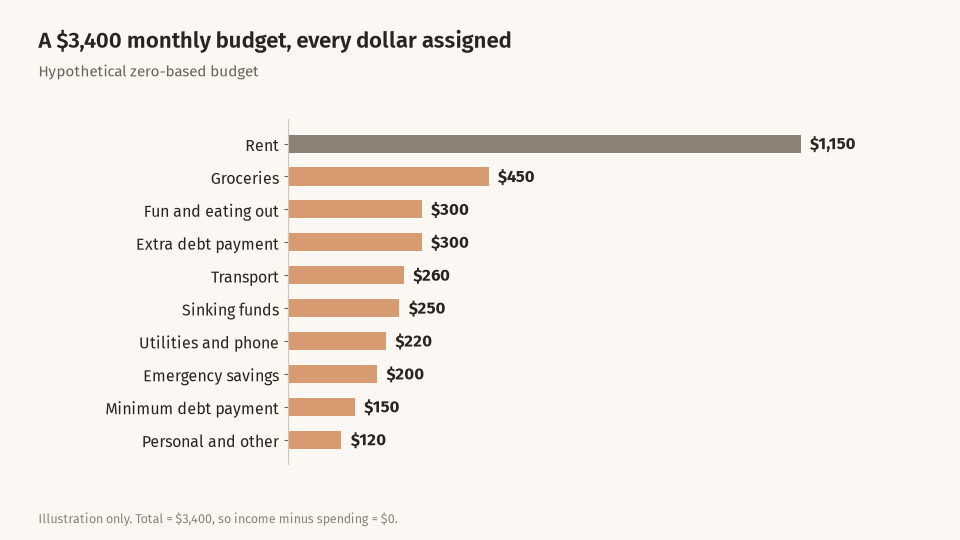
Jordan takes home $3,400 a month and assigns every dollar:
| Category | Monthly amount |
|---|---|
| Rent | $1,150 |
| Utilities and phone | $220 |
| Groceries | $450 |
| Transport | $260 |
| Minimum debt payment | $150 |
| Sinking funds (see below) | $250 |
| Emergency savings | $200 |
| Fun and eating out | $300 |
| Personal and other | $120 |
| Extra debt payment | $300 |
| Total | $3,400 |
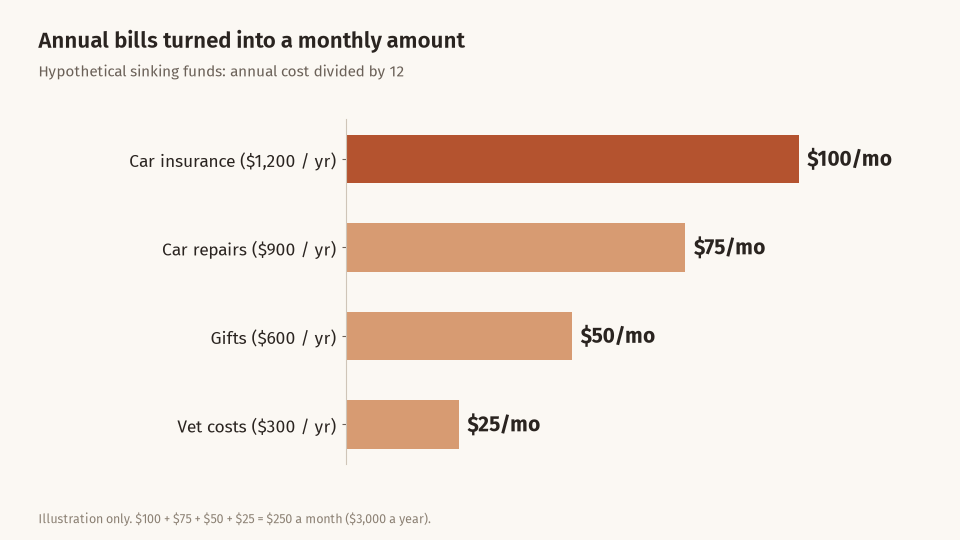
The sinking fund line covers four known annual costs:
- Car insurance: $1,200 ÷ 12 = $100
- Car repairs: $900 ÷ 12 = $75
- Gifts: $600 ÷ 12 = $50
- Vet costs: $300 ÷ 12 = $25
That adds up to $250 a month, or $3,000 a year.
To use envelopes on top, Jordan could take just the fun and eating out and groceries amounts, $750 in total, as cash on payday, and leave everything else automated.
Where to keep your money
Moneysmart suggests separate accounts to make budgeting easier: one for bills, one for spending and a higher-interest savings account, with a regular transfer on pay day. In the US, the FDIC insures deposits in checking, savings, money market deposit accounts and CDs at FDIC-insured banks, to at least $250,000 per bank. Our guide to savings accounts, money market accounts and CDs compares them. If you are budgeting with a partner, see our money checklist for newly married couples.
How to choose a method
- You overspend in one or two categories: envelopes or cash stuffing for those categories only.
- You are surprised by annual bills: sinking funds.
- You want full control: a zero-based budget.
- You want something quick: compare your spending to the 50/30/20 rule of thumb, then refine.
- You hate tracking: automate savings and bills on pay day and track only your “spending” account.
How to set one up in an afternoon
You do not need a perfect system on day one. This sequence follows the order in the CFPB and Moneysmart guides:
- Gather three months of statements if you can, along with payslips and your bills. If that feels like too much, the CFPB suggests starting small, for example by reviewing one week of spending at a time.
- Write down your income. Use take-home pay, and for irregular income use a low average.
- List fixed bills and their due dates. Mark any that fall just after payday and any that fall just before.
- List irregular costs. Check last year’s statements for annual bills and repairs, then divide each by 12 to find its sinking fund amount.
- Choose your limits for the flexible categories. These are usually groceries, eating out, entertainment and personal spending. This is where envelopes help.
- Automate what you can. Set up transfers to savings and sinking funds for payday.
- Book a monthly check-in. Fifteen minutes is enough to compare plan against actual and adjust.
Budgeting in the US, UK, EU and Australia
The methods above work everywhere, but the tools and the safety nets differ:
- US: the CFPB offers free worksheets, including a cash flow budget tool that plans week by week. Deposit accounts at FDIC-insured banks are protected to at least $250,000 per bank.
- UK: MoneyHelper’s free Budget planner lets you enter costs per year and converts them to a monthly average. It also links to free debt advice if you are overspending.
- Australia: Moneysmart’s budget planner separates essentials, debts and irregular costs. It can also be saved, printed or exported.
- EU: there is no single EU budgeting service, so check the free money advice offered by your own country’s consumer or financial authority.
Common mistakes
- Budgeting before tracking. Start with real numbers from your statements.
- Setting limits that are too tight. An unrealistic plan is abandoned. Include a buffer.
- Forgetting irregular costs. Annual bills and repairs break budgets, so list them.
- Keeping too much cash. Cash stuffing is for spending money, not savings.
- Never reviewing. Moneysmart advises updating when income, bills or goals change.
- Treating a rule of thumb as a law. 50/30/20 is a guide.
- Doing it alone when it is a shared budget. MoneyHelper notes it is best to be consistent about whether the budget covers just you or others in your household.
- Not paying yourself first. Move savings out on payday rather than saving what is left.
Frequently asked questions
What is the best budgeting method for beginners?
A simple zero-based budget based on your actual statements is the usual starting point in the official guides, because it shows you where the money goes. Add envelopes only for categories where you overspend.
Is cash stuffing safe?
It can work for everyday spending, but cash is not covered like a bank deposit. In the US, the FDIC insures only money in deposit accounts at insured banks, so keep only what you plan to spend.
How much should I put in sinking funds?
Add up your predictable annual costs and divide by 12. In the example above, $3,000 of annual costs means $250 a month.
Do budgets work with irregular income?
Yes. MoneyHelper suggests budgeting from your lowest monthly income and putting any extra into savings in better months.
How often should I review my budget?
Moneysmart says checking it each month keeps it accurate, and that you should update it whenever your income, bills or goals change.
This article is general education about budgeting, not personal financial advice. The examples are illustrations and your situation is your own. Check the sources below, and consider talking to a qualified adviser or a free money guidance service before making decisions. See our Editorial Policy and Disclaimer pages for how we work.
Sources
- CFPB: Budgeting: how to create a budget and stick with it
- CFPB: Your Money, Your Goals cash flow budget tool
- Moneysmart: How to do a budget
- MoneyHelper: Budget planner
- FDIC: Deposit insurance