

Last verified: October 2026. Covers the US (tax year 2026), the UK (2026-27 tax year) and Australia (2026-27 income year), with general notes on the EU. Figures come from the IRS, HMRC (GOV.UK), the ATO and the European Commission.
A side hustle is only worth doing if it pays after costs, tax and the value of your time. In every country covered here, money you earn on the side is taxable income; what changes is the threshold at which you have to tell the tax authority and how much you keep. Before you pick an idea, run the numbers in this guide.
This article covers the United States, United Kingdom and Australia in detail. EU rules vary by country, so the EU section points to what is common and where to check locally.
Key takeaways
- Side income is generally taxable everywhere, whether or not anyone sends you a form. The US IRS says you must report it even without a 1099.
- US: file once net self-employment earnings reach $400; self-employment tax is 15.3% on 92.35% of your profit, on top of income tax.
- UK: the £1,000 trading allowance can cover small amounts. Above £1,000 of gross income you generally register for Self Assessment.
- Australia: you pay no tax on the first $18,200 of total income, but side income counts toward it, and you need to register for GST at $75,000 turnover.
- EU: national rules apply. Platforms report seller income to tax authorities under the DAC7 rules, but that creates no new tax.
- Anyone promising big money for little work is, according to the US FTC, almost certainly running a scam.

Types of side hustle and how they are taxed
You can group most side hustles into a few types. The category matters because it affects costs, records and platform reporting.
- Services you sell your time for: freelance writing, design, tutoring, bookkeeping, pet care, cleaning or repairs. Costs are usually low, and your income is the time you can bill.
- Gig and platform work: delivery, ride-sharing and tasks through an app. The IRS lists driving, deliveries, errands, creative work and other on-demand work as gig work. The ATO says it makes no difference whether you are an employee, contractor or neither: the income is still assessable.
- Selling goods: making, sourcing or reselling items. Costs of stock matter. In the UK, GOV.UK says selling personal belongings, like items from a loft or garage, is unlikely to be taxable, but buying or making goods to sell at a profit usually is.
- Renting out something you own: a spare room, equipment or a vehicle. Separate rules often apply, for example the UK property allowance and Rent a Room Scheme.
- Content and digital products: videos, writing, templates or courses. Income can be uneven and slow to start.
What you can realistically earn
No honest guide can quote a typical figure for “a side hustle”, because it depends on your skill, time, costs and market. A better way is to calculate your own number:
- Estimate income: hours available × rate you can realistically charge × the share of hours that are actually paid. Time spent finding clients or listing items is unpaid.
- Subtract costs: materials, fees, software, transport and platform commissions.
- Subtract tax: use the examples below as a guide.
- Divide by the hours you actually spent to find your real hourly rate.
If the figure is below what you could earn from extra hours at your main job, or below what you need, think again before investing money.
Spotting scams
The US Federal Trade Commission warns that scammers advertise “jobs” the same way honest employers do. It says that if someone offers a lot of money in a short time with little work, it is almost certainly a scam. Its advice includes:
- Honest employers never ask you to pay to get a job.
- Never bank on a “cleared” check. If you are told to deposit a check and send part of it on, it is a fake check scam.
- Reshipping goods is never a real job.
- Search the company name plus “scam”, “review” or “complaint” before you accept.
Side hustle taxes in the United States
| When you report | Key figures | Platforms | |
|---|---|---|---|
| US | Net self-employment earnings of $400+ | SE tax 15.3% on 92.35% of profit | Income taxable with or without a 1099 |
| UK | Gross trading income over £1,000 | £1,000 trading allowance; £12,570 Personal Allowance | Report to HMRC since 1 Jan 2024 |
| Australia | All assessable income, even one-off | $18,200 tax-free threshold; GST at $75,000 | Platform income is assessable |
| EU | National rules apply | Varies by country | DAC7 platform reporting; no new tax |
Who pays and on what: per the IRS, you must file a tax return if you have net earnings from self-employment of $400 or more from gig work, even if it is a side job. You must report all income, even if you do not receive a 1099-NEC, 1099-K or other form.
- Forms: independent contractors file Schedule C (profit or loss) and Schedule SE (self-employment tax) with Form 1040.
- Self-employment tax: 15.3% of 92.35% of your net earnings. You can deduct half of it. Our self-employed taxes guide walks through it in detail.
- Estimated tax: if you are an independent contractor you may have to pay quarterly. The IRS dates are April 15, June 15, September 15 and January 15. If you also have a job, you may be able to avoid estimated payments by raising withholding on a new Form W-4; see how withholding works.
- 1099-K: payment apps and marketplaces report to the IRS once you pass certain thresholds, but income is taxable whether or not you get a form.
- Hobby vs business: the IRS asks whether you carry on the activity like a business, depend on it for income, have a profit motive and keep complete records. Income from a hobby is reported on Schedule 1, line 8, and if you are not trying to make a profit, you cannot use a loss to offset other income.
Worked example: US side hustle
This is a hypothetical illustration using 2026 rules, not advice for your situation.
Alex has a job that puts them in the 22% federal bracket (single, taxable income above $50,400). On the side, Alex earns $12,000 from freelance work and has $2,000 of business expenses.
- Net profit: $12,000 − $2,000 = $10,000
- SE tax: $10,000 × 0.9235 = $9,235; × 15.3% = $1,413
- Half of SE tax is deductible: $1,413 ÷ 2 ≈ $707
- Income tax: ($10,000 − $707) × 22% = $2,045
- Left after federal tax: $10,000 − $1,413 − $2,045 = $6,542, or about 65% of net profit
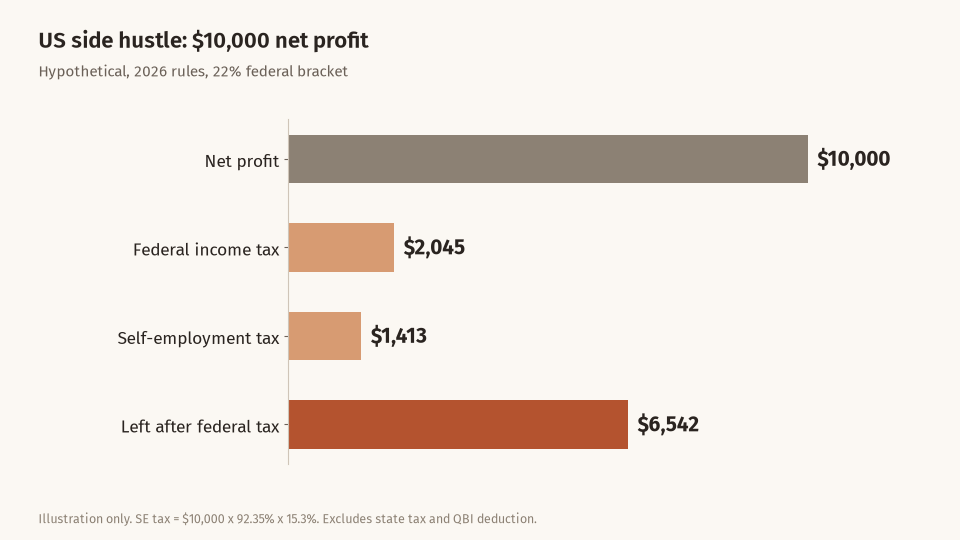
This ignores state tax, the qualified business income deduction and anything else on Alex’s return, so the real figure could differ.
Side hustle taxes in the United Kingdom
- Trading allowance: up to £1,000 a year of gross income from self-employment, casual services or hiring out personal equipment is tax-free. If your gross trading income is £1,000 or less you may not have to tell HMRC, but there are exceptions (for example if you want to claim a loss).
- Above £1,000: you must register for Self Assessment, by 5 October after the end of the tax year in which you passed £1,000. You can deduct the £1,000 allowance or your actual expenses, not both. If your expenses are more than £1,000, claiming expenses is usually better.
- When you cannot use it: income from a company you control, a partnership you or someone connected to you is in, or your employer or your spouse’s employer.
- Tax rates 2026-27: Personal Allowance £12,570, then 20% up to £50,270, 40% up to £125,140 and 45% above that (Scotland has different bands).
- Platforms: since 1 January 2024, UK digital platforms report sellers’ income to HMRC. Goods sellers are reported only if they make 30 or more sales or receive €2,000 (about £1,700) or more. GOV.UK says a report does not automatically mean you owe tax.
National Insurance is separate from income tax, so check the GOV.UK pages for your situation.
Illustration: a basic-rate taxpayer who already uses their Personal Allowance earns £4,000 from tutoring and has £600 of expenses. Using the allowance (£1,000 is more than £600 of expenses) gives taxable profit of £4,000 − £1,000 = £3,000, taxed at 20% = £600 of income tax.
Side hustle taxes in Australia
- All income counts. The ATO says income from providing services through a platform is assessable and must be reported, even if it is a one-off payment, and whether or not you are in business.
- Tax-free threshold: residents get $18,200 tax-free, but claim it from only one employer. Income from work under an ABN counts toward it.
- Rates 2026-27: nil to $18,200; 15c per $1 over $18,200 to $45,000; $4,020 plus 30c per $1 over $45,000 to $135,000 (plus the 2% Medicare levy).
- GST: you must register once your GST turnover is $75,000 or more, within 21 days. Ride-sourcing and some platform work require registration regardless of turnover. You need an ABN first.
- Prepaying tax: if you earn salary and also run a business or work through a platform, you can enter the PAYG instalment system to avoid a lump-sum bill.
Worked example: Australian side hustle
This is a hypothetical illustration using 2026-27 rates, not advice for your situation.
Sam earns $60,000 in salary and $5,000 net side income from weekend work.
- Tax on $60,000: $4,020 + 30% × $15,000 = $8,520
- Tax on $65,000: $4,020 + 30% × $20,000 = $10,020
- Extra income tax: $1,500
- Medicare levy on the extra income: 2% × $5,000 = $100
- Left: $5,000 − $1,500 − $100 = $3,400
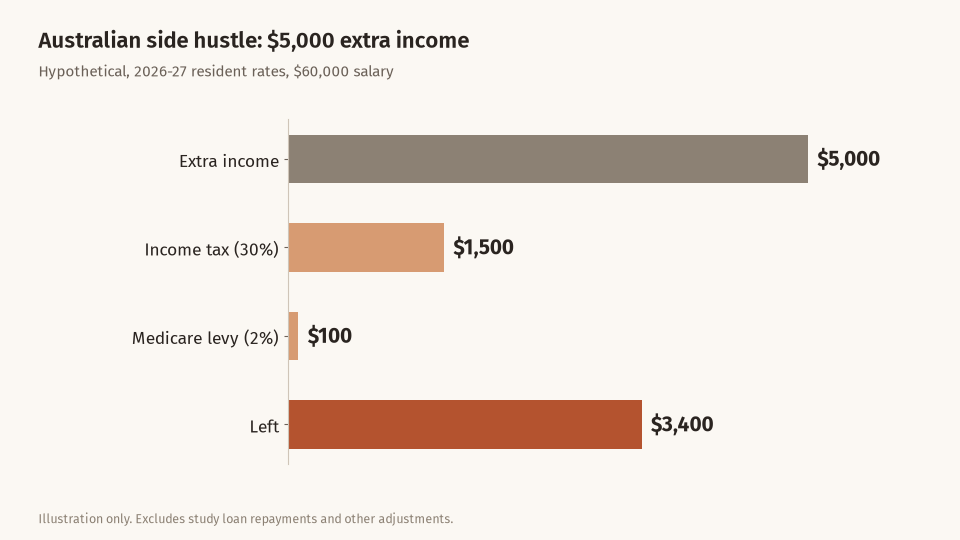
If Sam has a study loan, compulsory repayments may increase as well, as the ATO notes.
Side hustle taxes in the EU
The EU does not set a single rule for side income. Each member state taxes it under its own national rules, with different thresholds, registration steps, social contributions and VAT regimes. What is common is platform reporting: under the DAC7 directive (Directive (EU) 2021/514), platform operators report sellers’ details and income to tax authorities, covering property rental, personal services, sales of goods and rental of transport. The European Commission stresses that DAC7 does not create any new tax. If you live in the EU, check your national tax authority’s guidance on platform income, and whether VAT or social contributions apply.

Keeping records and money separate
Whatever the country, three habits help: keep a separate account for side income, record every receipt and sale, and set money aside for tax as you go. For the UK, GOV.UK lists invoices, bank statements and spreadsheets of receipts as examples of records. If your side income is irregular, our budgeting methods guide explains sinking funds for tax bills.
Common mistakes
- Assuming small amounts are invisible. Platforms increasingly report income to tax authorities.
- Not setting aside tax. A freelance bill arrives as a lump sum unless you prepay.
- Claiming the same expense twice. In the UK you cannot claim the trading allowance and expenses on the same income.
- Treating gross income as profit. Costs and fees reduce what you keep.
- Ignoring the main-job interaction. Side income can push you into a higher bracket.
- Paying to get “work”. Honest employers never ask you to pay for a job.
- Forgetting registration thresholds. For Australian GST, you must register within 21 days of passing the threshold.
- Mixing personal and business money. It makes records harder to prove.
Frequently asked questions
Do I have to pay tax on a small side hustle?
In general, yes. In the US you must report all income, and file once net self-employment earnings reach $400. In the UK, up to £1,000 of gross trading income may be covered by the trading allowance. In Australia, side income is assessable and counts toward the $18,200 threshold.
What if I earn money but never get a tax form?
The IRS says you must report all income even if you do not receive Forms 1099. The ATO says one-off payments are assessable too.
Should I register a business?
That depends on your country and how you operate. In the UK, you register for Self Assessment once gross trading income passes £1,000. In Australia, you need an ABN before you can register for GST. Check your tax authority’s guidance.
Can I deduct my expenses?
Generally yes, if they relate to earning the income and you keep records. In the UK you choose between actual expenses and the trading allowance.
How do I avoid a large bill at the end of the year?
In the US, make quarterly estimated payments or increase your W-4 withholding. In Australia, consider PAYG instalments. In the UK, set money aside for Self Assessment.
This article is general education about side hustle taxes in the US, UK and Australia, not individual tax advice. Tax rules and thresholds change and your situation is your own. Check the official sources below, and consider talking to a qualified tax professional before making decisions. See our Editorial Policy and Disclaimer pages for how we work.
Sources
- IRS: Manage taxes for your gig work
- IRS: Self-employment tax
- IRS: Know the difference between a hobby and a business
- IRS: Understanding your Form 1099-K
- IRS Publication 334
- GOV.UK: Tax-free allowances on property and trading income
- GOV.UK: Income Tax rates and Personal Allowances
- GOV.UK: Selling goods or services on a digital platform
- ATO: Providing services
- ATO: Registering for GST
- ATO: Paying tax on multiple sources of income
- ATO: Tax rates for Australian residents
- European Commission: DAC7
- FTC: Job scams