

Last verified: October 2026. Tax rules, thresholds and dates were checked against the official pages listed at the end, and the worked examples were recalculated.
To start freelancing, treat it as a small business from day one: find a first client you can serve well, set a rate that covers your unpaid hours, costs and tax, and set tax money aside from the first payment. Most beginners underprice because they divide a salary by 2,080 hours. In the worked example below, that shortcut gives about $29 an hour, while the rate that actually delivers the same take-home is about $78.
This guide covers where first clients come from, how to price, what the US, UK and Australian tax authorities expect from a sole trader, and the money habits that stop an irregular income from becoming a problem.
Key takeaways
- Pricing has to cover unpaid time. Not every hour is billable, so a salary-equivalent rate falls short.
- No one withholds your tax. The IRS says that quarterly estimated payments cover income tax, Social Security and Medicare for the self-employed.
- US self-employment tax is a second tax. It is 15.3% on 92.35% of net earnings, and it applies from $400 of net earnings.
- Rules differ by country. The UK has a £1,000 trading allowance and Class 4 National Insurance; Australia has an ABN, PAYG instalments and a $75,000 GST threshold.
- Never accept a “client” who sends you a check to deposit and asks for money back. The FTC says this is a scam.

Before you start: are you really self-employed?
Freelancing means you are in business for yourself, not an employee of the client. The IRS says the test depends on the facts: whether the client controls how you do the work (behavioural control), controls the business side (financial control), and how both sides see the relationship. It is not decided only by how or how often you are paid.
GOV.UK describes the same idea. You are probably running a business if you have several customers at the same time, decide how, where and when you work, and provide your own main equipment. It also says you can run a business and be employed at the same time, which is how many people start: a side business next to a job.
If a client wants you to work fixed hours, with their tools, under their direction, ask whether that is really an employee role. In the US, the IRS says you can use Form SS-8 to ask for a decision on worker status.
Finding your first clients
You do not need a brand before you have a client. You need a specific service, a person who has a problem it solves, and a way to reach them.
- Pick one narrow offer. “Bookkeeping for small restaurants” is easier to sell than “business help”. A narrow offer is easier to describe, price and refer.
- Start with people who already know your work. Past employers, colleagues and contacts are warmer than strangers. Tell them what you do now and who it is for, and ask for introductions rather than work.
- Show a small piece of proof. One or two sample projects, or a short write-up of how you solved a real problem, is more useful than a long portfolio.
- Use platforms with care. Marketplaces can supply early work but usually add competition on price. Treat them as a way to get your first reviews, not the whole plan.
- Follow up. Many early clients come from a second or third message, not the first.
Take a small number of projects at first, and use them to learn how long the work really takes. That figure feeds directly into your pricing.
Protect yourself from fake clients
The FTC warns about fake check scams. In one version, a “client” sends a check, tells you to deposit it and send part of the money back, or to buy gift cards with it. The FTC says the check will bounce and the bank will want you to repay the full amount, and that no honest employer will ask you to do this. It also says honest employers never ask you to pay to get a job. Search the name of anyone you are unsure about with words like “scam”, “review” or “complaint”, and talk to someone you trust before you agree.
How to price your work
Why salary divided by hours falls short
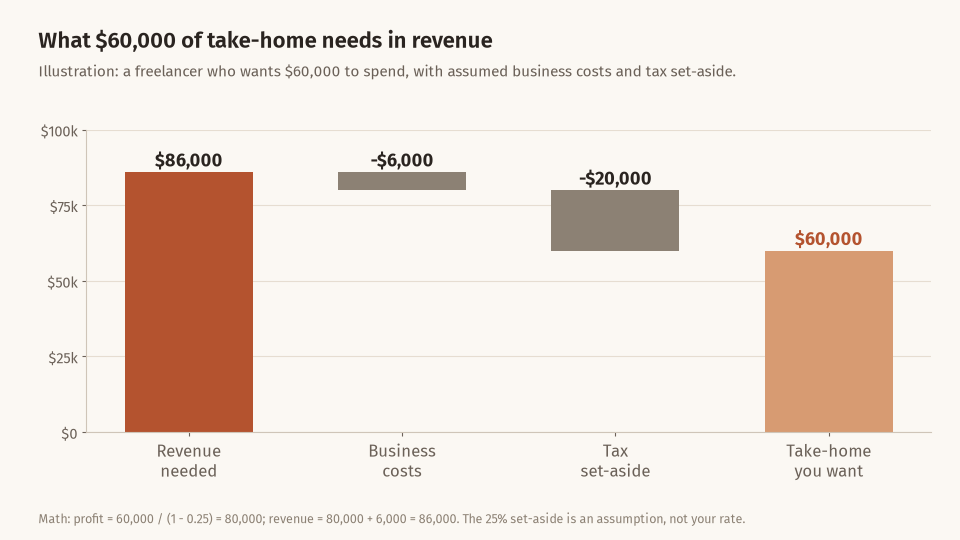
An employee’s salary is paid for time at work, including meetings, admin and holidays. A freelancer pays for all of that out of their own rate, and also pays business costs and tax. The next illustration shows the effect. All figures are assumptions, not typical numbers.
Say you want $60,000 a year to spend, after business costs and tax. Assume:
- Business costs: $6,000 a year (software, equipment, insurance, accounting)
- Tax set-aside: 25% of profit (an assumed figure to keep the math simple, not your rate)
- Working time: 46 weeks of 40 hours, which is 1,840 hours, after six weeks off for holidays and sickness
- Billable share: 60% of working hours, which is 1,104 hours. The rest goes on admin, finding clients and unpaid revisions.
Work backwards:
- Profit needed: $60,000 / (1 – 0.25) = $80,000
- Revenue needed: $80,000 + $6,000 = $86,000
- Hourly rate: $86,000 / 1,104 = $77.90
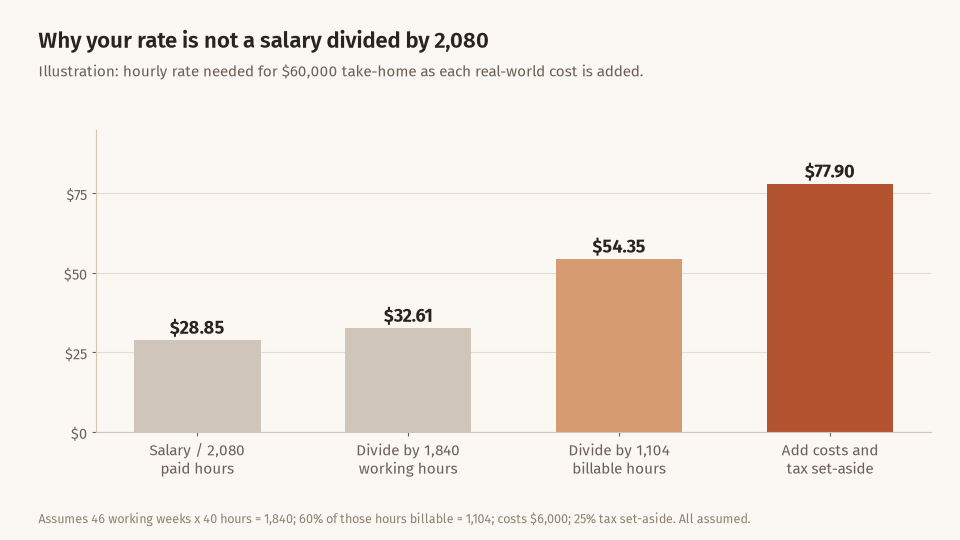
The naive answer, $60,000 / 2,080 = $28.85, is about 37% of the rate that actually delivers the goal. Your own inputs will differ, which is the point: replace the assumed numbers with your own costs, tax situation, holidays and billable share.
Hourly, fixed price or retainer
- Hourly is simple and protects you if the scope grows, but it can make clients focus on the clock.
- Fixed price rewards speed. It works when the scope is clear, and it needs written limits on revisions.
- Retainer is a set fee for a set amount of work each month. It gives steadier income and is a good fit once a client trusts you.
Whichever you use, put the scope, price, payment dates and what counts as extra work in writing before you start. Quote with your own hours in mind, since you will usually find that early jobs take longer than expected.
Taxes when you work for yourself
You are responsible for reporting your income and paying the tax, and no one is withholding it for you. The key rules differ by country, so start with where you live.
| United States | United Kingdom | Australia | |
|---|---|---|---|
| Report your income | Schedule C and Schedule SE with your Form 1040 | Self Assessment return; register by 5 October after the tax year | Individual tax return with business schedule; 31 October if self-lodged |
| Pay during the year | Quarterly estimated tax: Apr 15, Jun 15, Sep 15, Jan 15 | Bill by 31 Jan; payments on account also due 31 Jul | PAYG instalments, usually quarterly |
| Numbers to know | SE tax if net earnings are $400+; 1099-NEC threshold $2,000 | £1,000 trading allowance; Class 4 NI 6% above £12,570 | GST registration at $75,000 turnover; ABN is free |
United States
- Reporting. Independent contractors generally report income and expenses on Schedule C, and compute self-employment tax on Schedule SE. The IRS says you must file a return if your net earnings from self-employment are $400 or more.
- Self-employment tax. It is 12.4% for Social Security plus 2.9% for Medicare, applied to 92.35% of net earnings, and you can deduct half of it when figuring your adjusted gross income. The Social Security part has an annual earnings limit; the Medicare part applies to all net earnings.
- Quarterly estimated tax. The IRS says that if you are in business for yourself you generally need to make estimated payments, which cover income tax and self-employment tax. Payments are due April 15, June 15, September 15 and January 15 of the next year, moving to the next business day if the date falls on a weekend or holiday. You may owe a penalty if you underpay.
- 1099-NEC. For payments made after December 31, 2025, a payer must report payments to you of $2,000 or more in a year on Form 1099-NEC (it was $600 before). That is the payer’s reporting threshold. Your own obligation depends on your net earnings, which the IRS says triggers self-employment tax at $400.
The next table shows the self-employment tax method on an assumed $80,000 of net profit, the profit figure from our pricing example.
| Step | Calculation | Amount |
|---|---|---|
| 1. Net profit | Income minus business expenses | $80,000 |
| 2. Taxable base | $80,000 x 92.35% | $73,880 |
| 3. SE tax | $73,880 x 15.3% (12.4% + 2.9%) | $11,304 |
| 4. Deduction | Half of SE tax, off income tax base | $5,652 |
At $80,000 profit the self-employment tax is about $11,304, around 14% of profit, before any federal or state income tax. That is why a 25% set-aside in the earlier example is an assumption to adjust, not a rule.
United Kingdom
- Register. GOV.UK says that if your gross trading income is more than £1,000 in a tax year, you register for Self Assessment, by 5 October after the end of that tax year. The £1,000 trading allowance can be used instead of deducting actual expenses, so check which is better if your costs are higher. It cannot be used for income from your employer or from a company you control.
- National Insurance. For 2026 to 2027, with profits above £12,570 you pay Class 4 at 6% on profits up to £50,270 and 2% above that. At profits of £7,105 or more, Class 2 is treated as paid.
- Paying. The tax and Class 4 are usually paid through Self Assessment. The online return and payment deadline for 2025-26 is 31 January 2027, with a second payment date of 31 July if you make payments on account.
- Making Tax Digital. Sole traders and landlords registered for Self Assessment must use Making Tax Digital for Income Tax when qualifying income passes the threshold: over £50,000 (for 2024-25) from 6 April 2026, over £30,000 from 6 April 2027 and over £20,000 from 6 April 2028.
Australia
- ABN. An ABN is free to register on the Australian Business Register and you need to be running a business to get one. business.gov.au lists uses including verifying your business, avoiding PAYG tax on payments you receive and claiming GST credits.
- Tax return. The ATO says sole traders must lodge an individual tax return, with the business and professional items schedule, even if income is below the tax-free threshold. If you lodge it yourself, it is due by 31 October.
- PAYG instalments. These are regular payments, usually every three months, based on business income, credited against your tax when you lodge. The ATO says new businesses can enter voluntarily, and gives an example of setting aside a weekly amount to cover each quarterly instalment.
- GST. You must register within 21 days once your GST turnover reaches $75,000. The ATO says some work must register regardless of turnover, including ride-sourcing and food delivery or other platform-based work.

Money habits that keep a freelance income steady
- Move tax money out on the day you are paid. Put an assumed percentage in a separate savings account and adjust it once you know your real bill. In the US that percentage must cover self-employment tax as well as income tax.
- Build a bigger buffer. Income arrives unevenly, so an emergency fund matters more than it does for a salaried worker.
- Pay yourself a regular amount. Set a monthly “salary” from the business account and leave the rest as a buffer, then base your budget on that amount.
- Invoice quickly and chase politely. Late payment is a bigger risk to cash flow than a low rate.
- Plan your own retirement saving. There is no employer plan by default. Our 401(k) vs IRA guide, with UK and Australian equivalents is a starting point.
- Keep records. GOV.UK tells people using the trading allowance to keep invoices, bank statements and income records, and the same habit helps in any country.
Common mistakes
- Dividing a salary by 2,080. This ignores unbillable time, costs and tax.
- Forgetting self-employment tax. In the US, income tax is not the only tax on your profit.
- Not paying during the year. The IRS says you can be charged an underpayment penalty even if you are due a refund at filing.
- Mixing personal and business money. It makes tracking income and expenses harder.
- Starting without a written agreement. Scope, price, deadlines and payment terms should be written down.
- Relying on one client. One client leaving can remove most of your income overnight.
- Missing registration thresholds. In the UK, gross trading income over £1,000 means registering. In Australia, GST registration is triggered at $75,000 or by certain types of work.
Frequently asked questions
Do I need an LLC or company to freelance?
Not necessarily. The IRS says the term sole proprietor includes independent contractors, and GOV.UK and the ATO both describe sole trader routes. A company or LLC can change your tax and liability position, so ask a qualified adviser before choosing one.
How much should I set aside for tax?
It depends on your income, country and deductions, so there is no single figure. In the US, self-employment tax alone is 15.3% of 92.35% of net earnings, about 14.1% of profit, before income tax. Our 25% figure is only an illustration. Use the official calculators and forms, or an adviser, to estimate your own.
Do I have to make quarterly payments in the US?
The IRS says sole proprietors generally need to make estimated payments if they expect to owe $1,000 or more when they file. You can usually avoid the penalty by paying at least 90% of this year’s tax or 100% of last year’s tax, whichever is smaller (110% of last year’s if your prior-year adjusted gross income was over $150,000).
Can I freelance while employed?
GOV.UK says you can run a business and be employed at the same time. Check your employment contract for limits on outside work, and remember that your freelance income still needs to be reported.
What if a client does not send a 1099?
The 1099-NEC threshold applies to the payer’s reporting duty. Your income is still part of your business income. Keep your own invoices and bank records so you can report it accurately.
When should I register for GST in Australia?
When your GST turnover reaches $75,000, or you expect it to, and you must do so within 21 days. Some types of work, such as ride-sourcing and food delivery, require registration regardless of turnover, per the ATO.
This article is general information, not tax, legal or financial advice. Rules, limits and rates change, and your circumstances are your own. All figures in the worked examples are hypothetical. Check the official sources below, and consider speaking to a qualified tax adviser before making decisions. See our Editorial Policy and Disclaimer pages. Last verified: October 2026.
Sources
- IRS: Topic no. 554, Self-employment tax
- IRS: Self-employed individuals tax center
- IRS: Estimated taxes
- IRS: Estimated tax FAQs (payment dates and safe-harbour rules)
- IRS: Form 1099-NEC and independent contractors
- GOV.UK: Working for yourself
- GOV.UK: Tax-free allowances on property and trading income
- GOV.UK: Self-employed National Insurance rates
- GOV.UK: Self Assessment tax returns deadlines
- GOV.UK: Find out if and when you need to use Making Tax Digital for Income Tax
- Australian Taxation Office: Income tax return (sole traders)
- Australian Taxation Office: Starting PAYG instalments
- Australian Taxation Office: Registering for GST
- business.gov.au: Register for an Australian Business Number
- FTC: Job scams (fake check scams)