

Last verified: October 2026. Rules, thresholds and dates were checked against the official pages listed at the end, and the worked example was recalculated.
Small business finances come down to five habits: keep business money separate from personal money, keep records, know the difference between profit and cash, put tax aside as you earn, and choose a structure that fits your risk. Most money problems in a young business come from skipping one of these, not from a lack of sales.
This guide explains each habit with a worked example, shows how the US, UK and Australia differ on records and registration thresholds, and lists the mistakes to avoid.
Key takeaways
- Open a separate business account. The SBA says to do so as soon as you start accepting or spending money as your business.
- Profit is not cash. In our example a business made $7,000 of profit over four months and its bank balance still fell by $1,000.
- Records have legal minimums. The US, UK and Australia expect you to keep business records for years, not months.
- Your structure decides your liability. The SBA says a sole proprietor can be held personally liable for the business’s debts.
- Thresholds trigger registration. The UK VAT threshold is £90,000 of taxable turnover; Australia’s GST threshold is $75,000.

1. Keep business and personal money separate
The SBA says to open a business bank account when you are ready to start accepting or spending money as your business. It lists benefits including keeping funds separate, letting customers pay the business rather than you personally, and keeping business funds apart from personal funds, which it says offers limited personal liability protection. The FDIC, in its September 2026 guidance, adds that IRS Publication 583 recommends keeping a business checking account separate from your personal one, and that clean records help you prepare financial statements and tax returns.
Two details are worth knowing:
- Deposit insurance can differ by structure. The FDIC says deposits of a corporation, partnership or association are insured up to $250,000 separately from the owners’ personal accounts. A sole proprietorship or “doing business as” account is instead insured as the owner’s single ownership account, combined with their personal single-ownership accounts at the same bank.
- Business accounts can have fewer protections. The FDIC says that Regulation E, which covers unauthorised electronic transfers, generally applies to consumer accounts, not business ones. Read your account agreement.
Even if you are a sole trader in the UK or Australia, the same logic applies: it is far easier to prove what the business earned and spent if its money passes through one account.
2. Choose a structure with your eyes open
In the US, the SBA says you are automatically a sole proprietorship if you do business without registering as another type. It also says that a sole proprietorship does not produce a separate business entity, so you can be held personally liable for the business’s debts. The IRS says the same: a sole proprietorship has no legal identity apart from its owner. An LLC with one owner is treated as a sole proprietorship for federal income tax unless it elects to be taxed as a corporation.
| Structure | Owners | Liability | Taxes (per SBA) |
|---|---|---|---|
| Sole proprietorship | One person | Unlimited personal liability | Self-employment tax; personal tax |
| Partnership | Two or more | Unlimited unless a limited partnership | SE tax (not limited partners); personal tax |
| LLC | One or more | Owners generally not personally liable | SE tax; personal or corporate tax |
| C corporation | One or more | Owners not personally liable | Corporate tax |
| S corporation | 100 or fewer, with limits | Owners not personally liable | Personal tax |
The SBA says that limited liability structures protect your personal assets in most cases, but that “that protection has limits”, and recommends talking to a business counsellor, attorney or accountant before you choose. It also notes that the rules on ownership, liability, taxes and filing differ by state.
If you are still testing an idea, a sole proprietorship or sole trader route is the simplest way to start; the SBA describes it as a good choice for low-risk businesses and owners testing an idea. As the business takes on more risk, such as employees, contracts or physical premises, revisit the choice with a professional.
3. Get your identifiers in order
- United States. An Employer Identification Number (EIN) is the business’s federal tax ID. The SBA says it is free to apply, that you need one to pay federal taxes, hire employees, open a bank account and apply for licences, and that you should not use websites that charge a fee for it. State and local licences and tax registrations vary, so check your own state. The SBA says the total cost of registering most businesses is under $300, but fees vary.
- United Kingdom. GOV.UK says you must tell HMRC when you become self-employed as a sole trader. Our freelancing guide covers the Self Assessment steps in more detail.
- Australia. An ABN is a unique 11-digit number that is free to register, and business.gov.au says you need to be running a business to get one. It can be used to verify your business, avoid PAYG tax on payments you receive and claim GST credits.
4. Keep records from day one
All three countries expect records, and each sets its own minimum.
| United States | United Kingdom | Australia | |
|---|---|---|---|
| Keep records for | Until the period of limitations ends; generally 3 years from filing; 4+ years for employment tax | 5 years after the 31 January deadline of the tax year | Most records 5 years |
| Sales tax or VAT/GST | State rules; check your state | VAT registration at £90,000 taxable turnover | GST registration at $75,000 turnover |
| Accounting method | No required method if it clearly reflects income | Cash basis is the default from 2024-25 | Not covered in this guide |
- US. The IRS says there is no required bookkeeping method, but it must clearly and accurately reflect your gross income and expenses, and your records should substantiate both. Keep them until the period of limitations for the return expires, which is generally three years from filing; the IRS gives six years if you omit more than 25% of the gross income shown, and no limit if you file no return or a fraudulent one. Employment tax records should be kept for at least four years.
- UK. GOV.UK says you must keep records for at least 5 years after the 31 January submission deadline of the relevant tax year. Since the 2024 to 2025 tax year, cash basis is the default method: you record income when you receive money and expenses when you pay them.
- Australia. The ATO says you must keep most business records for five years, in a form that cannot be altered and that you can show to the ATO on request. It also says you need clear documents showing the business portion of any expense that is part business and part personal.
A simple routine is enough: save every receipt and invoice digitally, record each sale and expense weekly, and reconcile your bank statement monthly. The IRS says the burden of proof is on you to substantiate the deductions you claim.
A deduction example: the home office
The IRS says you can deduct certain home-office costs if part of your home is used exclusively and regularly as your principal place of business or to meet clients. The simplified method is $5 per square foot of the business area, up to 300 square feet, so the largest simplified deduction is 300 x $5 = $1,500. The IRS notes that under this method depreciation is treated as zero and you claim the deduction on Schedule C. The rules on exclusive use are strict, so read the conditions before claiming.
5. Profit is not cash: a worked example
The most common surprise for new owners is that a profitable business can still run out of money. Profit counts a sale when you invoice it. Cash counts it when the customer pays. Bills usually fall due before customers pay.
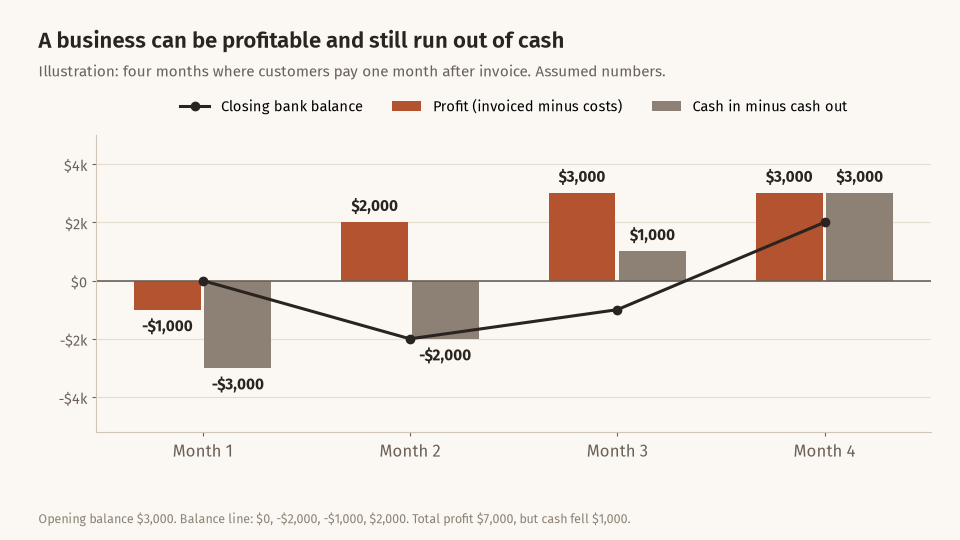
Here is an illustration with assumed numbers. A small business invoices customers each month. Customers pay one month after invoicing, and the business starts with $3,000 in the bank and $6,000 of unpaid invoices from the month before. Costs are paid in the month they arise.
| Month | Invoiced | Collected | Costs paid | Profit | Cash change | Bank balance |
|---|---|---|---|---|---|---|
| Month 1 | $8,000 | $6,000 | $9,000 | -$1,000 | -$3,000 | $0 |
| Month 2 | $12,000 | $8,000 | $10,000 | $2,000 | -$2,000 | -$2,000 |
| Month 3 | $14,000 | $12,000 | $11,000 | $3,000 | $1,000 | -$1,000 |
| Month 4 | $14,000 | $14,000 | $11,000 | $3,000 | $3,000 | $2,000 |
| Total | $48,000 | $40,000 | $41,000 | $7,000 | -$1,000 | $2,000 |
Across the four months:
- Profit (invoiced minus costs) is -$1,000, +$2,000, +$3,000 and +$3,000, a total of $7,000.
- Cash (collected minus costs paid) is -$3,000, -$2,000, +$1,000 and +$3,000, a total of -$1,000.
- The bank balance goes from $3,000 to $0, -$2,000, -$1,000 and then $2,000.
The gap of $8,000 sits in unpaid invoices: they grew from $6,000 to $14,000 as the business grew. Profit of $7,000 minus that $8,000 equals the cash change of -$1,000.
In months 2 and 3 the business is profitable but cannot comfortably pay its bills. Growth made it worse, because each extra sale adds costs now and cash later. The ATO notes that good records let you monitor cash flow so you can make payments on time and keep track of money you owe and are owed.
What to do about it:
- Forecast cash weekly. List money expected in and bills due out for the next 8 to 12 weeks.
- Invoice promptly and state the due date. Payment terms should be written down before work starts.
- Follow up on late invoices. Make it a routine, not an awkward exception.
- Hold a cash buffer. Our emergency fund guide explains the idea for households. Consider holding something similar for the business, sized to your own bills and how unevenly you are paid.
- Know your funding options before you need them. The FDIC says SBA Microloans provide up to $50,000 for eligible startups and growing businesses. Rates and eligibility vary, so compare terms before borrowing.
6. Set aside tax as you earn
Nobody withholds tax from your business profit unless you arrange it. The IRS says that if you are in business for yourself you generally need to make estimated tax payments, which cover income tax, self-employment tax and some other taxes, and that you may face a penalty if you underpay, even if a refund is due when you file. Our guide to starting as a freelancer walks through the US, UK and Australian methods.
A practical habit: when a customer pays, move a set percentage into a separate tax savings account. Start with a cautious percentage and adjust once you know your real bill. The right figure depends on your profit, deductions, country and state, so ask the tax authority or a tax adviser rather than copying a number from the internet.
Sales tax, VAT and GST
- UK VAT. You must register if your taxable turnover for the last 12 months is over £90,000, or you expect it to go over £90,000 in the next 30 days. You can also register voluntarily below that. If you register late, you pay VAT on sales since the date you should have registered and may face a penalty.
- Australian GST. You must register within 21 days once your GST turnover reaches $75,000 or is projected to. You need an ABN first, and once registered you lodge a business activity statement.
- US sales tax. The SBA says that income tax, sales tax and property tax vary significantly by state and local area, so check your state’s revenue department.
Turnover is not profit. These thresholds look at your sales, so a business with thin margins can reach them sooner than expected.

7. Protect the money you have
The FDIC lists practical fraud protections. It says that criminals may steal or alter checks or impersonate a vendor, employee or government agency, and that the FBI recommends independently verifying new or changed payment instructions before sending funds, and using multifactor authentication before sending money electronically. If a fraudulent transfer occurs, contact your bank immediately.
Insurance is the other half of protection. The SBA says you should insure against things you could not pay for on your own, and that some insurance is legally required once you have employees. Requirements vary by state, so check your own.
Common mistakes
- Mixing personal and business money. It makes records unreliable and can weaken liability protection.
- Confusing profit with cash. A profitable month can still leave you short when customers pay late.
- Not keeping receipts. The IRS says you carry the burden of proof for deductions, and the ATO requires clear documents for the business share of mixed expenses.
- Ignoring tax until the end of the year. Estimated payments and registration deadlines arrive during the year.
- Missing a registration threshold. Late VAT or GST registration can leave you paying tax on sales you never charged it on.
- Choosing a structure without advice. The SBA recommends speaking to a counsellor, attorney or accountant, and says state rules differ.
- Paying yourself whatever is left. Set a regular owner’s draw or salary and base your personal budget on it.
Frequently asked questions
Do I need a separate bank account for a small business?
The SBA says to open one as soon as you start accepting or spending money as your business, and the FDIC cites IRS Publication 583 in recommending a separate business checking account. Whether it is a legal requirement depends on your structure and country, but it makes your records far clearer.
Is a sole proprietorship or an LLC better?
It depends on risk, tax and state rules. The SBA says a sole proprietor can be held personally liable for the business’s debts, while LLC owners are generally not, although an LLC’s members still pay self-employment tax. Talk to a professional before deciding.
How long should I keep business records?
In the US, until the period of limitations ends, which is generally three years from filing, with longer periods in some cases and at least four years for employment tax records. In the UK, at least five years after the 31 January submission deadline. In Australia, most records for five years.
What is the difference between profit and cash flow?
Profit counts income and costs when they are earned or incurred. Cash flow counts when money actually moves. The example above shows $7,000 of profit alongside a $1,000 fall in cash.
When do I need to register for VAT or GST?
UK VAT registration is required above £90,000 of taxable turnover over 12 months, or when you expect to pass it within 30 days. Australian GST registration is required once your GST turnover reaches $75,000. Some US businesses must collect sales tax, but rules are set by each state.
How much cash should a small business hold?
There is no official figure. Base it on your regular bills and how unpredictably your customers pay. The forecast in section 5 shows how to see your own gaps.
This article is general information, not tax, legal or financial advice. Rules, limits and rates change, and your circumstances are your own. All figures in the worked examples are hypothetical. Check the official sources below, and consider speaking to a qualified accountant or adviser before making decisions. See our Editorial Policy and Disclaimer pages. Last verified: October 2026.
Sources
- SBA: Launch your business (structures, EIN, business bank account)
- FDIC: Strengthening your small business finances (September 2026)
- IRS: Topic no. 407, Business income
- IRS: Topic no. 305, Recordkeeping
- IRS: Recordkeeping for small business
- IRS: Topic no. 509, Business use of home
- IRS: Estimated taxes
- GOV.UK: Business records if you’re self-employed
- GOV.UK: How long to keep your records (self-employed)
- GOV.UK: When to register for VAT
- Australian Taxation Office: Overview of record-keeping rules for business
- Australian Taxation Office: Registering for GST
- business.gov.au: Register for an Australian Business Number