

Last verified: October 2026. This article covers US federal tax only. Figures were checked against the IRS and Social Security Administration pages listed at the end.
If you work for yourself in the United States, you owe two federal taxes on your profit: regular income tax and self-employment (SE) tax, which funds Social Security and Medicare. No employer holds either back for you, so you generally pay them yourself through quarterly estimated payments. The SE tax rate is 15.3% of 92.35% of your net profit, about 14.1% of your profit, and it applies on top of income tax.
This guide is for US taxpayers only. UK, EU and Australian self-employed people follow different systems (for example, self-assessment in the UK and the ATO’s pay-as-you-go system in Australia) and are not covered here.
Key takeaways
- SE tax is 15.3% (12.4% Social Security plus 2.9% Medicare) on 92.35% of net profit. You need to file Schedule SE once you have $400 or more of net earnings.
- You can deduct half of your SE tax when working out income tax.
- You generally need to pay estimated tax if you expect to owe $1,000 or more. The 2026 payments are due April 15, June 15 and September 15, 2026, and January 15, 2027.
- The safe harbor against the underpayment penalty: pay at least 90% of this year’s tax or 100% of last year’s (110% if last year’s AGI was over $150,000).
- Many self-employed people can also claim the qualified business income (QBI) deduction of up to 20%, which is separate from business expenses.
- Keep records of income and expenses. You can only deduct costs that are ordinary and necessary for your business.
How self-employment tax works
When you are an employee, you and your employer each pay half of the Social Security and Medicare taxes (7.65% each). When you are self-employed you are both, so you pay the full 15.3%:
- 12.4% Social Security, on net earnings up to the annual wage base. The Social Security Administration sets it at $184,500 for 2026 (it was $176,100 for 2025).
- 2.9% Medicare, with no cap.
- An extra 0.9% Additional Medicare Tax on earnings above $200,000 (single), $250,000 (married filing jointly) or $125,000 (married filing separately).
The tax is not applied to your whole profit. The Schedule SE and Form 1040-ES worksheets have you multiply net earnings by 92.35% first, and the 15.3% rate applies to that reduced amount. You owe SE tax whenever net earnings from self-employment reach $400, even if you owe no income tax.
The IRS also lets you deduct half of your SE tax on your income tax return. That deduction reduces income tax only; it does not reduce the SE tax itself.
A worked example (illustration only)
This is a hypothetical example, not a real person or a forecast. It uses 2026 figures for a single filer with $50,000 of net profit from Schedule C (income minus business expenses), no employer wages, no children, no other credits, and no state tax.
Step 1: SE tax
| Line | Calculation | Result |
|---|---|---|
| Net profit | $50,000 | |
| Earnings subject to SE tax | $50,000 × 92.35% | $46,175 |
| SE tax | $46,175 × 15.3% | $7,064.78, about $7,065 |
| Deductible half | $7,065 ÷ 2 | $3,532.50 |
| Step | Calculation | Result |
|---|---|---|
| Net profit (Schedule C) | Income minus business expenses | $50,000 |
| Earnings subject to SE tax | $50,000 x 92.35% | $46,175 |
| SE tax at 15.3% | $46,175 x 15.3% | $7,065 |
| Deductible half | $7,065 / 2 | $3,532.50 |
Step 2: income tax
- Adjusted gross income: $50,000 − $3,532.50 = $46,467.50
- Less the 2026 standard deduction for a single filer ($16,100): $30,367.50
- The QBI deduction is 20% of qualified business income, limited to 20% of taxable income. Here, 20% × $30,367.50 = $6,073.50, which is lower than 20% of profit after the SE tax deduction ($9,293.50), so the limit applies.
- Taxable income: $30,367.50 − $6,073.50 = $24,294
- Tax using the 2026 single brackets: 10% × $12,400 = $1,240, plus 12% × ($24,294 − $12,400 = $11,894) = $1,427.28, which is about $2,667
Step 3: total
SE tax $7,065 + income tax $2,667 = $9,732, which is about 19.5% of the $50,000 profit. Spread over four payments that is roughly $2,433 per quarter. Without the QBI deduction, income tax would have been about $3,396, which shows why the deduction is worth checking.
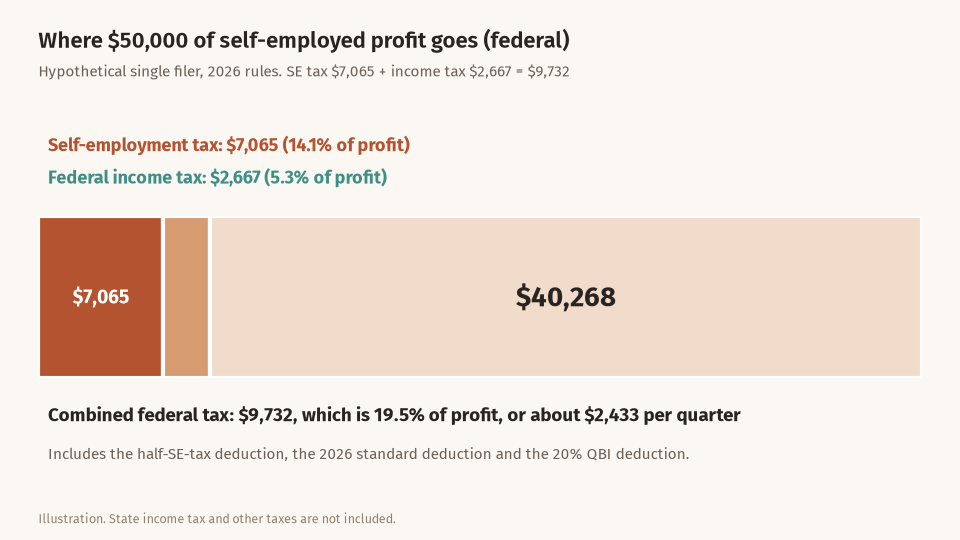
The point is not the exact figure. It is that about a fifth of profit in this example goes to federal tax, and that you need to set it aside as you earn, not when the bill arrives. If you also have a job with an employer, adjusting your W-4 can cover some of it, as we explain in how tax refunds and withholding work.
Estimated tax payments
Because nobody withholds tax from your self-employment income, the IRS expects you to pay during the year. According to the IRS, you generally need to make estimated payments if you expect to owe $1,000 or more after subtracting withholding and credits. You work out the amount with the Form 1040-ES worksheet. You can mail payments with a 1040-ES voucher, or pay online, by phone, through the IRS app or through your IRS online account; the IRS lists all options at IRS.gov/payments.
The four payment periods for 2026 and their due dates are:
- January 1 to March 31: due April 15, 2026
- April 1 to May 31: due June 15, 2026
- June 1 to August 31: due September 15, 2026
- September 1 to December 31: due January 15, 2027
The periods are not equal quarters, which catches many people out. If you file your full 2026 return by February 1, 2027 and pay the balance with it, you do not need to make the January payment.
How much to pay
You can avoid the underpayment penalty by paying enough, even if you still owe more at filing. The IRS lists the safe harbors: you generally will not owe the penalty if you owe less than $1,000, or if your payments and withholding total at least the smaller of 90% of this year’s tax or 100% of last year’s tax. If last year’s adjusted gross income was above $150,000 ($75,000 if married filing separately), the prior-year safe harbor rises to 110%.
The prior-year rule is useful when income is rising or unpredictable. You can base all four payments on last year’s tax and know you are covered, then pay the difference with your return. If your income falls, you can base payments on this year’s actual figures instead.
Deductions that apply to self-employed people
Your Schedule C profit is income minus ordinary and necessary business expenses. The IRS defines these as costs that are common and accepted in your trade and helpful and appropriate for your business. IRS Publication 334 covers the main ones:
- Home office: the simplified method is $5 per square foot of a space used regularly and exclusively for business, up to 300 square feet. That is a maximum of $1,500. The regular method uses actual expenses and Form 8829.
- Vehicle: you can deduct either actual costs or the standard mileage rate, which is 72.5 cents per mile for business use in 2026. Commuting from home to a regular workplace is generally not business mileage.
- Meals: generally limited to 50% of the cost.
- Self-employed health insurance: you may be able to deduct premiums for medical and dental insurance and qualified long-term care insurance for you and your family. This is taken on your Form 1040, not Schedule C.
- Other common costs: software, supplies, professional fees, advertising, and a share of phone and internet used for business.
- Retirement contributions: SEP, SIMPLE and solo 401(k) plans let you save for retirement and reduce taxable income. See the IRS page on retirement plans for self-employed people for current limits. Our guide to legally reducing taxable income covers other ways to lower your bill.
You cannot deduct personal expenses, and a few business-related items are specifically barred, including charitable contributions, political contributions, lobbying expenses, bribes and kickbacks, and penalties and fines paid to a government agency. If an expense is part business and part personal, you can only deduct the business share.
The QBI deduction
Separately from expenses, many sole proprietors can deduct up to 20% of qualified business income. The IRS says it is available whether you itemize or take the standard deduction, and the deduction is limited to the lesser of 20% of QBI or 20% of your taxable income minus net capital gains. Higher earners face extra limits depending on the type of business, and the IRS lists 2026 thresholds in Rev. Proc. 2025-32: $201,750 for most filers and $403,500 for joint filers. From 2026 there is also a minimum deduction for active qualified business income, so check the IRS page if your profit is small.

Forms you may receive or need to send
- 1099-NEC: a business that paid you for services may send one. For payments made after 2025, the filing threshold for payers is $2,000. If someone paid you less, or never sent a form, the income is still taxable.
- 1099-K: payment apps and marketplaces report transactions once you pass the third-party network threshold of more than $20,000 and more than 200 transactions. Payment cards have no threshold. As the IRS stresses, income is taxable whether or not you receive a form.
- Schedule C reports profit or loss, and Schedule SE calculates SE tax. Both go with your Form 1040.
- If you hire contractors, you may need to issue a 1099-NEC yourself.
If self-employment is a small side activity rather than your main income, our guide to side hustle income and tax explains what counts as taxable and how to keep records. Newer freelancers will find practical pricing and client advice in how to start freelancing.
Setting money aside for tax
A practical habit makes the quarterly payments far less painful: every time a client pays you, move a fixed share into a separate savings account that you only use for tax. In the example above, federal tax was about 19.5% of profit, so a person with similar numbers might move roughly a fifth of each payment. Your own percentage will differ because of your deductions, other income, state tax and credits, so treat the first year as a test and adjust each quarter. The IRS notes that if you estimated your earnings too high or too low, you can simply redo the Form 1040-ES worksheet and change the next payment. If your income is lumpy, the annualized income method on Form 2210 can lower or remove the penalty for quarters when you earned little.
Record keeping
Keep a record of every payment received and every expense. At a minimum, keep invoices, bank statements, receipts for deductible costs, and a mileage log if you claim vehicle expenses. IRS Publication 334 says to keep records until the period of limitations for your return runs out, and that period is generally 3 years from the date you filed your original return, with longer periods in some situations. Publication 334 suggests keeping a separate bank account for the business, which makes the bookkeeping much simpler.
Common mistakes
- Not paying estimated tax until filing. This can lead to a penalty on top of the tax. Set aside a fixed percentage of each payment you receive, based on last year’s total tax or a simple calculation like the one above.
- Forgetting SE tax when setting aside money. Many people reserve for income tax only and are surprised by the extra 15.3%.
- Mixing personal and business spending. It makes deductions hard to prove.
- Deducting 100% of meals. The general limit is 50%.
- Treating no 1099 as no income. All business income is taxable.
- Skipping the QBI deduction. It is easy to miss if you use software that does not prompt you, or if you prepare returns by hand.
FAQ
Do I have to pay SE tax if I also have a job?
Yes, if your net self-employment earnings are $400 or more. The IRS says that wages already subject to Social Security tax count toward the annual Social Security wage base, so if your wages alone reach the base you do not owe the 12.4% Social Security part on your net earnings, though the 2.9% Medicare part still applies.
What happens if I miss an estimated payment?
You may owe an underpayment penalty, even if you are due a refund when you file. If your income arrives unevenly during the year, the IRS says you may be able to avoid or lower the penalty by annualizing your income, using Form 2210. The penalty may also be waived in limited cases, such as a disaster or unusual circumstance, or if you retired after age 62 or became disabled during the year or the year before.
How do I make estimated payments?
You can mail a check with a Form 1040-ES voucher, or pay online, by phone or from your mobile device using the IRS app, or through your IRS online account. The IRS says you can pay weekly, monthly or on any schedule you like, as long as you have paid enough by the end of each period. The full list of payment options is at IRS.gov/payments.
Can I deduct my home office if I work from my kitchen table?
Only if you use part of your home regularly and exclusively for business. A dining table that is also used for meals generally does not qualify.
Is SE tax the same as the tax on a business like an LLC?
It depends on how the business is taxed. IRS Publication 334 explains that a single-owner LLC is generally disregarded as an entity separate from its owner for federal income tax, which usually means the owner reports it on Schedule C and pays SE tax on the profit. Other structures, such as corporations or partnerships, are taxed differently. A tax professional can help you choose a structure.
Do I pay Social Security tax if I am retired and still working for myself?
Yes. The IRS says the self-employment tax rules apply no matter how old you are and even if you are already receiving Social Security or Medicare.
This article is general education about US federal tax, not individual tax advice. Rules and thresholds change and your situation is your own. Check the IRS sources below, and consider talking to a qualified tax professional before making decisions. See our Editorial Policy and Disclaimer pages for how we work.
Sources
- IRS: Self-employment tax (Social Security and Medicare taxes)
- IRS: Estimated taxes
- IRS: Topic no. 306, Penalty for underpayment of estimated tax
- IRS Publication 334, Tax Guide for Small Business
- IRS Publication 505, Tax Withholding and Estimated Tax
- IRS: Qualified business income deduction
- IRS: Tax inflation adjustments for tax year 2026
- IRS: 2026 business standard mileage rate
- IRS: Understanding your Form 1099-K
- Social Security Administration: Contribution and benefit base
- IRS: Retirement plans for self-employed people