

Last verified: October 2026. This article covers US federal income tax only. Credit amounts shown are for tax year 2026 unless a different year is named, and come from the IRS pages listed under Sources.
A deduction lowers the income you are taxed on. A credit lowers the tax bill itself. That is why a $1,000 credit is worth far more than a $1,000 deduction for almost everyone: the credit takes $1,000 off your bill, while the deduction only saves you your tax rate on that $1,000, which is $100 to $240 for most filers.
This guide is about US federal taxes only. Credits and reliefs in the UK, EU and Australia work differently and are not covered here.
Key takeaways
- A deduction is subtracted from income before tax is calculated. A credit is subtracted from the tax you owe, dollar for dollar.
- A refundable credit can pay you back even if your tax is zero. A non-refundable credit can only reduce your tax to zero.
- For 2026 the Child Tax Credit is up to $2,200 per child, of which up to $1,700 can be refundable.
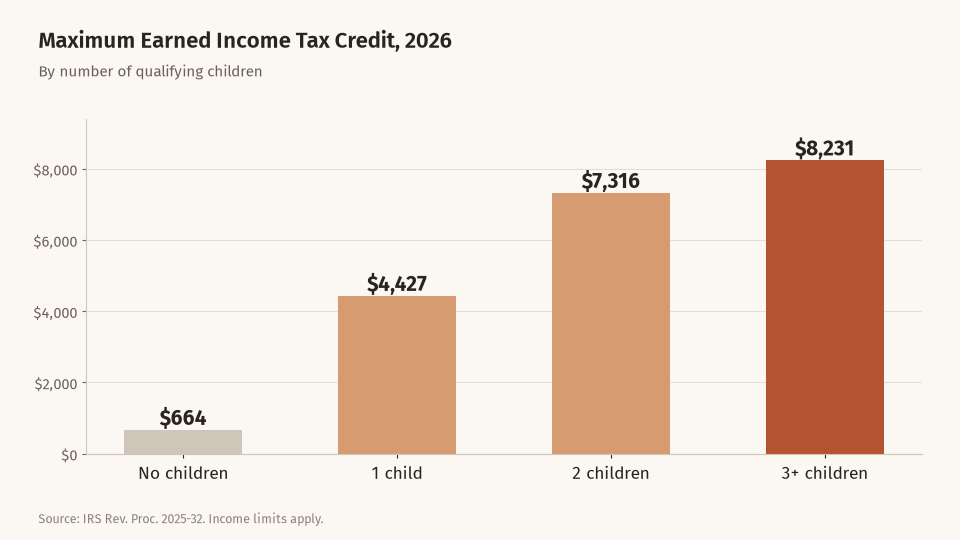
- The 2026 Earned Income Tax Credit tops out at $664 with no children and $8,231 with three or more.
- Several energy and clean-vehicle credits have ended. Do not budget for them without checking the IRS pages.
Credits vs deductions: the basic difference
The IRS describes it simply. A credit is an amount you subtract from the tax you owe, and it can lower your payment or increase your refund. A deduction is an amount you subtract from your income, so you do not pay tax on it. Both lower your tax, but they work at different points in the calculation.
Here is the order of operations in plain terms:
- You add up your income.
- You subtract deductions (the standard deduction or itemized deductions, plus a few adjustments such as IRA contributions or student loan interest). What is left is your taxable income.
- You apply the tax brackets to taxable income to get your tax before credits.
- You subtract credits from that tax. Refundable credits can push the result below zero and become a refund.
How a deduction saves money
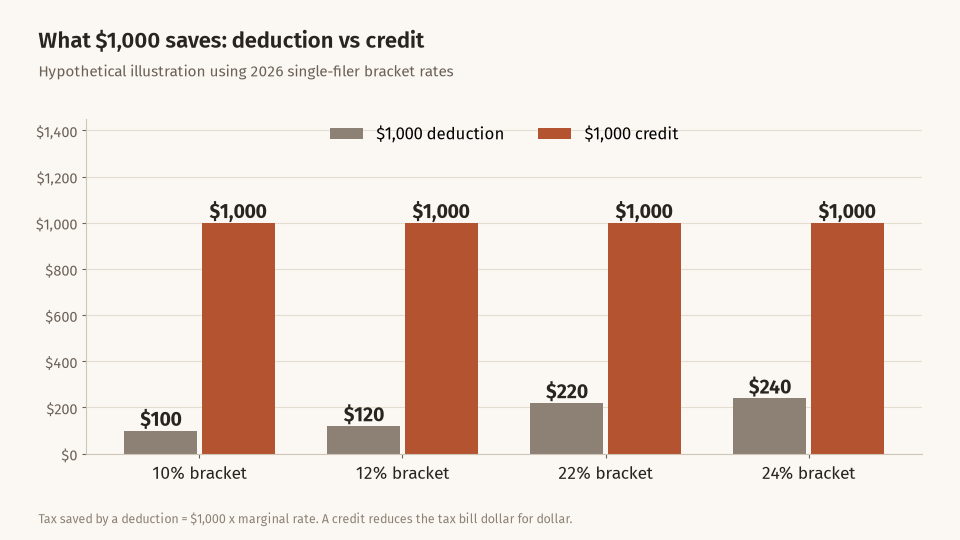
A deduction saves you money at your marginal tax rate, which is the rate on your last dollar of income. For 2026, a single filer pays 10% on taxable income up to $12,400, 12% up to $50,400, 22% up to $105,700 and 24% up to $201,775. A $1,000 deduction therefore saves $100, $120, $220 or $240 depending on which bracket the dollar falls in.
Most people claim the standard deduction instead of itemizing. For 2026 it is $16,100 for single filers, $32,200 for married couples filing jointly and $24,150 for heads of household. You only benefit from itemizing if your itemized deductions add up to more than that. For more ways to reduce what you are taxed on, see our guide to how to legally reduce your taxable income.
How a credit saves money
A credit does not care what bracket you are in. A $1,000 credit reduces your tax by $1,000, as long as you have enough tax to use it, or it is refundable.
Worked example: $1,000 deduction vs $1,000 credit
This is a hypothetical illustration, not a prediction for your return.
Take a single filer in the 22% bracket in 2026. Their taxable income is above $50,400 and below $105,700.
- A $1,000 deduction lowers taxable income by $1,000. At 22%, the tax falls by $1,000 × 0.22 = $220.
- A $1,000 credit lowers the tax bill by $1,000.
The credit is worth 4.5 times as much ($1,000 ÷ $220 ≈ 4.5). For a filer in the 10% bracket the same deduction saves only $100, so the credit is worth ten times as much.
Refundable vs non-refundable credits
This is the second distinction that matters.
- A non-refundable credit can reduce your tax to zero but no further. Any unused amount is generally lost, although some credits allow a carryforward.
- A refundable credit can be paid out even if you owe no tax at all.
- Some credits are partly refundable. The Child Tax Credit and the American Opportunity Credit both have a refundable portion.
Another hypothetical illustration. Suppose you owe $800 in federal income tax after deductions, and you qualify for a $2,000 credit.
- If the credit is non-refundable, it wipes out the $800 and the remaining $1,200 does no more good. You owe $0 and get no refund from the credit.
- If the credit is fully refundable, it wipes out the $800 and the remaining $1,200 is paid to you as a refund (assuming nothing else changes).
That is why refundable credits matter most to lower-income filers who owe little or no income tax.
The major US credits at a glance (2026)
| Credit | Maximum | Refundable? | Who it helps |
|---|---|---|---|
| Child Tax Credit | $2,200 per child | Partly (up to $1,700) | Children under 17 |
| Earned Income Tax Credit | $664 to $8,231 | Yes | Low to moderate earned income |
| American Opportunity | $2,500 per student | 40% refundable | First 4 years of college |
| Lifetime Learning | $2,000 per return | No | Any college or job-skills course |
| Child & Dependent Care | Up to 50% of $3,000 / $6,000 | No | Paid care so you can work |
| Saver’s Credit | $1,000 ($2,000 joint) | Limited to your tax | Retirement contributions |
| Adoption Credit | $17,670 | $5,120 refundable | Adoption expenses |
Child Tax Credit
The Child Tax Credit is worth up to $2,200 per qualifying child. A qualifying child is generally under 17 at the end of the year, lives with you for more than half the year, is claimed as your dependent and does not provide more than half of their own support. You and the child need a Social Security number that is valid for employment, issued before the due date of the return.
If your tax is too low to use the whole credit, the refundable Additional Child Tax Credit can pay up to $1,700 per child, and you must have earned income of at least $2,500. The full credit is available if your income is not more than $200,000 ($400,000 joint), and it phases out above that. For other dependents who do not qualify, the Credit for Other Dependents is up to $500 each and is non-refundable.
Earned Income Tax Credit (EITC)
The EITC is a refundable credit for working people with low to moderate income. The amount depends on your earned income, filing status and number of qualifying children. For 2026 the maximum credit is:
| Qualifying children | Maximum credit, 2026 | Income where it ends, single or head of household | Income where it ends, married filing jointly |
|---|---|---|---|
| None | $664 | $19,540 | $26,820 |
| One | $4,427 | $51,593 | $58,863 |
| Two | $7,316 | $58,629 | $65,899 |
| Three or more | $8,231 | $62,974 | $70,244 |
Investment income must not exceed $12,200 for 2026. For comparison, the maximums for tax year 2025 (the year most people filed for in 2026) were $649, $4,328, $7,152 and $8,046, with an investment income limit of $11,950.
Earned income includes wages, tips and self-employment income, including gig work. It does not include interest, dividends, pensions, Social Security, unemployment benefits, alimony or child support. A qualifying child for the EITC must have a valid Social Security number and meet age, relationship and residency tests. The IRS also says only one person can claim a child for the EITC, so shared custody situations have tiebreaker rules.
If you claim the EITC or the Additional Child Tax Credit, the IRS cannot issue your refund before mid-February. For how refunds are timed, see our guide to how tax refunds and withholding work.
Education credits
There are two, and you can claim only one of them per student. The American Opportunity Tax Credit (AOTC) is worth up to $2,500 per eligible student: 100% of the first $2,000 of qualified expenses plus 25% of the next $2,000. It is available for only four years per student, and 40% of it is refundable. The Lifetime Learning Credit (LLC) is worth up to $2,000 per return (20% of the first $10,000 of expenses), is non-refundable, has no four-year limit and also covers courses taken to acquire or improve job skills. You can claim both on one return only if they are for different students or different expenses.
The IRS says you generally cannot claim either credit if you file as married filing separately or if you are claimed as someone else’s dependent, and both phase out with income: the IRS states a modified adjusted gross income limit below $90,000 ($180,000 joint), and for 2026 the LLC phase-out begins at $80,000 ($160,000 joint). From 2026, new Social Security number requirements apply to both credits.
Child and Dependent Care Credit
This non-refundable credit helps with care costs that let you work or look for work. Qualifying expenses are capped at $3,000 for one qualifying person and $6,000 for two or more. From 2026 the maximum credit rate rises from 35% to 50% of qualifying expenses, with the rate depending on your income. At the 50% rate, the maximum credit is $1,500 for one person and $3,000 for two or more. Day care, before- and after-school care and day camps can qualify. Overnight camps and schooling costs generally do not.
Saver’s Credit
If you put money into an IRA or workplace retirement plan, you may get a credit of 50%, 20% or 10% of up to $2,000 of contributions ($4,000 joint), so up to $1,000 ($2,000 joint). The credit is limited by your tax liability on Form 8880, so it works like a non-refundable credit. You must be 18 or older, not claimed as a dependent and not a full-time student. For 2026 the 50% rate applies up to an adjusted gross income of $48,500 for joint filers, $36,375 for heads of household and $24,250 for everyone else; the 10% rate ends at $80,500, $60,375 and $40,250. If you are deciding where to save, see our Roth IRA guide.
Adoption credit
For 2026 the maximum adoption credit is $17,670, and up to $5,120 of it is refundable. The IRS notes that since 2025 up to $5,000 (indexed) can be refundable, and that carried-forward amounts cannot be used to figure the refundable part.

Credits that have ended or changed
- Clean vehicle credits (new 30D and used 25E) are not allowed for vehicles acquired after September 30, 2025.
- The Energy Efficient Home Improvement Credit (25C) is not allowed for property placed in service after December 31, 2025.
- The Residential Clean Energy Credit (25D) is not allowed for expenditures made after December 31, 2025.
- A new federal scholarship tax credit of up to $1,700 for donations to approved scholarship-granting organizations starts on January 1, 2027. It is non-refundable, excess can be carried forward for up to five years, and your state must opt in.
Credits are frequently changed by new legislation, so check the IRS page for the specific credit before you rely on a figure from any article, including this one.
Common mistakes
- Assuming a deduction and a credit are interchangeable. A $2,000 deduction is not a $2,000 credit. At a 12% bracket the deduction saves $240.
- Forgetting that non-refundable credits stop at zero. If your tax is small, a non-refundable credit may be partly wasted.
- Missing a Social Security number requirement. The Child Tax Credit and EITC require valid SSNs for you, your spouse (if filing jointly) and the qualifying child. A missing or wrong number can delay or deny the claim.
- Two people claiming the same child. Only one person can claim a child for the EITC, the Child Tax Credit, head of household status and the dependent care credit. Tiebreaker rules decide who can claim the child.
- Counting on a credit that has ended. Vehicle and home energy credits were cut off in late 2025.
- Ignoring income limits. Education credits, the Child Tax Credit and the Saver’s Credit all phase out as income rises.
- Leaving credits unclaimed because you are not required to file. The IRS says you can claim the EITC even if you do not normally file taxes, and the Child Tax Credit even if you do not normally file.
Frequently asked questions
Is a tax credit better than a deduction?
Dollar for dollar, yes. A credit reduces your tax by the full amount, while a deduction reduces it by your tax rate times the deduction. But they are not alternatives. Most filers get both, and many deductions and credits do not compete with each other.
What does refundable mean?
A refundable credit can be paid to you even if it is larger than your tax. A non-refundable credit can only bring your tax down to zero. The Earned Income Tax Credit is fully refundable. The Child Tax Credit is partly refundable through the Additional Child Tax Credit.
Can I claim both the standard deduction and credits?
Yes. Credits are separate from the standard deduction. You subtract the standard deduction (or itemized deductions) from income, and credits come after the tax is calculated.
Which credit can I get without any children?
The EITC is available with no qualifying children, with a 2026 maximum of $664 and lower income limits. The Saver’s Credit and education credits also do not depend on having children.
Do I have to be working to get the EITC?
You need earned income. Interest, dividends, pensions, Social Security, unemployment benefits, alimony and child support do not count as earned income for the EITC.
How do I find out which credits I qualify for?
The IRS runs an Interactive Tax Assistant and an EITC Assistant on IRS.gov, and tax software asks the eligibility questions for you. You can also get free help from the IRS on their free tax preparation pages.
This article is general education about US federal tax, not individual tax advice. Tax rules and thresholds change and your situation is your own. Check the IRS sources below, and consider talking to a qualified tax professional before making decisions. See our Editorial Policy and Disclaimer pages for how we work.
Sources
- IRS: Credits and deductions for individuals
- IRS: Child Tax Credit
- IRS: Earned income and Earned Income Tax Credit (EITC) tables
- IRS: EITC qualifying child rules
- IRS: Education credits (AOTC and LLC)
- IRS: Child and Dependent Care Credit
- IRS: Saver’s Credit
- IRS: Form 8880 (PDF)
- IRS: Working Families Tax Cuts
- IRS: Tax inflation adjustments for tax year 2026 (IR-2025-103)
- IRS Rev. Proc. 2025-32