

Last verified: October 2026. This article covers US federal income tax only. 2026 limits come from IRS announcements, Revenue Procedures and the 2026 Form W-4, and the new 2025-2028 deductions from IRS fact sheet FS-2025-03.
Your tax bill is calculated on taxable income, which is your income minus deductions. Lowering it legally means using the deductions and tax-favored accounts the law provides: contributing to a workplace retirement plan or HSA, claiming the right standard or itemized deductions, and claiming the new deductions for tips, overtime, car loan interest and seniors where you qualify. There is no loophole here, only rules you either use or do not.
This guide is about US federal taxes only. Other countries have their own allowances and are not covered.
Key takeaways
- Taxable income is income minus deductions. Each dollar you remove is taxed at your marginal rate, not your average rate.
- For 2026 the standard deduction is $16,100 (single), $32,200 (married filing jointly) or $24,150 (head of household). Itemize only if your itemized deductions are larger.
- The biggest levers most people have are 401(k) contributions (up to $24,500 for 2026), HSA contributions ($4,400 self-only, $8,750 family) and traditional IRA contributions if you qualify for the deduction.
- New deductions for tips, overtime, car loan interest and people 65 or older apply for 2025 through 2028, to both itemizers and non-itemizers, with income limits.
- A deduction is not a refund. A $1,000 deduction saves you your marginal rate on it, such as $100 at 10% or $220 at 22%, not $1,000. See our credits vs deductions guide.
How taxable income is calculated
The IRS describes a deduction as an amount you subtract from your income so you do not pay tax on it. Some deductions come off your income whether or not you itemize, and some only if you itemize. In practice the order is:
- Start with your gross income: wages, business income, interest and other taxable income.
- Subtract adjustments that apply to everyone, such as pre-tax retirement and HSA contributions and student loan interest. This gives your adjusted gross income (AGI).
- Subtract the standard deduction or your itemized deductions, plus any other eligible deductions.
- The result is taxable income, and the tax brackets apply to it.
Pre-tax payroll contributions, such as a traditional 401(k) deferral, reduce the wages shown for income tax purposes, so the effect is similar.
Why your marginal rate matters
For 2026 a single filer pays 10% on taxable income up to $12,400, 12% up to $50,400, 22% up to $105,700 and 24% up to $201,775. A $1,000 reduction in taxable income saves $100 in the 10% bracket and $220 in the 22% bracket.
Step 1: Choose between the standard deduction and itemizing
Most people take the standard deduction. For 2026 it is $16,100 for single filers and married filing separately, $32,200 for joint filers and $24,150 for heads of household. Itemizing only helps if your qualifying expenses are greater than that. The IRS lists these itemized deductions:
- State and local taxes. For 2026 you can enter up to $40,400 if your income is under $505,000 ($20,200 and $252,500 for married filing separately), according to the 2026 Form W-4 worksheet.
- Home mortgage interest, with the worksheet limit based on home acquisition debt under $750,000.
- Gifts to charity, counted above 0.5% of your income for 2026.
- Medical and dental expenses above 7.5% of your income.
If you rent or have a small mortgage, you may fall short of the standard deduction. In that case, the sections below matter more.
New for 2026: a charitable deduction without itemizing
Starting with 2026, if you take the standard deduction you may deduct up to $1,000 of cash gifts to eligible charities ($2,000 if married filing jointly). Gifts to donor-advised funds and supporting organizations do not qualify, and the deduction is for cash gifts only.
Step 2: Use pre-tax and tax-favored accounts
| Tool | 2026 limit | Notes |
|---|---|---|
| 401(k) / 403(b) / 457(b) | $24,500 | +$8,000 if 50+ ($11,250 at 60-63) |
| IRA | $7,500 | +$1,100 if 50+; deduction may phase out |
| HSA | $4,400 / $8,750 | Needs a high-deductible plan; +$1,000 if 55+ |
| Student loan interest | $2,500 | Phases out at $85,000-$100,000 ($175,000-$205,000 joint) |
| Educator expenses | $350 | Eligible educators |
Workplace retirement plan
For 2026 you can defer up to $24,500 into a 401(k), 403(b) or governmental 457(b). The catch-up is $8,000 if you are 50 or older, and $11,250 instead of $8,000 for ages 60 to 63. Traditional (pre-tax) contributions reduce your taxable wages. Roth contributions do not, but they have a different benefit; see our Roth IRA guide.
Traditional IRA
For 2026 the IRA limit is $7,500 (plus $1,100 if you are 50 or older). Whether the contribution is deductible depends on whether you or your spouse is covered by a workplace plan. For 2026, if you are covered by a workplace plan, the deduction phases out between $81,000 and $91,000 of modified AGI for single filers and between $129,000 and $149,000 for joint filers. If only your spouse is covered, the joint range is $242,000 to $252,000.
Health savings account
If you are covered by a qualifying high-deductible health plan, you can put up to $4,400 (self-only) or $8,750 (family) into an HSA for 2026, plus $1,000 if you are 55 or older. The IRS lists HSA contributions among the deductions available whether or not you itemize. Our HSA vs FSA guide explains the eligibility rules.
Other adjustments
- Student loan interest: up to $2,500 for 2026, phasing out between $85,000 and $100,000 of modified AGI ($175,000 and $205,000 if joint).
- Educator expenses: up to $350 for 2026 for eligible educators.
- Self-employed deductions: self-employed people can deduct half of their self-employment tax and may deduct health insurance and retirement plan contributions. Our self-employed taxes guide covers them.
Step 3: Claim the new 2025-2028 deductions if you qualify
| Deduction | Maximum | Phase-out starts (MAGI) |
|---|---|---|
| Qualified tips | $25,000 | $150,000 ($300,000 joint) |
| Qualified overtime premium | $12,500 ($25,000 joint) | $150,000 ($300,000 joint) |
| New car loan interest | $10,000 | $100,000 ($200,000 joint) |
| Age 65 or older | $6,000 per person | $75,000 ($150,000 joint) |
The IRS says four new deductions apply from 2025 through 2028. All four are available whether you itemize or take the standard deduction. The tips, overtime and senior deductions require a Social Security number and, if you are married, a joint return.
- Tips. Up to $25,000 a year for qualified tips in occupations the IRS lists as customarily and regularly receiving tips. Phase-out above $150,000 of MAGI ($300,000 joint). Specified service trades or businesses are excluded for self-employed individuals and for employees of those businesses.
- Overtime. Up to $12,500 ($25,000 joint) for the pay above your regular rate, such as the “half” in time-and-a-half, that is required by the Fair Labor Standards Act. Phase-out above $150,000 ($300,000 joint).
- Car loan interest. Up to $10,000 a year, for a new vehicle for personal use that had final assembly in the United States, with a loan taken out after December 31, 2024 and secured by a lien. The vehicle identification number must be on your return, and leases do not qualify. Phase-out above $100,000 ($200,000 joint).
- Seniors. An additional $6,000 per person aged 65 or older by the end of the year, on top of the existing additional standard deduction. Phase-out above $75,000 ($150,000 joint).

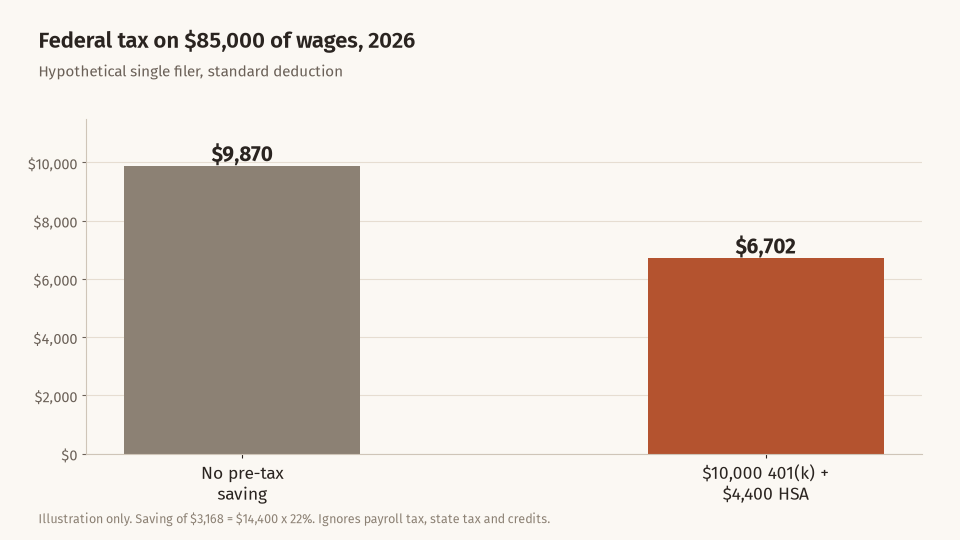
Worked example: $14,400 of pre-tax saving
This is a hypothetical illustration using 2026 rules, not advice for your situation.
A single filer earns $85,000 in wages and takes the standard deduction. Compare two cases.
Without pre-tax saving
- Taxable income: $85,000 − $16,100 = $68,900
- Tax: 10% × $12,400 = $1,240; 12% × ($50,400 − $12,400) = $4,560; 22% × ($68,900 − $50,400) = $4,070
- Total tax: $9,870
With $10,000 into a traditional 401(k) and $4,400 into an HSA (assuming HDHP coverage)
- Taxable income: $85,000 − $14,400 − $16,100 = $54,500
- Tax: $1,240 + $4,560 + 22% × ($54,500 − $50,400) = $902
- Total tax: $6,702
The difference is $3,168, which equals $14,400 × 22% because every dollar removed came out of the 22% bracket. This ignores payroll taxes, state tax and credits. The money did not disappear: $14,400 went into accounts the filer owns.
Common mistakes
- Confusing deductions with credits. A deduction only saves your marginal rate on the amount.
- Itemizing when the standard deduction is bigger. Add up your expenses before you bother with receipts.
- Over-contributing. Exceeding the HSA or IRA limits triggers excise taxes, and the deductible IRA amount depends on workplace plan coverage and income.
- Missing the income limits. The student loan interest and new tips, overtime, car loan and senior deductions all phase out as income rises.
- Claiming a deduction you do not have paperwork for. The new deductions have information-reporting and Social Security number requirements, and car loan interest needs the vehicle’s VIN on your return.
- Forgetting to file jointly when married. Married couples must file jointly to claim the tips, overtime and senior deductions.
- Spending money just to get a deduction. A deduction returns only a portion of the spending, so make sure the underlying purchase makes sense.
- Assuming aggressive schemes are legitimate. Anything promising to wipe out your tax without the rules above should be checked against IRS guidance.
Frequently asked questions
What is the easiest way to lower my taxable income?
For employees, increasing pre-tax contributions to a workplace retirement plan is usually the simplest, since it comes straight out of your paycheck. If you have a high-deductible health plan, an HSA is another.
Do these deductions apply if I do not itemize?
The IRS says the new tips, overtime, car loan interest and senior deductions are available to both itemizers and non-itemizers. Retirement, HSA and student loan interest are also available whether or not you itemize. The charity deduction for non-itemizers is capped at $1,000 ($2,000 joint) from 2026.
Is the overtime deduction for all overtime pay?
No. It covers the premium portion, such as the half in time-and-a-half, that is required by the Fair Labor Standards Act and is reported on your tax forms. It is capped at $12,500 ($25,000 joint) and phases out above $150,000 ($300,000 joint).
Do I need to change my paycheck withholding?
Possibly. If these deductions lower your tax during the year, you can use the IRS Tax Withholding Estimator and your Form W-4 so that less is withheld. See how refunds and withholding work.
Can I still claim the deductions after 2028?
The tips, overtime, car loan interest and senior deductions are described by the IRS as effective for 2025 through 2028. Rules can change, so check IRS.gov for later years.
This article is general education about US federal tax, not individual tax advice. Tax rules and thresholds change and your situation is your own. Check the IRS sources below, and consider talking to a qualified tax professional before making decisions. See our Editorial Policy and Disclaimer pages for how we work.
Sources
- IRS: Credits and deductions for individuals
- IRS: Tax inflation adjustments for tax year 2026 (IR-2025-103)
- IRS Rev. Proc. 2025-32
- IRS FS-2025-03: Tax deductions for working Americans and seniors
- IRS: Working Families Tax Cuts
- IRS: 401(k) limit increases to $24,500 for 2026, IRA limit increases to $7,500
- IRS Notice 2025-67
- IRS Rev. Proc. 2025-19
- IRS: 2026 Form W-4