

Last verified: October 2026. This article covers US federal tax rules only. 2026 figures come from the IRS announcement and Notice 2025-67; rules on withdrawals come from IRS Publications 590-A and 590-B.
A Roth IRA is a retirement account funded with money you have already paid tax on. You get no deduction when you put money in, but if you follow the rules, the growth and the withdrawals in retirement are free of federal income tax. For 2026 you can contribute up to $7,500 ($8,600 if you are 50 or older), as long as you have enough earned income and your income is under the limit for your filing status.
This guide is about US federal tax rules only. The UK, EU and Australia have different tax-advantaged accounts, and this article does not cover them.
Key takeaways
- The 2026 Roth IRA contribution limit is $7,500, or $8,600 if you are 50 or older. It was $7,000 ($8,000 if 50+) for 2025.
- You cannot contribute directly if your modified adjusted gross income (MAGI) is $168,000 or more (single) or $252,000 or more (married filing jointly) in 2026. The limit shrinks gradually before that.
- You can never contribute more than your taxable compensation for the year.
- You can take out your contributions at any time without tax or penalty. Earnings are only tax-free once the 5-year rule and an age or other qualifying condition are both met.
- Contributing too much triggers a 6% excise tax each year the excess stays in the account.
How a Roth IRA works
The IRS summarizes the basics this way: you cannot deduct Roth IRA contributions, qualified distributions are tax-free, you can keep contributing after age 70½, and you can leave the money in the account for as long as you live. Unlike a traditional IRA, there is no required withdrawal schedule for the original owner.
Two points often confuse people:
- The limit is shared. The same combined contribution limit applies to all of your Roth and traditional IRAs. If you put $3,000 into a traditional IRA, you can put at most $4,500 into a Roth for 2026 (under the standard $7,500 limit).
- The account must be designated Roth when it is opened. A Roth IRA is a different account type, not a setting you can change later (although conversions from a traditional IRA are possible and are explained below).
For the difference between a Roth and a pre-tax account at work, see our guide to how to legally reduce your taxable income, which explains where traditional contributions fit.
Roth IRA contribution limits for 2026
| 2025 | 2026 | |
|---|---|---|
| Contribution limit | $7,000 | $7,500 |
| If you are 50 or older | $8,000 | $8,600 |
| Phase-out, single / head of household | $150,000 – $165,000 | $153,000 – $168,000 |
| Phase-out, married filing jointly | $236,000 – $246,000 | $242,000 – $252,000 |
| Married filing separately, lived with spouse | $0 – $10,000 | $0 – $10,000 |
| 2025 | 2026 | |
|---|---|---|
| Contribution limit | $7,000 | $7,500 |
| Limit if you are 50 or older | $8,000 | $8,600 |
| Phase-out, single or head of household | $150,000 to $165,000 | $153,000 to $168,000 |
| Phase-out, married filing jointly | $236,000 to $246,000 | $242,000 to $252,000 |
| Phase-out, married filing separately (lived with spouse) | $0 to $10,000 | $0 to $10,000 |
The deadline matters too. You can make contributions for a tax year at any time during that year or up to the due date of that year’s return, not counting extensions. For 2025, that was generally April 15, 2026. For 2026, the same rule points to the 2026 return due date in 2027, which is generally April 15, 2027.
You need earned income
Your contribution is capped at the lesser of the annual limit and your taxable compensation. Wages, salaries, tips and net self-employment income count. Investment income, rent and most pension income do not. If you earn $5,000 in a year, the most you can put into IRAs for that year is $5,000, even though the limit is higher.
Married couples and a non-working spouse
If you file a joint return, a spouse with little or no income can still contribute to their own IRA, as long as the couple’s combined taxable compensation is enough to cover the contributions. This is often called a spousal IRA. Each spouse has their own limit and their own account. For other first-year money decisions for couples, see the money checklist for newly married couples.

Income limits and the phase-out
You can contribute the full amount if your MAGI is below the bottom of the range for your filing status. Within the range, your allowed contribution is reduced step by step. At or above the top of the range, you cannot contribute directly to a Roth IRA for that year.
Modified AGI is your adjusted gross income with a few adjustments added back. Pub 590-A has a worksheet for it. The phase-out uses the worksheet in the same publication:
- Subtract the bottom of your phase-out range from your MAGI.
- Divide by the width of the range: $15,000 for single filers and heads of household, $10,000 for joint filers and for separate filers who lived with their spouse. Round the result to at least three decimal places.
- Multiply that decimal by the lesser of the annual limit or your compensation.
- Subtract the result from the same limit and round up to the nearest $10. If the answer is below $200, the minimum is $200.
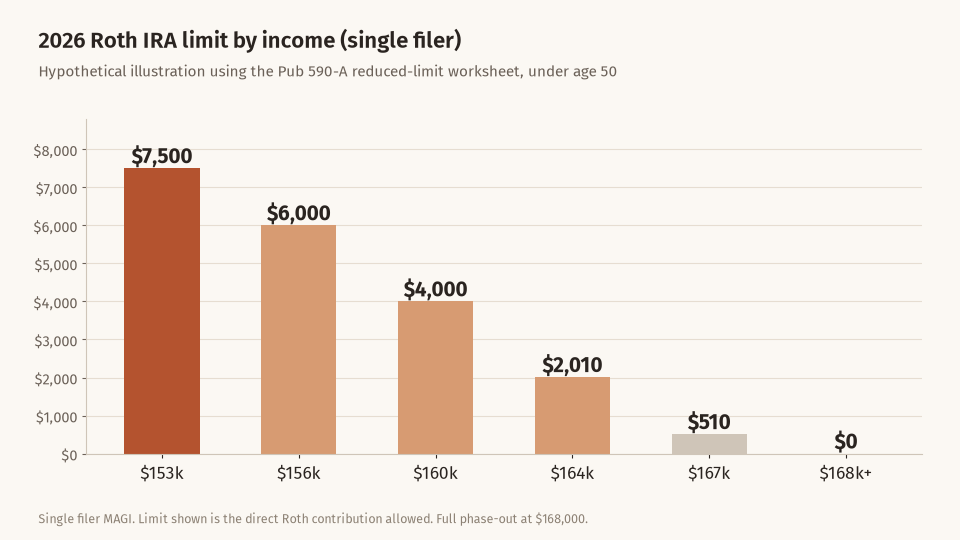
Worked example: single filer, MAGI $160,000
This is a hypothetical illustration using the 2026 figures, not advice for your situation.
A single filer under 50 has MAGI of $160,000, enough compensation and no other IRA contributions.
- MAGI minus phase-out start: $160,000 − $153,000 = $7,000
- Divide by the range: $7,000 ÷ $15,000 = 0.467 (rounded to three places)
- Multiply by the limit: 0.467 × $7,500 = $3,502.50
- Subtract: $7,500 − $3,502.50 = $3,997.50
- Round up to the nearest $10: $4,000
So this person can contribute $4,000 directly to a Roth IRA for 2026. At $155,000 the same steps give $6,510. At $168,000, nothing.
If your income is too high
Reducing MAGI is one route, for example through pre-tax contributions to a workplace plan or HSA. Another is to contribute to a traditional IRA and later convert it to a Roth. A conversion is a separate transaction: the pre-tax amount you convert is taxed as income in the year of conversion, and special timing rules apply. IRS Publication 590-A explains the methods. If you plan this, a tax professional can help because the details depend on any other IRAs you hold. See also our guide to HSA vs FSA accounts for another way to lower MAGI.
Roth IRA withdrawal rules
Roth withdrawals follow an ordering system. The IRS treats the money you take out as coming from these layers in this order:
- Regular contributions (what you put in). Taking these out is not taxed.
- Conversion and rollover contributions, oldest first. Within each conversion, the taxable part comes out before the non-taxable part.
- Earnings. These are the only layer that can be taxed.
| Order | What it is | Tax on withdrawal |
|---|---|---|
| 1. Regular contributions | Money you put in | Not taxed |
| 2. Conversions and rollovers | Oldest first | Taxable part first; 10% may apply in the 5 years after each conversion if under 59½ |
| 3. Earnings | Growth on your money | Taxed, plus possible 10%, unless qualified or an exception applies |
What makes a distribution “qualified”
A distribution is qualified, meaning fully tax-free, when both conditions are met:
- The 5-year period has passed. The period starts on January 1 of the first tax year for which you made any contribution to any Roth IRA, and one clock covers all your Roth IRAs.
- You have a qualifying reason: you are at least 59½, you are disabled, the distribution goes to a beneficiary after your death, or it is used for a first home purchase up to a $10,000 lifetime limit.
Withdrawing before the rules are met
If a distribution is not qualified, you can still take out your contributions without tax. The earnings you withdraw are included in your income and may face an extra 10% additional tax if you are under 59½, unless an exception applies. The IRS lists exceptions including disability, death, first-home purchase, substantially equal periodic payments, unreimbursed medical expenses above 7.5% of AGI, health insurance premiums while unemployed, qualified higher education expenses, an IRS levy, birth or adoption, certain disaster distributions and domestic abuse. Each conversion has its own separate 5-year period for the 10% additional tax. See Publication 590-B for the full list and the conditions.
529 plan rollovers to a Roth IRA
Since 2024 a beneficiary can roll money from a 529 plan into a Roth IRA, but only through a direct trustee-to-trustee transfer, up to the annual Roth contribution limit each year, up to $35,000 over a lifetime, and only from a 529 account open for more than 15 years.
Roth IRA vs workplace plans
If your employer offers a Roth 401(k), it has a much higher limit: for 2026, the elective deferral limit for 401(k) plans is $24,500. The IRS comparison chart notes the Roth IRA has income limits while a designated Roth 401(k) has no income limitation to participate. Many people use both. If your income is modest, the Saver’s Credit can reward you for contributing; we explain it in our credits guide.
Common mistakes
- Contributing above the income limit. If your MAGI turns out higher than expected, you can withdraw the excess contribution and its earnings by the return due date (including extensions) and it is treated as not contributed. Otherwise, the 6% excise tax applies for each year the excess remains.
- Contributing more than your earned income. The limit is the lesser of the cap and your taxable compensation.
- Ignoring the combined limit. The $7,500 limit covers all Roth and traditional IRAs together.
- Confusing the 5-year rules. There is one 5-year clock for qualified distributions and a separate clock for each conversion for the 10% additional tax.
- Assuming earnings are always accessible. Contributions are, earnings usually are not until you meet the rules.
- Missing the deadline. The deadline for a given tax year is generally the return due date, not extended.
- Treating a first-home exception as unlimited. It is capped at $10,000 over your lifetime.
Frequently asked questions
What is the Roth IRA limit for 2026?
$7,500, or $8,600 if you are 50 or older by the end of the year (the IRS lists a $1,100 catch-up). The limit is for all your IRAs combined. It can be lower if your income is in the phase-out range or if your taxable compensation is less than the limit.
Can I contribute to a Roth IRA at any age?
Yes. The IRS notes that you can make Roth IRA contributions after age 70½. You still need taxable compensation for the year, and the original owner does not have to take distributions during life.
What happens if I earn too much?
Within the phase-out range your contribution limit shrinks. At or above the top of the range you cannot contribute directly. You can fix an excess contribution by withdrawing it, with earnings, by the return due date.
Can I withdraw my contributions early?
Yes. Regular contributions come out first under the ordering rules and are not taxed when withdrawn. Earnings are taxed, and may face a 10% additional tax, unless the distribution is qualified or an exception applies.
Can I use a Roth IRA for a first home?
You can withdraw up to $10,000 over your lifetime for a first home purchase and have that count as a qualified distribution, once the 5-year period has passed. If the 5 years have not passed, the earnings portion may be taxable but exempt from the 10% additional tax. Our first-time home buyer guide covers the other costs of buying.
Is a Roth IRA better than a traditional IRA?
It depends on whether you expect your tax rate to be higher now or in retirement and on whether you qualify for the traditional deduction. Neither is better for everyone, and many people split their savings across both.
This article is general education about US federal tax, not individual tax or investment advice. Rules and limits change and your situation is your own. Check the IRS sources below, and consider talking to a qualified tax professional or financial adviser before making decisions. See our Editorial Policy and Disclaimer pages for how we work.
Sources
- IRS: Roth IRAs
- IRS Publication 590-A
- IRS Publication 590-B
- IRS: 401(k) limit increases to $24,500 for 2026, IRA limit increases to $7,500
- IRS Notice 2025-67
- IRS: Roth comparison chart
- IRS: Saver’s Credit