

Last verified: October 2026. Figures and rules below were checked against the official sources listed at the end of the article.
There is no single right amount, because it depends on when you want to stop, how you want to live and what the state pension covers. A common guide is to aim for an income of about 70% to 80% of your pre-retirement pay, then work backwards to what you need to save. The Social Security Administration (SSA) uses that range, Australia’s Moneysmart uses about 70%, and the UK’s MoneyHelper gives a sliding scale from 80% for low earners down to 50% for high earners.
This guide shows how to turn that guide into a number for you, with a worked example, the 2026 benchmarks published in the US, UK and Australia, and a note on the EU.
Key takeaways
- Think in income, not just a pot. Decide what yearly income you want, subtract the state pension, and the gap is what your savings must produce.
- The usual guide is about 70% to 80% of your working income. The SSA says that is what most financial advisers suggest. UK guidance falls from 80% to 50% as salary rises.
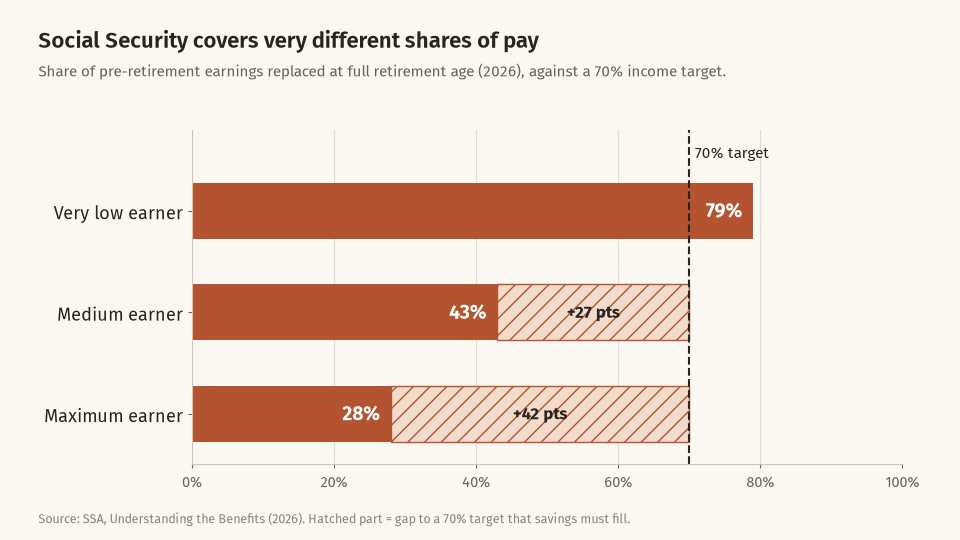
- State benefits cover very different shares of pay. For 2026 the SSA says Social Security replaces about 79% of earnings for very low earners, 43% for medium earners and 28% for the maximum earner.
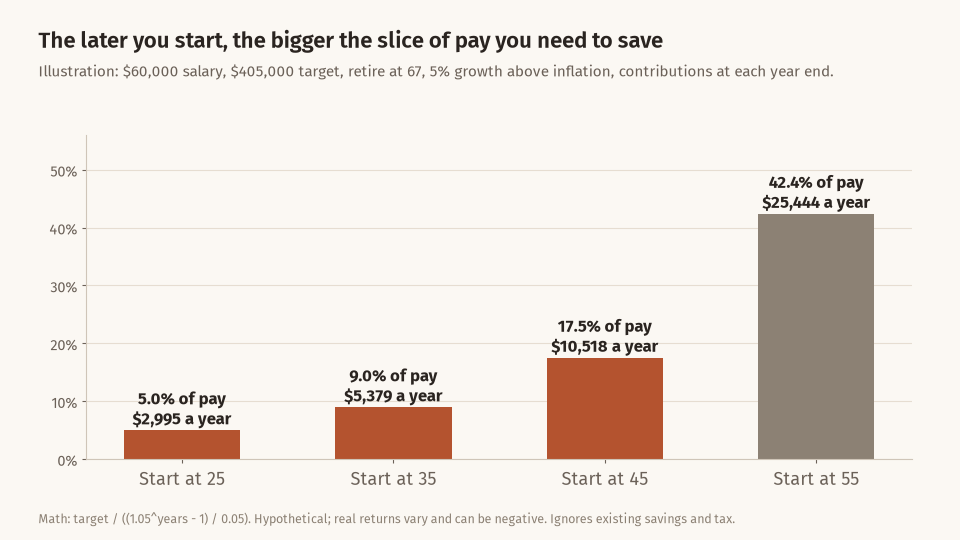
- Starting early matters more than finding the perfect number. In the illustration below, starting at 25 needs 5% of pay a year; starting at 45 needs 17.5%.
- Recheck every year or two. Pay, markets and your plans will change.

Why there is no single number
Two people with the same salary can need very different amounts. One may own a home outright and live cheaply. The other may rent, support family or want to travel. Official bodies say the same thing. Moneysmart states that there is no one answer, and its rule of thumb of about 70% of working-life income assumes that you own your home.
That is why most guides use a replacement rate: the share of your pre-retirement income you want to have each year in retirement. It is lower than 100% because, for many people, some costs fall away. You might no longer be saving for retirement, commuting, or paying off a mortgage.
The 70% to 80% guide, country by country
United States
The SSA’s booklet Understanding the Benefits says most financial advisers suggest you will need about 70% to 80% of your pre-retirement income, and its figures show Social Security replaces only part of that for most workers. For 2026, at full retirement age, it replaces about 79% of earnings for very low earners, 43% for medium earners and 28% for maximum earners.
Full retirement age is 67 if you were born in 1960 or later. You can claim from 62, but the monthly benefit is cut by 30%: a $1,000 benefit at full retirement age becomes $700. You need 10 years of work to qualify for retirement benefits.
The Federal Reserve’s survey of 2025 found that 61% of adults had a tax-preferred retirement account, and that 35% of people who were not yet retired thought their retirement saving was on track. In the lowest income group (under $25,000), only 7% did.
United Kingdom
MoneyHelper publishes how much of your current salary you typically need in retirement. The share falls as you earn more, because the State Pension replaces more of a lower salary:
| Current salary | Typical income needed in retirement |
|---|---|
| Up to £15,900 | 80% |
| £15,900 to £29,000 | 70% |
| £29,001 to £42,000 | 67% |
| £42,001 to £67,000 | 60% |
| Over £67,000 | 50% |
MoneyHelper also lists the Retirement Living Standards: after tax and excluding housing costs, a Minimum lifestyle costs £13,900 a year for one person (£22,500 for a couple), Moderate £32,700 (£45,400), and Comfortable £45,400 (£62,700). The 2026 update from Pensions UK gives gross income for a single person of £14,232, £37,732 and £54,720, and the estimated size of a defined contribution pot to fund each on top of the State Pension: £23,000 to £34,000 for Minimum, £335,000 to £505,000 for Moderate and £560,000 to £845,000 for Comfortable. Those pot figures count the State Pension at £12,548 a year.
The full new State Pension is £241.30 a week, about £12,548 a year. You need 35 qualifying years of National Insurance for the full amount and at least 10 for any. Check your own State Pension age on GOV.UK. Pensions UK estimates that about 82% of workers are on course to reach Minimum, 23% Moderate and 9% Comfortable.
Australia
Moneysmart says a rough guide is about 70% of your working-life income, assuming you own your home. The ASFA Retirement Standard (June quarter 2026) puts the annual spending of a single homeowner aged 65 to 84 at $56,166 for a comfortable lifestyle and $36,548 for a modest one. For a couple it is $78,998 comfortable and $52,690 modest. ASFA’s lump sums to fund a comfortable retirement, assuming a partial Age Pension, are about $630,000 for a single person and $730,000 for a couple.
The Age Pension from 20 September 2026 has a maximum of $1,237.70 a fortnight for a single person, about $32,180 a year, and $933.00 each for a couple. What you get depends on your income and assets. Employers pay the super guarantee of 12% on top of your pay, which is the base of most Australians’ retirement savings.
| Country | Benchmark | Figure | Published by |
|---|---|---|---|
| US | Income to replace in retirement | About 70% to 80% of pre-retirement pay | Social Security Administration |
| UK | Moderate lifestyle, one person | £37,732 gross a year; pot of £335k to £505k | Pensions UK (PLSA) |
| UK | Income needed by salary | 80% (up to £15,900) down to 50% (£67,000+) | MoneyHelper |
| Australia | Comfortable, single homeowner, 65-84 | $56,166 a year; lump sum about $630,000 | ASFA (June 2026) |
| Australia | Maximum Age Pension, single | $1,237.70 a fortnight (about $32,180 a year) | Services Australia |
The EU
There is no single EU retirement standard. State pensions, retirement ages and supplementary schemes are set by each country, so use your national pension authority’s forecast tool. The EU has created the voluntary Pan-European Personal Pension Product (PEPP) under Regulation (EU) 2019/1238, but Member States control the conditions and tax incentives, so what it means for you depends on where you live.
A worked example: turning a target into a monthly figure
Here is an illustration with assumed numbers, not a recommendation. Suppose you are 35, earn $60,000 and plan to retire at 67. We will use US figures and the SSA’s rough shares.
- Pick a target. Aim for 70% of pay: 0.70 × $60,000 = $42,000 a year in today’s money.
- Subtract what the state provides. For a medium earner the SSA says Social Security replaces about 43%: 0.43 × $60,000 = $25,800. This is a rough guide only. Your own statement from the SSA will show your estimate.
- Find the gap. $42,000 − $25,800 = $16,200 a year that savings must produce.
- Turn the gap into a pot. This step needs an assumption. If you assume your savings can safely provide 4% of their value each year (a simple rule of thumb for this example, not an official rate or a guarantee), the pot is $16,200 ÷ 0.04 = $405,000. At 5% the pot is $324,000.
- Work out the saving. If you assume your investments grow 5% a year above inflation (so the answer stays in today’s money) and you save at the end of each year for 32 years, the yearly saving is $405,000 ÷ ((1.05³² − 1) ÷ 0.05) = about $5,379 a year, or 9.0% of pay (about $448 a month).
The same maths shows what waiting costs. Starting at 25 would need about $2,995 a year (5.0% of pay). Starting at 45 would need about $10,518 (17.5%), and at 55 about $25,444 (42.4%).
Treat these as rough. The real answer changes with your pay growth, fees, taxes, investment returns, how long you live and what you already have saved. The workplace match (see 401(k) vs IRA) can cut what you need to put in yourself.
How to start with a number
- Estimate your retirement income target. Use 70% to 80% of pay (or your country’s guide) as a starting point, then adjust for housing and health.
- Find your state pension. In the US, your Social Security statement; in the UK, your State Pension forecast (start from GOV.UK); in Australia, the Age Pension information at Services Australia.
- Check your workplace saving. The UK minimum is 8% in total (5% from you, 3% from your employer). Australian employers pay 12%. In the US the 2026 401(k) limit is $24,500, and the IRA limit is $7,500.
- Automate it. Raise your contribution when your pay rises.
- Keep a cushion first. An emergency fund stops you raiding retirement savings in a crisis.

Common mistakes
- Using someone else’s number. A rule of thumb is a starting point. Your own housing, health and plans matter.
- Forgetting inflation. A pot that looks large today buys less in 30 years. Work in today’s money, as in the example above.
- Counting on a return. Investment returns are not guaranteed and can be negative in any given year.
- Claiming early without checking the cost. In the US, claiming Social Security at 62 cuts the benefit by 30% for people born in 1960 or later.
- Waiting for a bigger paycheck. Saving a small percentage now beats a big percentage later, as the chart shows.
- Ignoring the first rung. Many people need to get the employer match or tackle high-interest debt first. See avalanche vs snowball.
Frequently asked questions
Is 70% of my salary enough in retirement?
It is a common guide, not a guarantee. The SSA says most advisers suggest 70% to 80%, and MoneyHelper’s figures range from 50% to 80% depending on salary. Your own number depends on housing costs, health and lifestyle.
How much do I need to save each month?
It depends on your age, your target, your existing savings and what your state pension provides. In the example above, a 35-year-old on $60,000 would need about 9% of pay under the stated assumptions. Use a calculator from your country’s official body, such as MoneyHelper in the UK, to run your own numbers.
Should I include Social Security or the State Pension in my plan?
Yes, but check your own estimate. The amount varies by earnings record. In the UK the full new State Pension is £241.30 a week, but you need 35 qualifying years. In the US you need 10 years of work for any retirement benefit.
What if I am starting late?
Start now, and consider whether to work a little longer. Delaying retirement gives savings more time to grow and shortens the time they must last. The example above shows that saving rates must rise sharply the later you start.
Does the 4% rule work?
It is a simplifying rule of thumb used in the example, not an official rate, and it does not guarantee your savings will last. If you use it, treat it as a starting estimate and revisit it as markets and your needs change.
Does my employer’s contribution count?
Yes. In the UK your employer’s 3% minimum and in Australia the 12% super guarantee count toward your retirement saving. In the US, a 401(k) match counts too if your plan offers one.
This article is general information, not financial advice. Rules, limits and rates change, and your circumstances are your own. Check the official sources below, and consider speaking to a qualified adviser before making decisions. See our Editorial Policy and Disclaimer pages. Last verified: October 2026.
Sources
- SSA: Understanding the Benefits (2026)
- SSA: Reduction for retirement benefits claimed early
- SSA: Learn about retirement benefits
- Federal Reserve: Economic Well-Being of U.S. Households in 2025, savings and investments
- IRS: 401(k) limit increases to $24,500 for 2026, IRA limit increases to $7,500
- MoneyHelper: How much should I save for retirement?
- Retirement Living Standards: 2026 update
- Retirement Living Standards: How much do I need?
- Pensions UK: Retirement Living Standards update press release
- GOV.UK: New State Pension, what you’ll get
- GOV.UK: New State Pension eligibility
- GOV.UK: Check your State Pension age
- GOV.UK: Workplace pensions, what you, your employer and the government pay
- Moneysmart (ASIC): Work out how much you need to retire
- ASFA: Retirement Standard
- Services Australia: How much Age Pension you can get
- ATO: Super guarantee
- EUR-Lex: Regulation (EU) 2019/1238 on a pan-European Personal Pension Product (PEPP)