

Last verified: October 2026. US tax figures are for tax year 2026 from IRS Revenue Procedure 2025-32 and IRS publications. UK, Australian and EU details come from GOV.UK, MoneyHelper, Moneysmart and the European e-Justice Portal. Rules and thresholds change, so check the linked pages before you act.
The most important money tasks after you marry are to agree how you will handle accounts and debt, update your legal name and records, review your tax filing options, and check insurance and beneficiaries. Most of this is paperwork rather than strategy, and a few items have deadlines. This guide puts them in order. The tax sections are US-focused, and each country section covers where the rules differ for the UK, Australia and the EU. Marriage rules vary by country and, in the US, by state, so use this as a starting point.
Key takeaways
- Talk first. Agree on income, debts, goals and how you will run accounts before you merge anything.
- US tax filing status is set on 31 December. If you are married on that date, the law treats you as married for the whole year, and you choose between filing jointly or separately.
- Update your name, withholding and health cover early. Mismatched names can delay a refund, and a Marketplace Special Enrollment Period after marriage lasts 60 days.
- Joint means joint liability. Joint tax returns and joint accounts can leave each of you responsible for the whole amount.
- Review beneficiaries and wills. They do not update themselves when you marry.

Start with the money conversation
Before you open accounts or file anything, agree on the basics. Moneysmart suggests discussing income, regular expenses, debts, savings, super and investments, and your attitudes to spending and saving. It also suggests agreeing on shared goals. MoneyHelper makes the same point: understand each other’s approach, because that helps you spot problems before they happen.
A simple agenda for a first conversation:
- Take-home pay for each of you, and any irregular income
- All debts: balances, rates, who owes what
- Savings, retirement accounts and investments
- Big goals in the next one to five years, such as a home or children
- What counts as a “joint decision” purchase (many couples set a dollar threshold)
If you need a method for the monthly plan, our guide to budgeting methods compares zero-based budgets, envelopes and sinking funds.
Joint, separate or a mix: choosing how to hold money
There is no single right setup. Moneysmart and MoneyHelper describe the same three broad options:
- Fully joint: one pot for income and spending. This can make budgeting simpler, but both of you need similar spending habits and an agreed threshold for large purchases.
- Fully separate: each keeps their own income and you split shared bills in an agreed way.
- A mix (“yours, mine and ours”): a joint account for shared bills with a set monthly contribution from each of you, plus separate accounts for personal spending.
Whichever you pick, know what joint means. MoneyHelper notes that joint account holders are each responsible for any debt or overdraft, and the bank can ask either one to repay the whole amount. Moneysmart says the same for joint accounts: both people are responsible for all transactions. MoneyHelper suggests that if you are nervous about a full merge you can start small: open a joint account with no overdraft and cover one or two household bills from it for a few months before sharing more.
What marriage does to your credit
Marriage does not merge credit reports. The CFPB says credit scores are calculated on an individual’s history, so a spouse’s bad score will not affect yours. However, if you apply for a loan together, lenders look at both of your scores, and a poor score for one of you counts against you both. The CFPB notes that you may get better terms by applying under the person with the better score. MoneyHelper adds that in the UK a joint account or mortgage can link your credit records.
The first weeks: paperwork and cover
Update your name and records
If you change your name, tell the Social Security Administration first, because the name on your tax return must match SSA records or your refund could be delayed. The SSA says you will need evidence of your identity, your new legal name and the name change event. Many requests can be started online, and otherwise you use Form SS-5 and show documents. After that, update your driver’s licence or ID, passport, employer payroll, banks and other accounts. Tell the IRS and your employer about any address change too.
Health insurance
On HealthCare.gov, getting married can open a Special Enrollment Period if it happened in the past 60 days. If you pick a plan by the last day of the month, coverage can start on the first day of the next month. If you have employer cover, ask HR about their enrolment window, because plans set their own deadlines.
Withholding
The IRS says a change in marital status may affect how much tax should be withheld from your pay. It recommends using the Tax Withholding Estimator and then giving your employer a new Form W-4. Step 2 of the W-4 is for people who hold more than one job or are married filing jointly with a working spouse, because the correct withholding depends on income from all jobs. Our guide to tax refunds and withholding explains how to complete it.
Tax filing: joint or separate
Your US filing status generally depends on whether you are married on the last day of the tax year. The IRS says that if a couple is married on 31 December, the law treats them as married for the whole year. Each year you can choose to file jointly or separately, and the IRS suggests figuring the tax both ways.
Joint filing is often the lower-tax option, but there are trade-offs:
- Shared responsibility. Pub. 501 says both spouses may be held jointly and individually responsible for the tax, interest and penalties on a joint return, even if one spouse earned all the income. Relief such as innocent spouse relief exists but requires a request.
- You cannot switch back. Once you file a joint return, you cannot choose separate returns for that year after the due date.
- Separate filing has costs. Pub. 501 lists several limits for married filing separately, including no education credits, no student loan interest deduction, and generally no earned income credit. The child tax credit and the Saver’s Credit phase out at income levels half those for a joint return.
Worked example: filing jointly or separately in 2026
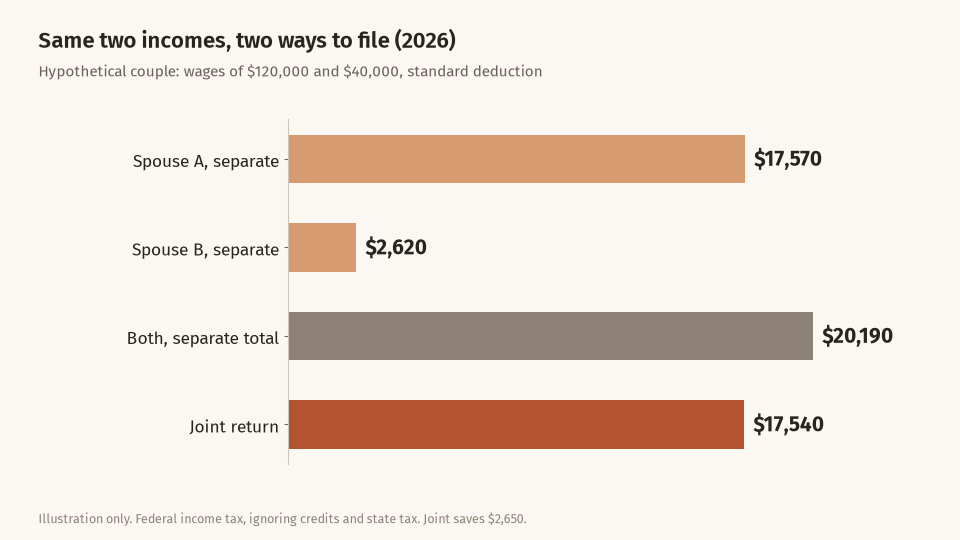
Illustration only. Priya earns $120,000 and Daniel earns $40,000, both from wages. We ignore credits, state tax and other income, and assume they use the standard deduction. We compare filing separately with filing jointly using the 2026 figures in Revenue Procedure 2025-32. We use the married filing separately brackets, which match the single brackets at these income levels.
Separate returns:
- Priya: $120,000 − $16,100 = $103,900 taxable. Tax = $1,240 + $4,560 (12% of $38,000) + $11,770 (22% of $53,500) = $17,570.
- Daniel: $40,000 − $16,100 = $23,900 taxable. Tax = $1,240 + $1,380 (12% of $11,500) = $2,620.
- Combined: $20,190.
Joint return:
- $160,000 − $32,200 = $127,800 taxable. Tax = $2,480 (10% of $24,800) + $9,120 (12% of $76,000) + $5,940 (22% of $27,000) = $17,540.
In this illustration the joint return costs $2,650 less. The result will differ with other incomes, credits, itemised deductions and state taxes. At very high incomes, the picture can change: for 2026 the 37% bracket starts at $640,600 for single filers but at $768,700 for joint filers, which is less than double.
Retirement accounts and spousal IRAs
Marriage can help a spouse with little or no income save for retirement. Under the Kay Bailey Hutchison Spousal IRA rule in Pub. 590-A, a couple filing jointly can contribute to the IRA of the lower-earning spouse based on their combined compensation. The 2026 IRA limit is $7,500, or $8,600 if the person is 50 or older. For Roth IRAs, the 2026 income phase-out is $242,000 to $252,000 for joint filers, but only $0 to $10,000 for married-filing-separately filers who lived together. Our Roth IRA guide explains the limits.
Insurance, beneficiaries and wills
Marriage does not automatically update the people named on your accounts. Moneysmart lists reviewing super beneficiaries, updating insurance policies to include your partner, and reviewing your will as part of its checklist. It also notes that getting married can revoke an existing will in Australia. The same review is sensible anywhere: check the beneficiaries on retirement accounts, life insurance and bank accounts, then confirm your will and any power of attorney still reflect your wishes. MoneyHelper notes that, without a power of attorney, a joint account could be frozen if one partner loses mental capacity.
| When | Task | Where |
|---|---|---|
| First weeks | Update name with SSA | SSA, then ID and employer |
| First weeks | Choose account setup | Your bank |
| Within 60 days | Marketplace health cover | HealthCare.gov |
| First 3 months | New Form W-4 | Employer and IRS estimator |
| First 3 months | Beneficiaries and will | Accounts, insurers, lawyer |
| First year | Compare joint and separate tax | Tax software or preparer |
The UK, Australia and the EU
| Region | Tax | Key action |
|---|---|---|
| US | Choose joint or separate each year | Update SSA, W-4, beneficiaries |
| UK | Individual tax; Marriage Allowance | Check allowance and credit links |
| Australia | Individual return; offsets change | Update ATO and Services Australia |
| EU | Set by each country | Check national rules |
United Kingdom
The UK taxes individuals, not couples. Married couples and civil partners can use Marriage Allowance, which lets one partner transfer £1,260 of their Personal Allowance to the other and cuts the other’s tax by up to £252 a year. To benefit, the lower earner usually has income below the Personal Allowance (usually £12,570) and the partner pays tax at the basic rate. You can backdate a claim to the 2022 to 2023 tax year. Assets given or sold between spouses do not usually trigger Capital Gains Tax, unless you separated and did not live together at all in that tax year. MoneyHelper also notes that prenups are not fully binding in England, Wales and Northern Ireland but courts take them into account, and are enforceable in Scotland.
Australia
Moneysmart notes that you still lodge an individual tax return, but your relationship status affects your entitlement to rebates and offsets and to government payments such as pensions and allowances. Its checklist includes updating your details with Services Australia and the ATO through myGov, updating your licence and passport if you change your name, and reviewing super beneficiaries, insurance and your will.
European Union
There is no single EU marriage-and-money rulebook. Tax, name changes and property ownership are set by each country, so check your own country’s rules. For couples with an international element, the European e-Justice Portal says EU rules apply in 18 EU countries and decide which country’s courts and law handle matrimonial property.

Common mistakes
- Not updating the Social Security record before filing. A name mismatch can delay a refund.
- Assuming withholding adjusts itself. Use the estimator and file a new W-4.
- Merging everything on day one. You can start with a joint account for bills and keep separate accounts.
- Ignoring joint liability. Joint accounts, loans and tax returns can make each of you responsible for the full amount.
- Only comparing filing status by feel. Figure the tax both ways, as the IRS suggests.
- Forgetting beneficiaries and wills. Review them after you marry.
- Missing the health insurance window. The Marketplace window is 60 days.
Frequently asked questions
Do I have to file taxes jointly after I get married?
No. If you are married on 31 December, you can file jointly or separately each year. The IRS suggests figuring the tax both ways.
Does marriage combine our credit scores?
No. The CFPB says credit scores are calculated on each person’s own history. Joint accounts and joint loan applications can still link you, because lenders look at both of your scores.
Is it better to have a joint account or separate accounts?
Neither is better for everyone. Many couples use a mix: a joint account for shared bills and separate accounts for personal spending. Remember each joint holder can be responsible for the whole debt.
How long do I have to add a spouse to health insurance?
On HealthCare.gov the Special Enrollment Period after marriage covers the past 60 days. Employer plans set their own deadlines, so ask HR.
Do I need to change my name with Social Security first?
If you change your name, tell the SSA first so your records match what goes on your tax return. Then update your ID, passport, employer and banks.
What happens in the UK if only one of us pays tax?
Marriage Allowance may help if the lower earner has income below the Personal Allowance and the partner pays basic-rate tax. Check the GOV.UK page for the current conditions.
This article is general education about money and marriage, with US federal tax details, not individual tax or legal advice. Rules and thresholds change and your situation is your own. Check the sources below, and consider talking to a qualified tax professional or adviser before making decisions. See our Editorial Policy and Disclaimer pages for how we work.
Sources
- IRS: Essential tax tips for marriage status changes
- IRS Publication 501 (2025): Dependents, Standard Deduction, and Filing Information
- IRS Revenue Procedure 2025-32 (2026 inflation adjustments)
- IRS: Tax Withholding Estimator
- IRS Publication 590-A: Contributions to Individual Retirement Arrangements (IRAs)
- IRS Notice 2025-67 (2026 retirement plan limits)
- Social Security Administration: How do I change or correct my name on my Social Security number card?
- HealthCare.gov: Special Enrollment Periods
- CFPB: If my spouse has a bad credit score, does it affect my credit score?
- GOV.UK: Marriage Allowance
- GOV.UK: Capital Gains Tax, gifts to your spouse or charity
- MoneyHelper: Should you manage money jointly or separately
- Moneysmart (ASIC): Marriage and money
- European e-Justice Portal: Matrimonial property regimes