

Last verified: October 2026. Limits and rules below were checked against the official sources listed at the end. All growth figures are hypothetical illustrations, not forecasts.
To start investing, do four things in order. First, deal with expensive debt and keep some cash for emergencies. Second, decide what the money is for and when you will need it. Third, pick an account that suits your country, such as a 401(k) or IRA in the US, a stocks and shares ISA or workplace pension in the UK, or super in Australia. Fourth, put money regularly into a low-cost, diversified fund rather than betting on single companies. You can begin with small amounts, and you do not need to predict the market.
Key takeaways
- Investments can fall as well as rise. MoneyHelper puts it bluntly: there is no such thing as a “no-risk” investment.
- Money you will need within a few years generally belongs in lower-risk places like savings. Moneysmart treats 0 to 2 years as short term and 5 years or more as long term.
- Diversification (spreading money across many investments) is the main way beginners manage risk. Funds do much of the work for you.
- Fees compound too. In our example, a 1.0% yearly fee left $45,976 less after 30 years than a 0.1% fee.
- Employer matching contributions are extra retirement money, so claim them if your plan offers them.
- Check every provider with your national regulator, and be wary of returns that look too good to be true.

Step 1: Get the foundations in place
Investing works best with money you will not need to sell at a bad moment. Two things usually come first.
Expensive debt. The Federal Reserve’s August 2026 G.19 release reports an average credit card rate of 22.36% on accounts that were charged interest. No investment can be counted on to earn that every year, and paying off a card with that rate gives you a guaranteed saving. How to rank your debts is covered in our guide to avalanche vs snowball. The point at which to start investing alongside debt repayment is a personal judgement call. For most people with high-rate card debt, clearing it first is the simpler order.
An emergency fund. MoneyHelper says that if you have enough in cash savings to cover at least three to six months, and you want your money to grow over the long term, you might consider investing some of it. Without a cushion, a car repair or job loss could force you to sell investments after a fall. See how much to keep in an emergency fund for how to size yours.
Step 2: Decide what the money is for
Moneysmart suggests writing down each goal, how much you need and how long you have, then sorting goals into short term (0 to 2 years), medium term (3 to 5 years) and long term (5 years or more). The time frame decides the kind of investment:
- Short-term goals suit lower-risk options such as a savings account, term deposit or government bonds, which are less likely to fall in value.
- Long-term goals can use higher-return investments such as shares and property. They carry more risk, but with years ahead you can wait out short-term falls.
MoneyHelper’s guide is aimed at savings goals more than five years away. If your goal is a house deposit in two years, the stock market is probably the wrong place for it.
Step 3: Understand risk before you meet it
The main types of investment
MoneyHelper and Moneysmart both describe four main asset classes:
- Shares (stocks): a stake in a company.
- Bonds (fixed interest): loans to governments or companies that pay interest.
- Property: buildings that can earn rent and grow in value.
- Cash: savings accounts and term deposits.
As a general rule, the higher the expected return, the higher the risk. Moneysmart’s example is that a government bond is a lower-risk investment, while the price of a share can move up and down a lot over a short time. Cash is low-risk in the sense that you are unlikely to lose it, but MoneyHelper notes that inflation can reduce what it buys over time.
How you would feel in a fall
Moneysmart suggests asking yourself how you would feel if you woke up and your investments had dropped 20%. If that would make you worry and withdraw your money, high-risk investments are not for you. This is worth taking seriously, because selling after a fall turns a temporary loss into a permanent one.
The maths of recovery is also harsher than it looks:
If $1,000 falls 20% to $800, you need $800 × 1.25 = $1,000, a 25% rise, to get back. A 50% fall needs a 100% rise.
Step 4: Diversify
Diversification means spreading your money so you are less dependent on any one investment. The SEC’s Investor.gov sums it up as “don’t put all your eggs in one basket”, and the FCA says it can smooth out the effects of one investment performing badly. Neither claims it removes risk: the FCA says it cannot totally eliminate risks.
Moneysmart lists four ways to diversify:
- Across asset classes (shares, bonds, property, cash).
- Within an asset class (for shares, companies in different industries and countries).
- Across countries.
- Through funds, which hold many investments in one product.
Asset allocation and rebalancing
How you split your money between asset classes is called asset allocation. Investor.gov says it is a personal decision that depends on your time horizon and risk tolerance, and that the mix that suits you changes over life. Over time, some investments grow faster than others. For example, a 60% share allocation could drift to 80% after market gains. Rebalancing brings it back, and Investor.gov says some experts suggest doing it at regular intervals, such as every six or twelve months, while it tends to work best when done relatively infrequently.
A target date fund, which Investor.gov describes, has the fund’s adviser handle rebalancing and typically becomes more conservative as the target date approaches. That can suit people who do not want to manage an allocation themselves.
Step 5: Choose simple, low-cost funds
What funds are
Mutual funds and exchange-traded funds (ETFs) both pool money from many investors and buy a range of stocks, bonds or other assets. The SEC’s bulletin notes that:
- Both can help you diversify, but some are narrower than others. Some even track a single stock, so check the top holdings of any fund.
- Mutual funds are bought from the fund at the end-of-day price. ETFs trade on an exchange at market prices throughout the day, and you need a brokerage account to buy them.
- Both charge fees whatever the fund’s performance.
- Inside a tax-advantaged account such as a 401(k) or IRA, there is no tax difference between an ETF and a mutual fund.
Moneysmart describes ETFs in the same way: managed funds you buy and sell on a stock exchange like a share, many of which track a market index. More on how ETFs work is in our ETFs explained guide.
Index funds
An index fund seeks to track the returns of a market index, such as the S&P 500. The SEC says index funds generally follow a passive style, which may mean lower costs than actively managed funds, though “not all index funds have lower costs”, and they can slightly underperform their index because of fees and tracking error. Always check the actual cost of any fund.
Costs: the number to look at
The expense ratio is the percentage of a fund’s average net assets used each year to pay its operating expenses, shown in the prospectus fee table. In the UK, MoneyHelper points to the Ongoing Charges Figure (OCF). In the EU, key information documents for packaged retail investment products must state costs in a document of no more than three pages.
Here is why that matters. Suppose you invest $300 a month for 30 years (you pay in $108,000) and your investments earn 6% a year before fees. We approximate a fee by subtracting it from the annual return:
| Yearly fee | Value after 30 years | Compared with no fee |
|---|---|---|
| None | $301,355 | n/a |
| 0.1% | $295,654 | $5,701 less |
| 0.5% | $274,084 | $27,271 less |
| 1.0% | $249,678 | $51,677 less |
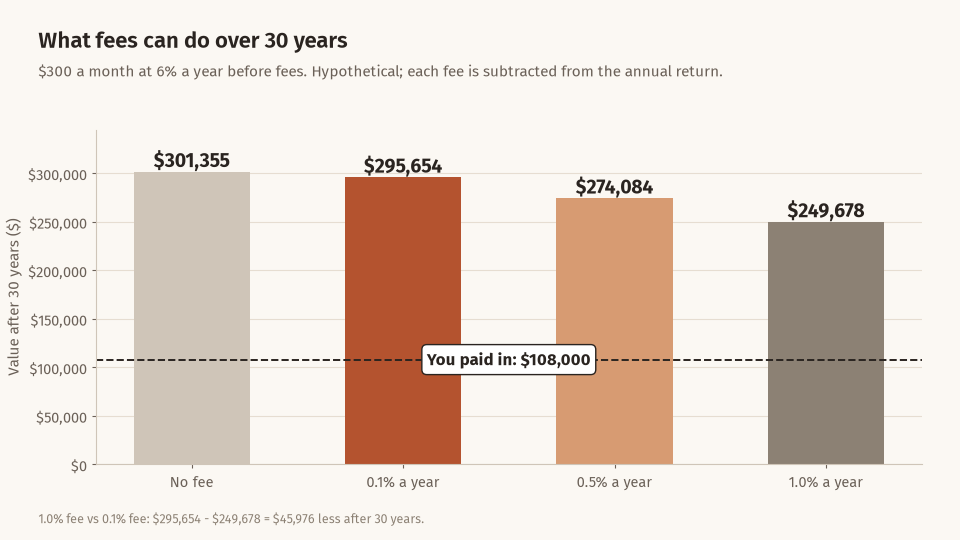
A single percentage point looks small, but it costs about 17% of the no-fee result here. Fees are one of the few parts of investing you can control.
Step 6: Let time and regular saving do the work
Compounding means earning returns on your earlier returns. Investor.gov defines compound interest as interest paid on principal and on accumulated interest. As a simple example, $1,000 at 6% a year for 10 years becomes $1,000 × 1.06¹⁰ = $1,790.85, compared with $1,600 if the 6% were only ever paid on the original $1,000. Our compound interest guide goes deeper.
Now add regular deposits. Here is $200 a month for 30 years (you pay in $72,000) at three hypothetical annual returns, compounded monthly:
| Hypothetical return | Value after 30 years | Growth on top of $72,000 |
|---|---|---|
| 4% | $138,810 | $66,810 |
| 6% | $200,903 | $128,903 |
| 8% | $298,072 | $226,072 |
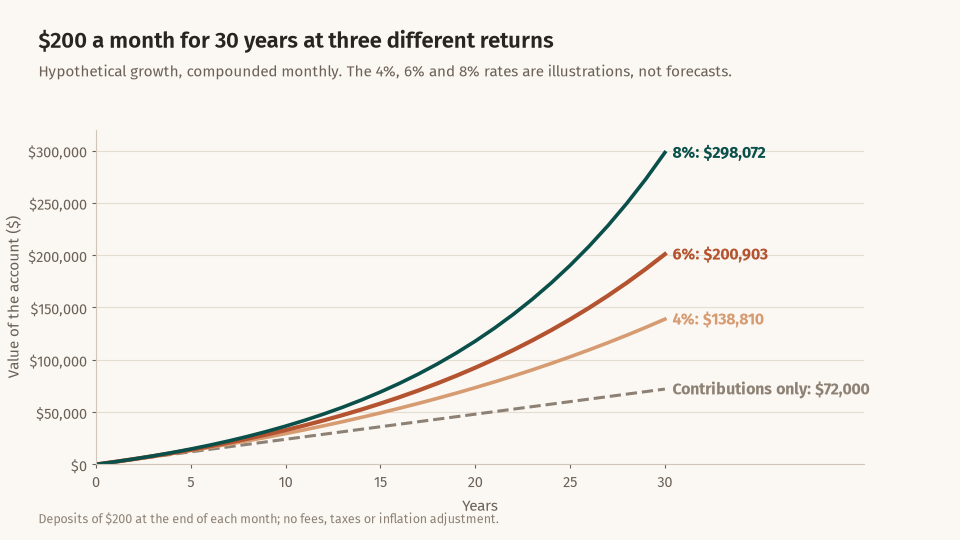
The lesson is the shape of the curve. Most of the growth comes in the later years, so starting earlier and keeping going matters more than the exact return you pick. Real markets do not move in a smooth line, and you may see losses along the way.
Step 7: Choose the right account for where you live
The account you use can matter as much as the investment. Limits change each year, so check the official page.
| Region | Account | Key figure (checked October 2026) |
|---|---|---|
| US | 401(k) and similar workplace plans | $24,500 employee limit for 2026; employer match depends on your plan |
| US | IRA (traditional or Roth) | $7,500 annual limit for 2026 |
| UK | Stocks and shares ISA | Up to £20,000 a year across ISAs; no tax on income or gains |
| UK | Workplace pension | Automatic enrolment minimum 8% (employer 3% + you 5%) of earnings between £6,240 and £50,270 |
| Australia | Super | Employers must pay at least 12% of ordinary time earnings |
| EU | Varies by country | Tax-advantaged accounts differ in each member state |
United States
- 401(k) and similar workplace plans. The IRS says the limit on employee contributions is $24,500 for 2026. Many plans include an employer match, and the IRS calls this free money you may walk away from if you do not contribute. In its example, a plan matches 50% of your contributions up to 5% of salary. On a $30,000 salary, contributing $1,200 earns $600 from your employer, and contributing $2,000 earns $750, not $1,000, because the match is capped at 5% of salary ($1,500 × 50%). Check your plan document for the real formula and any waiting period.
- IRAs. The annual limit is $7,500 for 2026, with income limits that affect deductibility and Roth eligibility. See 401(k) vs IRA and Roth IRA for the differences.
- Brokerage protection. If a SIPC-member brokerage fails, SIPC may protect up to $500,000, including $250,000 for cash. It does not protect against falls in market value.
United Kingdom
- Stocks and shares ISA. You can save up to £20,000 per tax year (6 April to 5 April) across your ISAs, and GOV.UK says you pay no tax on income or capital gains from investments in an ISA. A Lifetime ISA, if you use one, has a £4,000 yearly maximum within that allowance.
- Workplace pension. In most automatic enrolment schemes, the legal minimum is 3% from your employer and 5% from you, 8% in total, on earnings between £6,240 and £50,270. For someone earning £30,000, that band is £30,000 − £6,240 = £23,760. Employer 3% is £712.80 and employee 5% is £1,188.00, for £1,900.80 in total. Your scheme may require more, and tax relief is usually added if you pay Income Tax.
- Check the firm. MoneyHelper suggests using the FCA Firm Checker before investing and seeking regulated advice if you are considering an offer.
European Union
Rules, tax-advantaged accounts and regulators differ by country, so there is no single EU account. What is common is the PRIIPs Regulation, which requires a key information document of no more than three pages for packaged retail investment products. It must include a summary risk indicator, the possible maximum loss of invested capital, performance scenarios and costs. Use this to compare products, and use your national financial regulator’s website to check a firm.
Australia
- Superannuation. The ATO says the super guarantee rate is 12% of ordinary time earnings from 1 July 2025. For example, on $70,000 of ordinary time earnings, 12% is $8,400 a year paid by the employer (subject to the rules and caps in the ATO guidance). Many people’s super is already invested in a diversified mix, which Moneysmart notes is a good example of diversification. Check your fund’s investment options.
- Outside super. ETFs, managed funds and shares are available, and Moneysmart notes that an ETF tracking the S&P/ASX 200 gives exposure to the largest 200 Australian companies, and that investing overseas diversifies by country but adds currency risk.

A simple starting plan
This is general education and not a recommendation. A common beginner outline looks like this:
- Clear high-rate debt and build a cash cushion.
- Write your goals with amounts and dates.
- Claim any employer match or mandatory employer contribution.
- Choose a broad, low-cost fund (or a target date or diversified fund) that fits your time horizon.
- Automate a regular amount, even a small one, so that you invest through ups and downs.
- Review once or twice a year, rebalance if needed and avoid reacting to every headline.
Avoiding scams
MoneyHelper advises avoiding unsolicited investment offers and checking firms on the FCA Firm Checker. Moneysmart says that if returns look too good to be true, it could be an investment scam, and that high returns with low risk do not exist. Be suspicious of anyone who guarantees returns, pressures you to act quickly or asks you to move money to an unfamiliar platform.
Common mistakes
- Investing money you will need soon. A short time horizon and stocks are a bad mix.
- Putting everything in one company or sector. A single collapse could cost you most of your money, as Moneysmart warns.
- Ignoring fees. The difference between a 0.1% and 1.0% fee was $45,976 in our example.
- Skipping the employer match. It is money you would not otherwise receive.
- Panic selling after a fall. The recovery maths is simple: a 20% fall needs a 25% gain to get back to where you started, which is one reason staying invested matters, though only you can judge what risk you can bear.
- Chasing last year’s winner. A fund that did well recently may not do so again.
- Using borrowed money to invest. Moneysmart notes this can magnify your losses.
Frequently asked questions
How much money do I need to start investing?
There is no single minimum. The SEC says some mutual funds set relatively low dollar amounts to buy shares and ETF shares can often be purchased for relatively low dollar amounts. Check your provider for any minimums and fees.
Should I buy individual stocks or funds?
Funds spread your money across many companies, which is why the FCA and Moneysmart point to them as a simple way to diversify. Individual shares carry company-specific risk. Just remember some funds are narrow, so look at what is inside.
How much will my investments grow?
Nobody knows. Our 4%, 6% and 8% figures are examples to show how compounding and time work, not predictions. Returns vary from year to year and you can lose money.
Should I pay off debt or invest first?
It depends on the interest rate and your situation. With a card charging an average 22.36%, many people find paying the card off is simpler and certain, but this is a judgement call, not an official rule. If your employer matches contributions, it is worth considering getting the match while paying down debt. See our debt payoff guide.
Do I need a financial adviser?
Not necessarily to start, but Moneysmart notes an adviser can help you work out your risk tolerance, set goals and choose investments, and MoneyHelper says to seek regulated advice if you are considering an investment offer. Check the adviser’s authorisation with your national regulator.
Is investing the same as saving?
No. Savings are usually kept in cash accounts where the main risk is that inflation reduces what the money buys. Investments can grow more over long periods but can also fall in value. See the emergency fund guide for where short-term money belongs.
This article is general information, not financial advice, and does not recommend any product. All returns shown are hypothetical. Rules, limits and tax treatment change and depend on your circumstances, so check the official sources below and consider regulated advice for your own decisions. See our Editorial Policy and Disclaimer pages for how we research and update articles. Last verified: October 2026.
Sources
- IRS: 401(k) limit increases to $24,500 for 2026, IRA limit increases to $7,500
- IRS: Matching contributions help you save more for retirement
- Investor.gov (SEC): Asset allocation and diversification
- Investor.gov (SEC): Characteristics of mutual funds and ETFs
- Investor.gov (SEC): Investor Bulletin: Index funds
- Investor.gov (SEC): Expense ratio
- Investor.gov (SEC): Compound interest
- Investor.gov (SEC): Securities Investor Protection Corporation (SIPC)
- Federal Reserve: Consumer Credit, G.19 (August 2026 release)
- GOV.UK: How ISAs work
- GOV.UK: Workplace pensions: what you, your employer and the government pay
- MoneyHelper: A beginner’s guide to investing
- FCA InvestSmart: Diversification
- Moneysmart (ASIC): Develop an investing plan
- Moneysmart (ASIC): Investment diversification
- ATO: How much quarterly super to pay
- European Commission: Key information documents for PRIIPs