

Last verified: October 2026. The worked examples below were recalculated, and the official figures quoted were checked against the sources listed at the end of the article.
Compound interest is interest you earn on your original money and on the interest that has already been added. Each time interest is added, the next calculation starts from a bigger balance, so growth speeds up over time. The same effect works against you on debt, where interest can be added to what you owe.
This guide shows the formula, walks through one example you can check with a calculator, and explains the Rule of 72 shortcut, how often interest is added, and why starting early matters.
Key takeaways
- Compound interest means interest on interest. Simple interest only applies to your starting amount (Moneysmart).
- The formula is A = P × (1 + r/n)^(n×t). You need the starting amount, the annual rate, how often interest is added and the number of years.
- Time matters more than most people expect. In the illustration below, $200 a month started at 25 ends up at about four times the amount from starting at 45.
- The Rule of 72 is a rough doubling estimate: divide 72 by the annual rate.
- It works on debt too. The CFPB says some credit card interest compounds daily.
What compound interest is
When you put money into a savings account, super or investments, Moneysmart explains, the balance can grow over time. With compound interest you earn on two things: your starting balance (the principal) and the interest you have already earned. That is what people mean by “interest on interest”.
Simple interest is different. It only applies to your starting amount. Moneysmart notes that some term deposits use simple interest, so it is worth checking which one you are being offered.
The SEC’s Investor.gov site gives the cleanest small example. If you have $100 and it earns 5% a year, you have $105 at the end of year one. In year two you earn 5% on $105, not on $100, so you finish with $110.25. You earned $5 on your original $100 and an extra $0.25 on the first year’s interest. That 25 cents looks trivial, but it is the start of the whole effect.
The compound interest formula
The standard formula, which Moneysmart sets out, is:
A = P × (1 + r/n)^(n × t)
- A is the ending balance.
- P is the starting balance (the principal).
- r is the annual interest rate as a decimal. 5% is 0.05.
- n is how many times a year interest is added: annually is 1, monthly is 12, daily is 365.
- t is the number of years.
In plain terms: work out the rate for each period (r divided by n), work out how many periods there are (n times t), then multiply your starting amount by (1 + the period rate) that many times.
Adding money regularly
Most people do not make one deposit and walk away. If you add the same amount every month and interest is added monthly, a standard version of the formula is:
A = PMT × ((1 + i)^N − 1) / i
where PMT is your monthly amount, i is the annual rate divided by 12 (as a decimal), and N is the number of months. If you also have a starting balance, add P × (1 + i)^N. This is the maths behind the chart further down. If you would rather not do it by hand, both the SEC and Moneysmart publish free calculators (linked in the sources) that include regular deposits.

A worked example, step by step
This is an illustration with an assumed rate. It is not a forecast and not a current offer. Say you put $5,000 in an account that pays 4% a year, with interest added monthly, and you leave it for 3 years.
- Rate for each period: 0.04 ÷ 12 = 0.003333.
- Number of periods: 3 years × 12 months = 36.
- Growth factor: (1 + 0.003333)^36 = 1.12727.
- Ending balance: $5,000 × 1.12727 = $5,636.36.
- Interest earned: $5,636.36 − $5,000 = $636.36.
For comparison, simple interest on the same $5,000 at 4% for 3 years would be $5,000 × 0.04 × 3 = $600, so you would finish with $5,600. Compounding adds $36.36 here. Over three years the difference is small, because both time and the rate are modest. It gets much larger over decades.
Moneysmart’s own worked example uses the same steps: $2,000 at 5% for 2 years, compounded monthly, comes to $2,209.88.
How much does time change the result?
Simple vs compound over 30 years
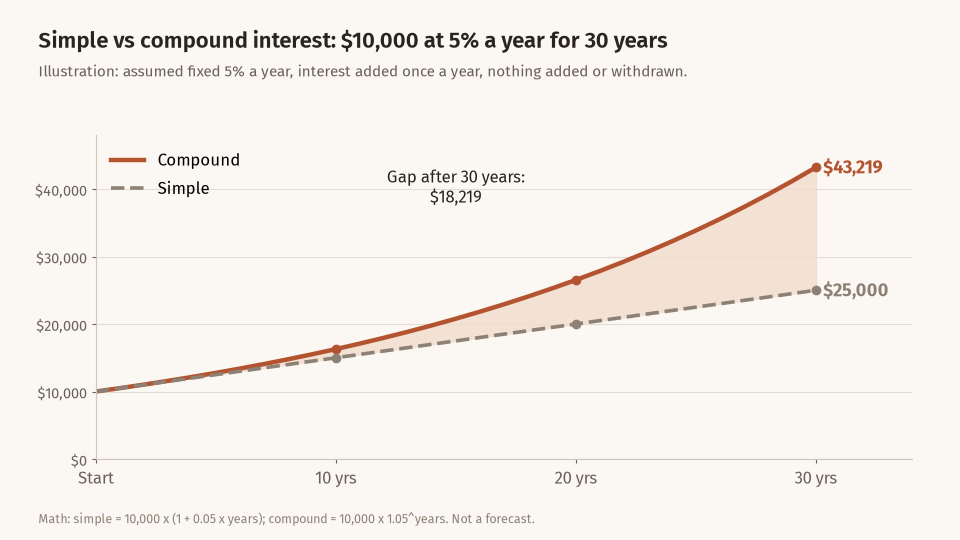
Here is the same idea stretched out. Assume $10,000 at a fixed 5% a year for 30 years, with interest added once a year and nothing else added or withdrawn.
| After | Simple interest | Compound interest |
|---|---|---|
| 10 years | $15,000 | $16,289 |
| 20 years | $20,000 | $26,533 |
| 30 years | $25,000 | $43,219 |
Simple interest adds the same $500 every year. Compound interest adds $500 in year one, about $525 in year two, and by year 30 it is adding more than $2,000 a year. The gap after 30 years is $18,219 ($43,219 − $25,000).
The SEC makes a similar point with its own classroom example: $730 (the cost of a $2 pizza slice every day for a year) saved and invested at 5% grows to $931.69 after 5 years and $3,155.02 after 30 years.
Starting earlier vs later
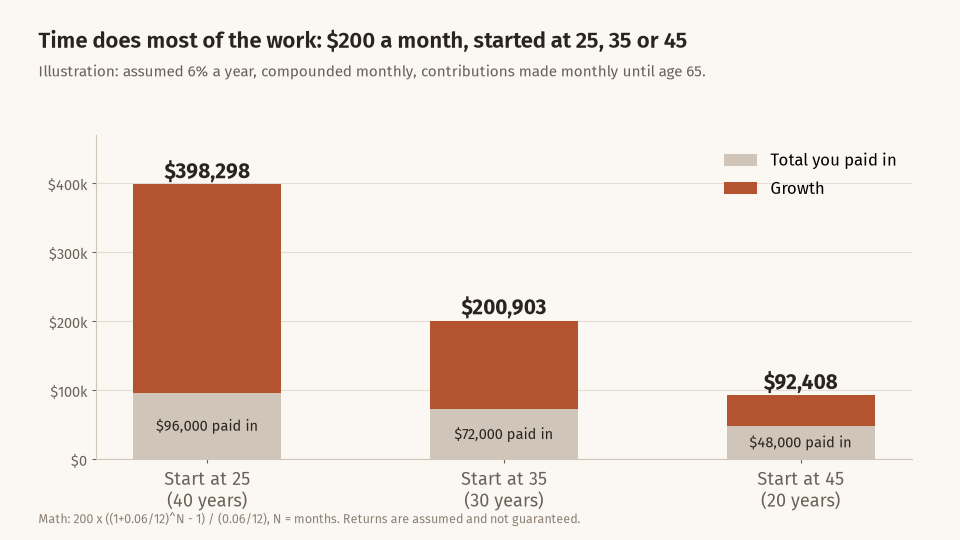
The next illustration adds regular saving. Assume you put in $200 a month and earn an assumed 6% a year, with interest added monthly, until age 65. The only thing that changes is when you start.
| Start age | Years saving | Total paid in | Balance at 65 |
|---|---|---|---|
| 25 | 40 | $96,000 | $398,298 |
| 35 | 30 | $72,000 | $200,903 |
| 45 | 20 | $48,000 | $92,408 |
Starting at 25 means paying in twice as much as starting at 45 ($96,000 against $48,000), yet the ending balance is more than four times larger. Most of the difference is the extra growth on early money, not the extra deposits. Real returns are not fixed, and a bank savings rate is not the same thing as an investment return, so use this as a picture of the mechanism rather than a prediction. If you are working out a target, our guide to how much to save for retirement covers that, and 401(k) vs IRA explains the common US accounts.
How often interest is added
The “n” in the formula matters, but less than the rate and the time. Using $10,000 at 5% for 10 years as an illustration:
| Interest added | Balance after 10 years |
|---|---|
| Once a year | $16,289 |
| Monthly | $16,470 |
| Daily | $16,487 |
Going from yearly to monthly adds about $181 here; going from monthly to daily adds only about $17 more. Moneysmart shows the same effect in a smaller case: $10,000 at 5% for 5 years is $12,834 with monthly compounding, against $12,500 if the interest is only paid at the end of the term. When you compare accounts, a higher stated rate usually matters more than a more frequent calculation. Check how a provider states its rate and when interest is paid.
The Rule of 72
The Rule of 72 is a quick way to estimate how long money takes to double. Investor.gov describes it this way: divide 72 by the expected annual rate of return. At 9%, 72 ÷ 9 = 8, so the money doubles in about 8 years.
It is an estimate, not an exact answer. Here it is next to the exact figure for interest added once a year:
| Annual rate | Rule of 72 (72 / rate) | Exact (interest added yearly) |
|---|---|---|
| 2% | 36.0 years | 35.0 years |
| 4% | 18.0 years | 17.7 years |
| 6% | 12.0 years | 11.9 years |
| 8% | 9.0 years | 9.0 years |
| 10% | 7.2 years | 7.3 years |
| 12% | 6.0 years | 6.1 years |
The rule is close for rates between about 4% and 12%, and it drifts at the low end (36 years against 35.0 at 2%). It also works backwards: if you want money to double in 12 years, you need about 6% (72 ÷ 12).
Compound interest on debt
Compounding does not care whether you are the saver or the borrower. MoneyHelper notes that when you borrow, you repay the amount borrowed plus interest, and that APR combines the interest rate with fees automatically included in the loan.
For credit cards, the CFPB explains that some issuers use a daily periodic rate, generally the APR divided by 360 or 365 depending on the issuer. Each day’s interest is added to the previous day’s balance, “which means that interest is compounding on a daily basis”.
As an illustration: a $1,000 balance at a 20% APR with no payments and no new purchases, using a 365-day year, grows to $1,000 × (1 + 0.20/365)^365 = about $1,221 after a year, not $1,200. Real cards differ in how they calculate balances and in minimum payment rules, so read your own agreement. The practical point is that carrying a balance is the mirror image of saving: time is working against you. That is why our guide to avalanche vs snowball debt payoff starts with the balances charging the most.
Taxes and fees take a bite
A stated interest rate is not the same as what you keep. In the UK, GOV.UK says interest from bank, building society, savings and credit union accounts can be taxable, while interest in ISAs and some National Savings and Investments products is not usually taxed. HMRC adds up the interest from all your savings accounts. Rules in the US, Australia and elsewhere differ, so check your local tax authority. Fees on investments also reduce growth in the same compounding way; our guide to how to start investing covers costs for beginners.
Common mistakes
- Waiting for the “right” time to start. The charts above are the cost of waiting, under assumed returns.
- Treating illustrative returns as promises. A savings account rate can change, and investment returns vary from year to year. MoneyHelper notes that savings interest can differ if rates or balances change.
- Ignoring inflation, tax and fees when you compare a headline rate.
- Comparing rates on different bases. A rate with interest added monthly and one added yearly are not directly comparable until you work out the result.
- Letting cash sit with no emergency buffer, then selling investments at a bad time. A small emergency fund protects the long-term money.
- Forgetting that debt compounds too, especially revolving credit.
Frequently asked questions
What is the difference between simple and compound interest?
Simple interest is calculated only on your starting amount. Compound interest is calculated on the starting amount plus any interest already added, so you earn interest on interest (Moneysmart).
What is the compound interest formula?
A = P × (1 + r/n)^(n×t), where A is the ending balance, P the starting amount, r the annual rate as a decimal, n the number of times interest is added per year and t the number of years.
How do I calculate compound interest with monthly deposits?
Use the monthly-deposit version: A = PMT × ((1 + i)^N − 1) / i, with i as the annual rate divided by 12 and N as the number of months, and add P × (1 + i)^N for any starting balance. Alternatively, use the free SEC or Moneysmart calculators.
Does daily compounding beat monthly compounding by a lot?
Not usually. In the $10,000, 5%, 10-year illustration, daily compounding finishes about $17 ahead of monthly. The rate and the time have far more influence.
What does the Rule of 72 tell me?
It estimates how many years it takes money to double: 72 divided by the annual rate. At 6%, about 12 years. It is a shortcut, and it is less accurate at very low or very high rates.
Is compound interest the same as the return on shares?
No. A savings account usually states an interest rate. Share and fund returns are not fixed and can be negative in some years. The compounding idea still applies when gains stay invested, but the numbers in this article use assumed rates for illustration.
This article is general information, not financial advice. Rules, limits and rates change, and your circumstances are your own. All investment figures here are illustrations with assumed returns. Check the official sources below, and consider speaking to a qualified adviser before making decisions. See our Editorial Policy and Disclaimer pages. Last verified: October 2026.
Sources
- Moneysmart (ASIC): Compound interest
- Moneysmart (ASIC): Compound interest calculator
- SEC Investor.gov: What is compound interest? (classroom resource, includes the Rule of 72)
- SEC Investor.gov: Compound interest calculator
- CFPB: What is a “daily periodic rate” on a credit card?
- MoneyHelper: Interest rates explained
- GOV.UK: Tax on savings interest