
Last verified: October 2026. Figures and rules below were checked against the official sources listed at the end of the article.
An exchange-traded fund, or ETF, is a fund that holds a basket of investments and trades on a stock exchange like a single share. You buy one share (or unit), and you own a slice of everything the fund holds. ETFs are popular because they give you broad diversification in one trade, and many have low annual fees. They are still investments: their value goes up and down, and costs beyond the headline fee can add up.
This guide explains how ETFs work, how they differ from mutual funds, what they cost, the risks, and how to get started in the US, UK and Australia.
Key takeaways
- An ETF pools investors’ money into a portfolio and you buy shares of it on an exchange at the market price, during trading hours.
- Many ETFs track an index, but some are actively managed. Read what the fund actually holds and aims to do.
- The expense ratio is not the only cost. Brokerage commissions, the bid-ask spread and premiums or discounts to net asset value (NAV) also matter.
- You can lose money. Moneysmart lists market, sector, currency, liquidity, inflation, interest rate, credit, complex strategy and manager risk.
- Check the fund’s own documents (prospectus or product disclosure statement and website) before you buy.
What an ETF is
The US Securities and Exchange Commission (SEC) describes an ETF as a type of exchange-traded investment product that pools money in a fund investing in stocks, bonds, other assets, or a combination. Each share represents your proportionate ownership of the fund’s portfolio and the income it generates. In Australia, Moneysmart describes ETFs as managed funds that trade on a stock exchange. You own units in the fund, not the underlying investments themselves.
ETFs can hold shares, bonds, property, commodities, currencies and crypto-assets. A broad share-market ETF might hold hundreds of companies, so one trade spreads your money across all of them. That is the diversification benefit Moneysmart and the SEC both describe.
Index ETFs and active ETFs
The SEC says ETFs can be index-based or actively managed. An index-based ETF tries to match the returns of an index. An actively managed ETF’s adviser buys and sells holdings without trying to match an index, within the fund’s stated objective. Moneysmart says most ETFs in Australia are passive, aiming to track an index or asset, while active ETFs have a manager choosing investments.
How ETFs differ from mutual funds
| ETF | Mutual fund | |
|---|---|---|
| How you buy | On an exchange through a broker, at a market price that moves during the day | Directly from the fund company (the SEC says ETFs, unlike mutual funds, do not sell or redeem shares directly to retail investors) |
| Price | Market price through the trading day, which can sit above or below NAV | Not traded on a stock exchange the way ETFs are (SEC) |
| Typical annual costs | The SEC says ETFs have tended to be cheaper to run than mutual funds that invest in a similar way | Can include 12b-1 and other fees (the SEC says 12b-1 fees typically apply to mutual funds, not ETFs) |
| Other costs | Brokerage commission, bid-ask spread | Some funds charge sales loads and other shareholder fees |
How ETFs work behind the scenes
You never deal with the fund directly. The SEC explains that ETF sponsors contract with financial institutions called authorized participants, typically large broker-dealers. Only they buy and redeem shares directly with the ETF, and only in large blocks called creation units (for example 50,000 shares), usually exchanging a basket of securities that mirrors the fund’s portfolio.
- Creating shares. An authorized participant deposits the designated basket with the ETF and receives ETF shares, which it can sell on an exchange.
- Redeeming shares. The process in reverse: the participant buys a block of shares on the market, delivers it to the fund, and receives the underlying securities or their cash equivalent.
- You trade on the exchange, with other investors, at market prices.
This structure also helps keep the price close to the fund’s value. The SEC says an ETF’s market price may be a little above or below its end-of-day NAV per share, but the arbitrage that authorized participants can carry out generally keeps the market price close to NAV.
What ETFs cost
The SEC’s fee bulletin points out that fees reduce your returns, and that a fund with higher costs must perform better than a lower-cost fund to generate the same return. For an ETF the costs fall into several layers.
- Expense ratio. This is the fund’s total annual operating expenses as a percentage of average net assets. It includes the management fee and other expenses, and it is paid out of fund assets, so you do not receive a separate bill. It is in the prospectus fee table.
- Brokerage commission. Your broker may charge a fee each time you buy or sell. The SEC notes that with a flat fee, the smaller the trade, the larger the percentage cost.
- Bid-ask spread. ETFs have a price at which you can buy (the ask) and a price at which you can sell (the bid). The SEC’s example: a share trading at $59.50 bid and $60 ask. If you buy 200 shares at $60 and sell them straight away at $59.50, you lose $100. Heavily traded ETFs tend to have tighter spreads.
- Premium or discount to NAV. The SEC describes this as a potential cost but also a potential gain: you may pay more or less than NAV when you buy and receive more or less when you sell.
- Costs outside the expense ratio. The SEC notes that things like securities lending and the fund’s own trading costs are not in the expense ratio.
| Cost | What it is | Where to find it |
|---|---|---|
| Expense ratio | Annual operating costs, paid out of fund assets | Prospectus fee table or fund website |
| Brokerage commission | Charged by your broker when you buy or sell | Your broker’s fee schedule |
| Bid-ask spread | Gap between the buying and selling price | Fund website (median spread) |
| Premium or discount | Market price above or below NAV | Fund website, as of last close |
A worked example: why a small fee matters
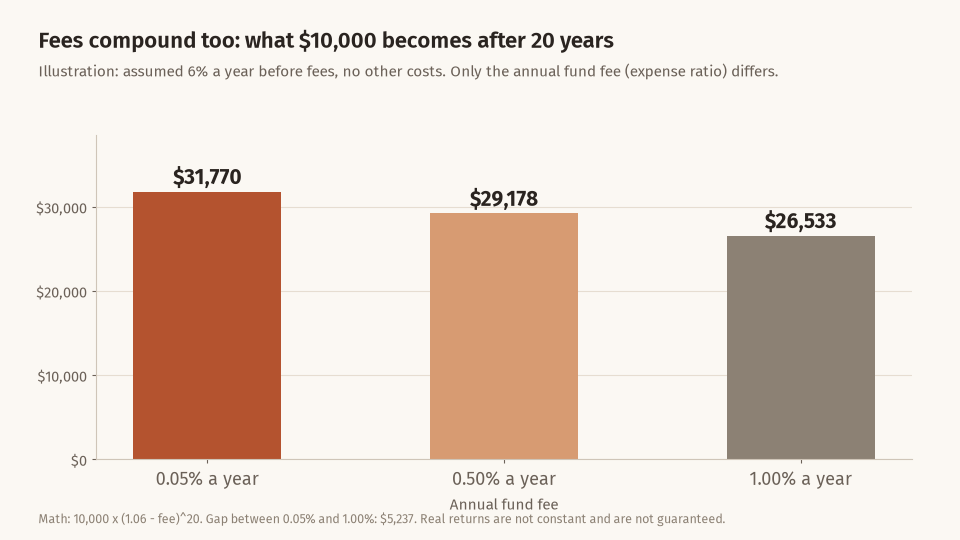
Here is an illustration, not a forecast. Assume you invest $10,000 and the investments earn 6% a year before fees, for 20 years, with no other costs. Only the expense ratio differs:
| Annual fee | Value after 20 years | Difference from the lowest-fee fund |
|---|---|---|
| 0.05% | $31,770 | n/a |
| 0.50% | $29,178 | −$2,592 |
| 1.00% | $26,533 | −$5,237 |
The maths is $10,000 × (1.06 − fee)^20. The gap between the 0.05% and 1.00% fund is $31,770 − $26,533 = $5,237, on the same underlying returns. The returns here are assumed, not promised, but the principle holds: a higher fee gets deducted every year, and each year’s deduction no longer grows for you. Compare expense ratios for funds that invest in a similar way. The SEC points to the FINRA Fund Analyzer for comparing fees and expenses.
The risks
Moneysmart lists the main risks of ETFs. Not every ETF has every risk, and they depend on what the fund holds and how it is run.
- Market risk. The assets in the fund can fall because of events affecting the entire market. You can lose money if the value of the underlying assets falls.
- Sector risk. A fund focused on one sector, country or theme can be hit by events in that area.
- Currency risk. Overseas investments can be affected by exchange rates.
- Liquidity risk. An ETF can be harder or costlier to trade if its underlying assets are hard to sell. The SEC adds that there is a risk a trading market may not develop at all.
- Inflation risk. Returns may not keep up with rising prices.
- Interest rate and credit risk. These mainly affect bond funds.
- Complex strategy risk. If a fund borrows to invest, uses derivatives or short sells, gains and losses can be magnified.
- Manager risk. The manager may make poor decisions.
- Counterparty risk (synthetic ETFs). Moneysmart says synthetic ETFs use derivatives to copy an index and add the risk that the counterparty to the derivative fails.
Diversification does not remove market risk. A broad ETF can still fall sharply when the whole market falls. Moneysmart says ETFs may not suit you if you need your money back at short notice or you are not comfortable with the risk of losses.

How to get started
- Know the goal and the timeframe. Our beginner guide to how to start investing covers the basics. Keep your emergency fund separate so you do not have to sell investments at a bad time.
- Choose the account. The type of account affects tax. In the US, our guide to 401(k) vs IRA explains the main retirement accounts. In the UK, MoneyHelper says ETFs can be held inside a stocks and shares ISA, where growth and income are free of Income Tax and Capital Gains Tax, within the £20,000 allowance for the 2026 to 2027 tax year. In Australia, you buy units through a broker or investment platform, and may pay brokerage.
- Read the fund’s documents. The SEC recommends reading the prospectus and visiting the ETF’s website for NAV, closing market price, premiums and discounts, holdings and the median bid-ask spread. In Australia, the product disclosure statement (PDS) explains the goal and strategy.
- Compare costs for like-for-like funds. Look at the expense ratio, your broker’s commissions, and the spread.
- Place the trade. In Australia, trades settle two business days after the trade (T+2), according to Moneysmart. In the US and UK, check your broker’s settlement information.
Tax notes
The SEC says ETFs can be tax efficient because many buy and sell portfolio securities in in-kind exchanges, which typically means fewer capital gain distributions than mutual funds. The tax you pay still depends on your country, account type and how long you hold. Our guide to how much to save for retirement puts investment accounts in the wider savings picture.
Common mistakes
- Judging an ETF by its name. Funds with similar names can hold quite different things. Check the holdings and the objective.
- Ignoring all costs except the expense ratio. With a flat commission, small trades cost a larger percentage (SEC).
- Ignoring trading volume. The SEC says ETFs with higher trading volume typically have tighter spreads.
- Buying complex or leveraged funds without understanding them. Moneysmart says complex strategies can magnify both gains and losses.
- Concentrating in one sector or theme and calling it diversified.
- Selling in a panic. If you need the money soon, it probably should not be in a share-market fund.
Frequently asked questions
Is an ETF the same as an index fund?
Not exactly. Many ETFs track an index, which is why people call them index funds, but the SEC says ETFs can also be actively managed. “Index fund” can also refer to an index mutual fund, which is not traded on an exchange.
Can I lose money in an ETF?
Yes. Moneysmart says the value of an ETF can go up or down and you can lose money if the value of the underlying assets falls. Fees and trading costs also affect your return.
What is NAV, and why does it matter?
NAV, or net asset value, is the value of all the fund’s assets minus its liabilities, divided by the number of shares. The SEC says ETFs calculate it every business day. The market price can be above NAV (a premium) or below (a discount). It is usually close, but check before large trades.
Do ETFs pay dividends?
ETF shares represent your proportionate share of the income the portfolio generates, according to the SEC. How and when that income is paid depends on the fund, so check the fund’s documents.
Can I hold ETFs in a retirement or tax-advantaged account?
Often yes, though it depends on your country and provider. In the UK, MoneyHelper says ETFs can be held in a stocks and shares ISA. In the US, check which funds your retirement account or broker allows.
Are ETFs safe?
No investment is risk-free. Moneysmart lists market, sector, currency, liquidity and other risks. In the UK, MoneyHelper notes that compensation schemes do not cover a fall in the value of your investments.
This article is general information, not financial advice. Rules, limits and rates change, and your circumstances are your own. Investments can fall as well as rise. Check the official sources below, and consider speaking to a qualified adviser before making decisions. See our Editorial Policy and Disclaimer pages. Last verified: October 2026.
Sources
- SEC Investor.gov: Updated Investor Bulletin: Exchange-Traded Funds (ETFs)
- SEC Investor.gov: Mutual Fund and ETF Fees and Expenses (Investor Bulletin)
- Moneysmart (ASIC): Exchange traded funds (ETFs)
- MoneyHelper: Stocks and shares ISAs
- GOV.UK: Individual Savings Accounts (ISAs)