
Last verified: October 2026. Figures and rules below were checked against the official sources listed at the end of the article.
A credit score is a number that lenders use to estimate how likely you are to repay what you borrow. It is worked out from your credit report, which is the record of your accounts and payments. Paying on time and using only a small part of your available credit matter most. Everything else, such as how long you have had credit and how often you apply, plays a smaller part. You can raise your score steadily by fixing errors, paying every bill on time, paying down card balances and applying for new credit sparingly.
This guide explains what goes into a score, how long negative items stay on file, and what to do, with the rules for the US, UK, EU and Australia.
Key takeaways
- Your credit report is the record. Your credit score is a number calculated from it. You can have several scores, and lenders set their own rules.
- In FICO’s published model, payment history (35%) and amounts owed (30%) make up about two-thirds of a score. The weights can vary from person to person.
- Accurate negative items cannot be removed early. They fall off with time: generally 7 years in the US, up to 6 in the UK, and 5 for most Australian defaults.
- Wrong information can be fixed for free. Check your reports, then dispute anything incorrect.
- Do not pay a “credit repair” company to do what you can do yourself.
- Improvement is steady, not instant. Nobody can promise a specific score by a specific date.

Credit report vs credit score
The two get mixed up, so it helps to separate them.
- A credit report lists the credit accounts you have, your repayment history, applications, and public records such as insolvencies. In the UK, MoneyHelper says your report does not carry other personal information such as salary, religion or any criminal record.
- A credit score is a number based on that report. The US Consumer Financial Protection Bureau (CFPB) describes it as a prediction of your credit behaviour, such as how likely you are to pay a loan back on time. Lenders also use scores for tenant screening and insurance, and to set interest rates and credit limits.
You do not have one single score. The CFPB says each score depends on the data used, the scoring model (which can depend on the type of loan) and even the day it was calculated. In the UK, MoneyHelper adds that having a high score does not guarantee that a particular lender will offer you credit, because each firm uses its own criteria.
Score ranges
- US: the CFPB says most credit scores range from 300 to 850.
- Australia: Moneysmart says that, depending on the credit reporting agency, your score will be between zero and either 1,000 or 1,200. Your report also shows a “band” such as low, fair, good, very good or excellent.
- UK: there is no single scale to quote. Free score tools link to different agencies, and the numbers they give will differ. MoneyHelper says a score is “a general indication”, so use it to track your own direction rather than compare it with a friend’s.
- EU: credit scoring and registers vary by country, so the ranges and the agencies depend on where you live.
What goes into a credit score
United States
The CFPB lists the factors that scoring models typically take into account: your bill-paying history, your current unpaid debt, the number and type of accounts you have, how long you have had them, how much of your available credit you use, new applications for credit, and whether you have had a debt sent to collection, a foreclosure or a bankruptcy.
FICO, the best-known scoring company, publishes how it weights five categories:
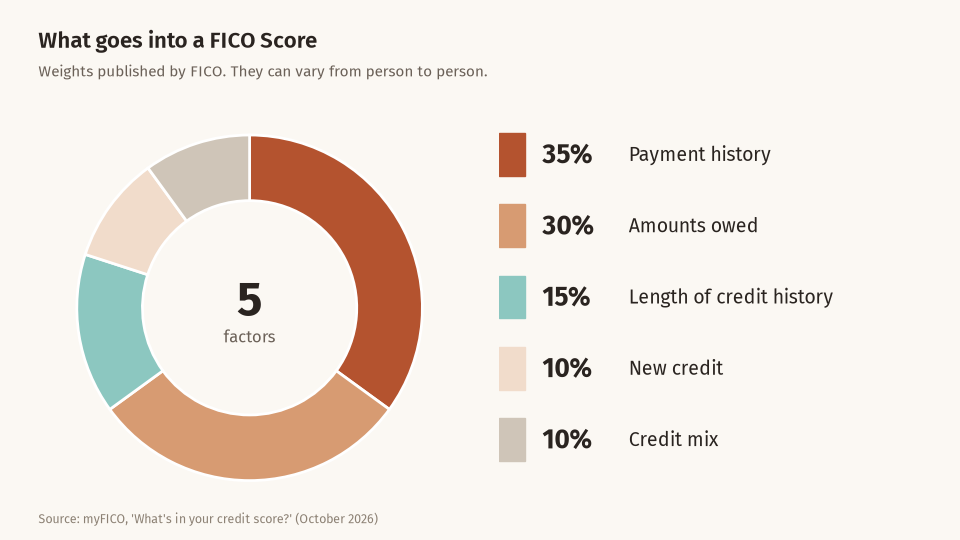
| Factor | Weight | What it looks at |
|---|---|---|
| Payment history | 35% | Whether you have paid past accounts on time |
| Amounts owed | 30% | How much you owe and how much of your available credit you are using |
| Length of credit history | 15% | Age of your oldest account, newest account and the average |
| New credit | 10% | Recent applications and newly opened accounts |
| Credit mix | 10% | Types of credit, such as cards, retail accounts and instalment loans |
Some points from FICO’s own explanation are worth remembering:
- A few late payments are not an automatic “score-killer.” FICO says an overall good history can outweigh one or two late credit card payments. A clean record does not guarantee a perfect score either.
- You do not need every type of credit. Credit mix is only 10%, and FICO says it most likely won’t be a key factor.
- A long history helps, but is not required. Someone with little history can still have a high score if the rest of the report looks good.
- Things that are not in a FICO Score include your age, where you live, your salary, occupation, employer and the interest rate on an account. A lender may still weigh income when deciding whether to lend.
These weights are FICO’s. Other scoring models exist, and lenders may use different versions, so treat the percentages as a guide to priorities and not an exact formula.
United Kingdom
In the UK, four credit reference agencies (Experian, Equifax, TransUnion and Crediva) each hold a report on you. Your report lists your credit products, whether you paid on time, financial links to other people such as a joint account holder, public records like County Court Judgments, and whether you are on the electoral register. MoneyHelper says the most recent information on your report has the most impact, because lenders care about your current situation.
Australia
Moneysmart says your score is calculated from what is in your credit report, for example the amount you have borrowed, the number of credit applications you have made and whether you pay on time. The report shows, for each credit product held in the last two years, details such as the limit, opening and closing dates, and repayment history, including how often you paid by the due date.
European Union
There is no EU-wide score. The European Commission says the new Directive (EU) 2023/2225 on consumer credit applies from 20 November 2026. It requires lenders to check individually whether you can repay, and says that where this check uses automated processing you can ask for a person to step in. How credit registers work and how to get your own data still depends on your country, so use your national consumer authority as the starting point.
Why your score matters: a worked example
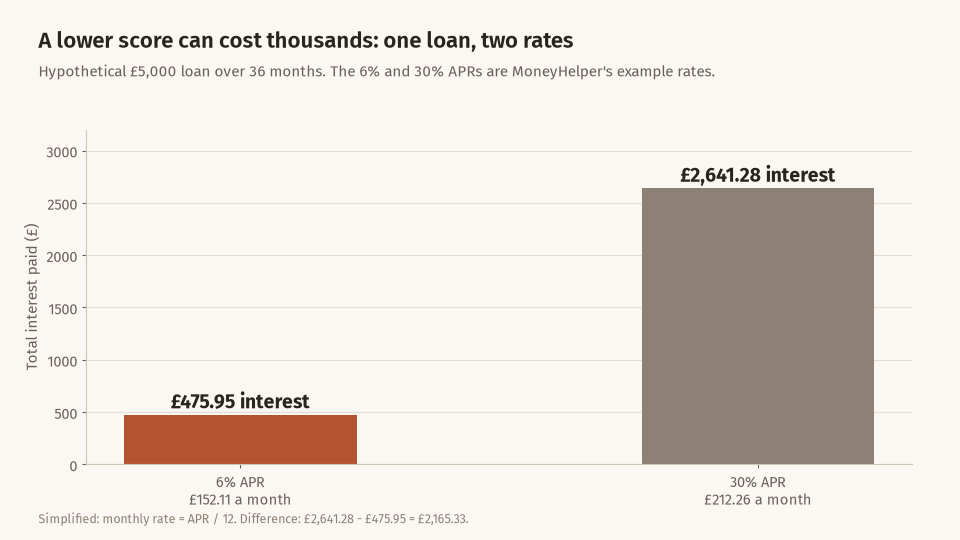
A better score can mean a lower interest rate, a higher limit and wider choice. MoneyHelper gives a UK example: a loan advertised at 6% APR might be offered at 30% if you have a poor score. Here is what that does to a hypothetical £5,000 loan over 36 months, using a simplified calculation where the monthly rate is the APR divided by 12:
| 6% APR | 30% APR | |
|---|---|---|
| Monthly payment | £152.11 | £212.26 |
| Total repaid (36 payments) | £5,475.95 | £7,641.28 |
| Interest paid | £475.95 | £2,641.28 |
The gap in interest is £2,641.28 − £475.95 = £2,165.33. A lender’s actual calculation will differ slightly, but the point stands: the rate you are offered is what costs you money.
MoneyHelper also points out that credit scores can affect more than loans: insurance premiums (as some insurers consider them for certain policies), rental approvals, and even some job checks. The FTC says the same for the US, noting that credit reports can affect jobs, insurance and renting.
How to improve your credit score
None of these steps is a trick. They are the same behaviours every regulator describes.
1. Check your reports and fix errors
You cannot improve what you have not seen. In the US, the FTC says the three bureaus let you check your report from each once a week for free at AnnualCreditReport.com. In the UK, MoneyHelper says all agencies must give you your statutory report free, and you can check as often as you like without affecting your score. In Australia, you can get a free copy every three months from both Experian and Equifax.
If you find a mistake:
- US: dispute it with the bureau and the business that reported it. The FTC says both must correct wrong or incomplete information for free, and the bureau has 30 days to investigate.
- UK: report it to the agency. MoneyHelper says this should not take longer than 28 days, and the entry is marked as disputed meanwhile.
- Australia: contact the credit reporting body or the lender. Moneysmart says this is free, and that accurate information cannot be removed even if it is negative.
2. Pay every bill on time
This is the biggest single lever in the FICO model, and the one every regulator mentions. Set up automatic payments for at least the minimum.
Late-payment rules differ. In Australia, a missed payment is one not made within 14 days of the due date. A default can be listed if $150 or more is owed, 60 days have passed since the due date, and the provider has asked you to pay. In the UK, missed or late payments and defaults stay on your report for up to six years.
3. Use less of your available credit
“Amounts owed” is 30% of the FICO model, and a large part of that is how much of your available credit you are using. FICO says that using a high percentage can signal you are overextended, while a low percentage can help.
A worked example. Suppose you have two cards with limits of $6,000 and $4,000, so $10,000 of limit in total.
| Total balance owed | Calculation | Share of limit used |
|---|---|---|
| $5,000 | $5,000 ÷ $10,000 | 50% |
| $3,000 | $3,000 ÷ $10,000 | 30% |
| $1,000 | $1,000 ÷ $10,000 | 10% |
The CFPB’s credit-building checklist says experts advise using no more than 30% of your limit. That is a guideline, and a lower share is generally better. No official source gives an exact point at which your score jumps. If you carry card debt, a payoff plan helps both your score and your interest bill, as we explain in avalanche vs snowball.
4. Keep old accounts open where it makes sense
FICO counts the age of your oldest and newest accounts and the average age. The CFPB’s guide on sharing credit warns that closing a long-standing card can lower a score, by shortening your history and by raising the share of your limit you are using. The CFPB also says positive history can still be reported after an account is paid off or closed. If a card has a fee you do not want to pay, ask the issuer what your options are before you close it.
5. Apply for new credit sparingly
Each application leaves a mark. FICO says opening several accounts in a short time is riskier, especially for people with a short history, and that it only considers inquiries from the last 12 months, though they stay on your report for two years.
In the UK, MoneyHelper says a hard search (made when you apply) can affect your score and stays on your report for up to two years, whereas a soft search is visible only to you and the agency. Checking your own report and using an eligibility checker are both soft searches, so use those before you apply. If you are planning a mortgage, MoneyHelper suggests avoiding other credit applications in the six months before.
In Australia, Moneysmart says too many applications in a short time can lower your score, and that applications stay on your report for five years. It also notes that Buy Now Pay Later applications trigger a credit check, so see buy now, pay later: how it works before using it.
6. Add information that helps (UK and Australia)
- UK: register on the electoral roll at your current address (councils send voter data each month, so it could help within eight weeks). If you rent, services such as CreditLadder and Canopy offer free versions to add rent to your report. The optional Experian Boost uses Open Banking data to include things like council tax and subscription payments. If you fell behind for reasons that no longer apply, you can add a Notice of Correction.
- Australia: if you cannot meet repayments, ask your lender for a financial hardship arrangement. Moneysmart says a hardship arrangement does not affect your credit score, and is shown only for the months it is in place and deleted after 12 months.

How long things stay on your file
- US: the CFPB says credit reporting companies can generally report most negative information for seven years, and bankruptcies for up to ten. Lawsuits and judgments can be reported for seven years or until the statute of limitations runs out, whichever is longer. There are exceptions, such as reports used for a job paying over $75,000 or credit or life insurance over $150,000.
- UK: missed or late payments and defaults usually stay for up to six years. Public records such as CCJs, bankruptcies, Debt Relief Orders and IVAs can stay up to six years or longer in some circumstances, according to MoneyHelper.
- Australia: a default stays for five years, or seven in the case of a “clearout” where the provider cannot contact you. Paying the debt does not remove the default, but the report will show it has been paid.
Accurate negative items cannot be removed early, whatever a paid service promises. The CFPB and Moneysmart both say you can fix errors yourself for free.
Common mistakes and myths
- Paying for credit repair. MoneyHelper says to avoid credit repair firms, and the CFPB says no one has the right to remove accurate negative information. You can fix errors yourself at no cost.
- Thinking one late payment ruins everything. It hurts, but FICO says a good overall history can outweigh one or two late payments. Do not let it become a pattern.
- Running cards close to their limits. FICO says using a high percentage of your available credit can signal that you are overextended.
- Closing your oldest card on impulse. It can shorten your history and raise your usage ratio.
- Applying everywhere “to see what you get.” In the UK, use eligibility checkers first, since MoneyHelper says they use soft searches.
- Assuming your income is in the score. FICO and MoneyHelper both say salary is not part of your credit data, although lenders may ask about it separately.
- Ignoring identity theft. Unknown accounts on a report can signal fraud. See our guide on freezing your credit.
Frequently asked questions
What is a good credit score?
There is no single answer. In the US most scores run from 300 to 850, and lenders choose their own cut-offs. In Australia, a report places your score in a band from low to excellent, within a range of 0 to 1,000 or 1,200 depending on the agency. In the UK, MoneyHelper says each lender uses its own criteria, so a high score does not guarantee approval. Work on the habits above and watch the direction of your score, not one number.
Why do I have different scores?
Because there are different scoring models, different agencies and different data. The CFPB says each score depends on the data used, the model and even the day it was calculated. In Australia, the two main agencies can hold different information, and in the UK the four agencies’ reports may differ.
Does checking my own credit report hurt my score?
In the UK, no: MoneyHelper says checking your own report is a soft search and you can do it as often as you like. Applying for credit, on the other hand, triggers a hard search. For a US report, check the terms of the service you use, and use AnnualCreditReport.com for your free reports.
How long does it take to improve a credit score?
There is no fixed timeline. Improvement depends on your starting point and what is on your report. Fixing an error can help once the correction goes through (28 days in the UK, 30 days in the US for a bureau to investigate). Voter registration in the UK could help within about eight weeks. Lowering a card balance helps once the lower balance is reported. Negative items fall away only with time.
Will closing a credit card lower my score?
It can. The CFPB says closing a long-standing account can lower a score because of the shorter history and a higher share of your limit being used. If you carry a balance on other cards, closing one card reduces your total limit and can raise your usage ratio.
Can I build a score if I have no credit history?
Yes. You need an account that reports to the bureaus and a record of on-time payments. Our guide on how to build credit from scratch covers secured cards, credit-builder loans and the UK and Australian equivalents.
This article is general information, not financial advice. Rules, limits and rates change, and your circumstances are your own. Check the official sources below, and consider speaking to a qualified adviser or a free debt charity for decisions about your own money. See our Editorial Policy and Disclaimer pages for how we research and update articles. Last verified: October 2026.
Sources
- CFPB: What is a credit score?
- CFPB: How long does information stay on my credit report?
- myFICO: What’s in your credit score?
- FTC: Disputing Errors on Your Credit Reports
- MoneyHelper: How to improve your credit score
- MoneyHelper: How to check your credit report for free
- Moneysmart (ASIC): Credit scores and credit reports
- Moneysmart (ASIC): Credit repair
- European Commission: Consumer protection in financial services