

Last verified: October 2026. This article covers US federal tax rules only. Limits come from IRS Revenue Procedures 2025-19, 2025-32 and 2026-24 and from IRS Publications 969 and 15-B.
A health savings account (HSA) and a flexible spending account (FSA) both let you pay medical costs with pre-tax money, but they are not interchangeable. An HSA belongs to you, stays with you and rolls over every year, but you can only have one if you are covered by a qualifying high-deductible health plan. A health FSA is offered through an employer, does not require a particular type of plan, and is generally use-it-or-lose-it.
This guide is about US federal tax rules only. Health savings accounts of this kind do not exist in the UK, EU or Australia.
Key takeaways
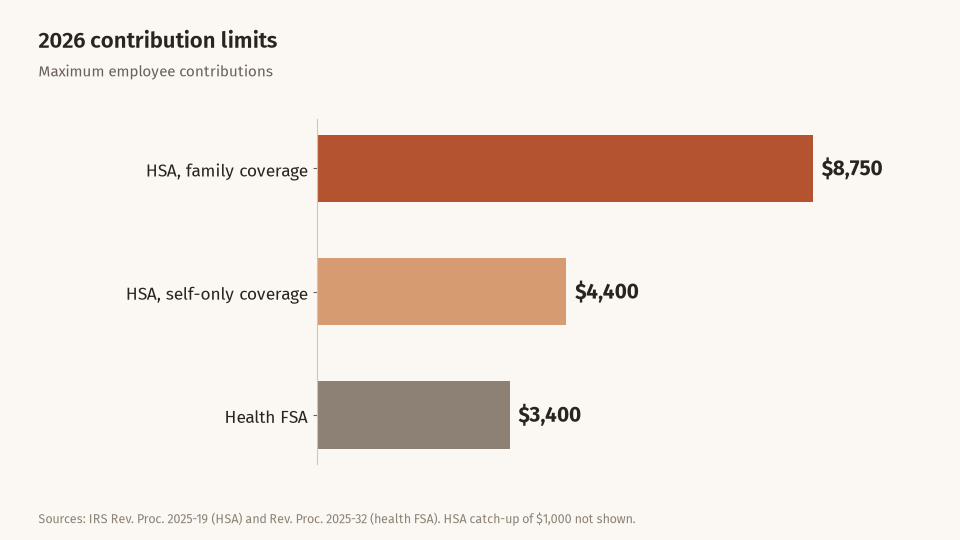
- For 2026 you can put up to $4,400 (self-only) or $8,750 (family) into an HSA, plus $1,000 if you are 55 or older. The health FSA limit is $3,400.
- You need a high-deductible health plan (HDHP) to contribute to an HSA. You do not need one for an FSA.
- HSA money rolls over and the account is yours. FSA money is generally lost if you do not use it, unless your plan offers a carryover (up to $680 for 2026) or a grace period (up to 2½ months).
- Being covered by a general-purpose health FSA generally stops you from contributing to an HSA. A limited-purpose FSA can be combined with an HSA.
- Taking money out of an HSA for non-medical reasons means income tax plus a 20% additional tax before you reach 65.
What is an HSA?
An HSA is a tax-favored account that you own and that you can open if you are an eligible individual. Contributions you or your employer make are tax-advantaged, the balance stays in your account year after year, and withdrawals for qualified medical expenses are tax-free. Your employer might contribute, and you report everything on Form 8889.
Who can contribute to an HSA
Under IRS Publication 969 you generally must meet all of these conditions:
- You are covered by an HDHP on the first day of the month.
- You have no other disqualifying health coverage, such as a general-purpose health FSA or HRA.
- You are not enrolled in Medicare.
- You cannot be claimed as a dependent on someone else’s return.
For 2026 a plan counts as an HDHP if its minimum annual deductible is at least $1,700 for self-only coverage or $3,400 for family coverage and its out-of-pocket maximum is no more than $8,500 self-only or $17,000 family. The IRS has already published 2027 figures: minimum deductibles of $1,750 and $3,500, and out-of-pocket maximums of $8,700 and $17,400.
Two recent changes widen who can qualify. From January 1, 2026, bronze and catastrophic plans are treated as HSA-compatible, whether bought through an exchange or not, and people in certain direct primary care arrangements can contribute to an HSA and pay periodic fees tax-free from it. Telehealth and other remote care can also be received before you meet the HDHP deductible without losing HSA eligibility.
HSA contribution limits
| 2025 | 2026 | 2027 | |
|---|---|---|---|
| Self-only coverage | $4,300 | $4,400 | $4,500 |
| Family coverage | $8,550 | $8,750 | $9,000 |
| Catch-up, age 55 or older | $1,000 | $1,000 | $1,000 |
The 2025 and 2026 limits are in IRS Publication 969, and the 2027 figures come from Revenue Procedure 2026-24. Each spouse who wants the catch-up needs their own HSA. You can make contributions for a year up to the due date of your tax return for that year, generally April 15 of the next year. Contributions above the limit are subject to a 6% excise tax for each year the excess stays in the account, unless you withdraw the excess and its earnings by the filing deadline.
Using HSA money
You can take tax-free distributions to pay or reimburse qualified medical expenses for you, your spouse and your dependents, as long as the expense was incurred after you set up the HSA. You do not have to withdraw each year, and you cannot also deduct the same expenses on Schedule A.
HSA funds generally cannot pay insurance premiums, with these exceptions: long-term care insurance, COBRA continuation coverage, coverage while receiving unemployment compensation, and Medicare or other health coverage once you are 65 or older (Medigap is excluded).
If you take a distribution for something that is not a qualified medical expense, it is taxed as income and generally carries a 20% additional tax. The 20% tax does not apply after you become disabled, reach 65 or die. Keep records showing that withdrawals paid for qualified expenses that were not paid or reimbursed any other way. For help with a bill, see how to negotiate medical bills.

What is an FSA?
A health FSA is a benefit your employer sets up through a cafeteria plan. You choose an amount to set aside from your paycheck before tax for the plan year. For 2026 the salary-reduction limit is $3,400.
Key FSA rules
- The full amount is available immediately. Under the IRS rules, you must be able to receive the maximum you elected at any time during the coverage period, even if you have not yet contributed it all.
- Reimbursement requires documentation. You must provide a written statement from an independent third party, such as an explanation of benefits or a receipt, saying that the expense was incurred and its amount. Employer-issued debit cards can reduce paperwork when the plan uses approved substantiation methods.
- Use it or lose it. Money left at the end of the plan year is generally forfeited. A plan can offer either a grace period of up to 2½ months or a carryover of up to $680 for 2026 (the plan may set a lower amount), but not both.
- You cannot deduct the same expense twice. Expenses reimbursed by the FSA cannot also be itemized.
Dependent care FSAs
A separate dependent care FSA pays for care that lets you work. For 2026 the exclusion limit increased from $5,000 to $7,500 ($3,750 if married filing separately), under the 2025 tax law changes noted in Publication 15-B. This is a different account from the health FSA, and it has its own rules.
FSA types that work with an HSA
If you have an HDHP and want an HSA, a limited-purpose health FSA or HRA (typically for dental and vision, plus preventive care) is allowed. So are a post-deductible FSA or HRA, a suspended HRA and a retiree-only HRA once retired. A general-purpose health FSA is the one that blocks HSA contributions, so check the plan name and your spouse’s plan before contributing.
HSA vs FSA side by side
| HSA | Health FSA | |
|---|---|---|
| Needs a high-deductible plan? | Yes | No |
| Who owns it? | You | Employer sets up the plan |
| 2026 limit | $4,400 / $8,750 (+$1,000 if 55+) | $3,400 |
| Unused money | Stays in your account | Generally forfeited unless carryover or grace period |
| Non-medical withdrawals | Taxed, plus 20% before 65 | Not allowed |
| HSA | Health FSA | |
|---|---|---|
| Needs an HDHP? | Yes | No |
| Who owns it? | You | Your employer sets up the plan |
| 2026 limit | $4,400 / $8,750 (+$1,000 if 55+) | $3,400 |
| Unused money | Stays in your account | Generally forfeited, unless carryover or grace period |
| Full amount available on day one? | No, only what is in the account | Yes, the full elected amount |
| Non-medical withdrawals | Taxed, plus 20% before 65 | Not allowed |
Worked example: what $4,400 saves
This is a hypothetical illustration using 2026 limits, not advice for your situation.
Maya is single and covered by a qualifying HDHP. She puts the 2026 self-only maximum of $4,400 into an HSA. Her last dollars of income are taxed at 22%.
- Federal income tax saved: $4,400 × 22% = $968
- If she instead had a health FSA at its $3,400 limit, the same calculation gives $3,400 × 22% = $748
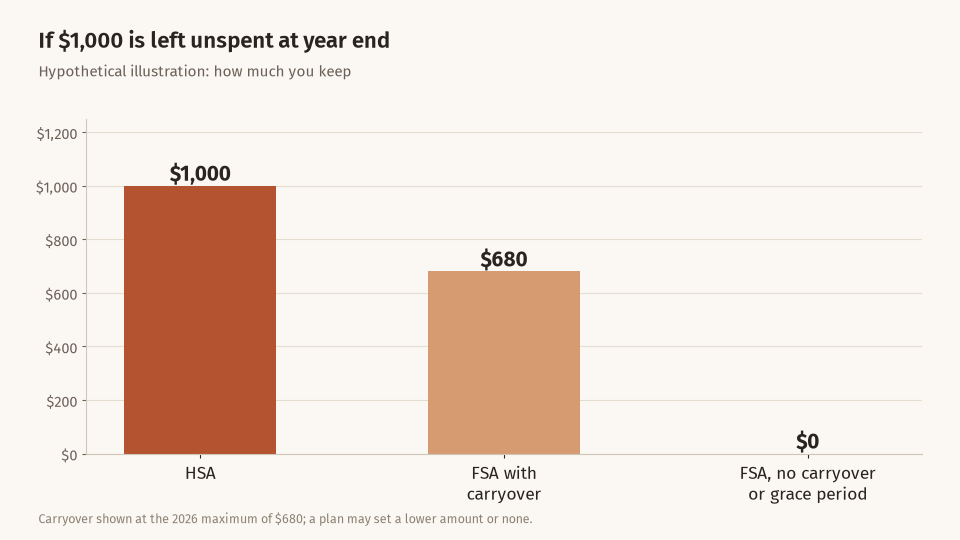
The tax saving is the same percentage either way. The difference is what happens if she does not spend the money. Suppose she ends the year with $1,000 unused:
- HSA: the full $1,000 stays in her account for future medical costs.
- FSA with a carryover: up to $680 carries into the next year and the other $320 is forfeited.
- FSA with no carryover: the $1,000 is forfeited, unless the plan has a grace period and she spends it within 2½ months.
Which should you choose?
- If you have an HDHP, an HSA is usually the more flexible tool: it rolls over and it is portable, which the IRS describes as staying with you if you change employers. The trade-off is a higher deductible that you have to be able to afford.
- If you do not have an HDHP, an HSA is not available to you, and a health FSA is the main option. Estimate your expenses conservatively to avoid forfeiting money.
- If your employer offers both, pair an HSA with a limited-purpose FSA so you can cover dental and vision costs without losing HSA eligibility.
- If you are on Medicare or can be claimed as a dependent, you cannot contribute to an HSA.
Neither account replaces insurance, and the right choice depends on your health costs, your cash reserves and your plan options. For retirement-related account choices, see our Roth IRA guide, and for other tax-saving ideas see how to legally reduce your taxable income.
Common mistakes
- Contributing to an HSA while covered by a general-purpose health FSA. Contributions you were not eligible to make can be treated as excess contributions, which face the 6% excise tax for each year they stay in the account.
- Over-funding an FSA. Money left over is generally forfeited, so base your election on predictable costs.
- Spending HSA money on non-qualified expenses. The withdrawal is taxed and may carry the 20% additional tax.
- Reimbursing yourself for expenses from before the HSA existed. Only expenses incurred after the HSA is established qualify.
- Forgetting Medicare. Once you enroll in Medicare you can no longer contribute to an HSA.
- Not keeping records. You must be able to show that HSA withdrawals paid for qualified expenses that were not reimbursed elsewhere.
- Assuming the family limit applies automatically. Your limit depends on your coverage type and on your months of eligibility.
Frequently asked questions
Can I have an HSA and an FSA at the same time?
Generally not if the FSA is a general-purpose health FSA. You can have an HSA with a limited-purpose or post-deductible FSA. A dependent care FSA is a separate benefit from a health FSA, so ask your plan administrator how it interacts with your HSA.
What happens to my HSA if I change jobs?
The IRS describes an HSA as portable: it stays with you if you change employers or leave the workforce. Contributions your old employer made are yours too, and the balance does not disappear.
Do I need to spend my HSA each year?
No. You do not have to make withdrawals from your HSA each year, and the balance carries over.
Can I use my FSA after the plan year ends?
Only if your plan offers a grace period of up to 2½ months or a carryover of up to $680 (for 2026). A plan cannot offer both for a health FSA.
Is there a deadline to contribute to an HSA?
You can make contributions for a tax year up to the filing deadline for that year’s return, not counting extensions. Publication 969 gives April 15, 2026 as the deadline for 2025 contributions.
Are over-the-counter items covered?
Both an HSA and a health FSA can cover over-the-counter medicine, whether or not prescribed, and menstrual care products, under Publication 969.
This article is general education about US federal tax and health accounts, not individual tax or medical advice. Rules and limits change and your situation is your own. Check the IRS sources below, and consider talking to a qualified tax professional or your plan administrator before making decisions. See our Editorial Policy and Disclaimer pages for how we work.
Sources
- IRS Publication 969
- IRS Rev. Proc. 2025-19
- IRS Rev. Proc. 2026-24
- IRS Rev. Proc. 2025-32
- IRS Notice 2026-05
- IRS: Guidance on new tax benefits for HSA participants (IR-2025-119)
- IRS Publication 15-B
- IRS: Working Families Tax Cuts