

Last verified: October 2026. Figures and rules below were checked against the official sources listed at the end of the article.
Car insurance is not one product but a bundle of separate coverages, each with its own price. Some pay for the damage you cause to other people. Others pay for your own car. The law in most places only requires the first kind, but the second kind decides whether you can afford to replace your car after a crash. Your premium depends on who you are, what you drive and how much risk you ask the insurer to take on, and several of those levers are in your control.
This guide explains the main coverages, what sets your premium, how to lower it without leaving yourself exposed, and how the rules differ in the US, UK, EU and Australia.
Key takeaways
- Liability cover pays for harm you cause others. Collision and comprehensive (or “comprehensive” in the UK) pay for your own car.
- Legal minimums are floors, not recommendations. The NAIC warns that state minimums are too low to fully cover you if you cause a serious accident.
- A higher deductible lowers the premium but raises what you pay at claim time. It only pays off if you claim rarely.
- Shopping around is the most reliable saving. Compare the same coverages and limits across several insurers and ask about discounts.
- Cheapest is not always the lowest cover. MoneyHelper notes comprehensive cover can sometimes cost less than third party only.
What the main coverages do
United States
The National Association of Insurance Commissioners (NAIC) describes the usual parts of a US auto policy. Each is priced separately, and some are optional.
| Coverage | What it pays for | Who requires it |
|---|---|---|
| Bodily injury liability | Injuries you cause to someone else | State law |
| Property damage liability | Damage you cause to someone else’s car or things your car hits | State law |
| Uninsured and underinsured motorist | Your costs if an uninsured, hit-and-run or under-insured driver hits you | Some states |
| Medical payments or personal injury protection (PIP) | Treating injuries to you and your passengers | Some states (PIP is for “no-fault” states) |
| Collision | Damage to your car from a crash, a pothole or a rollover | Your lender, if you have a car loan |
| Comprehensive | Damage to your car that is not a collision: theft, hail, flood, fire, hitting animals, glass | Your lender, if you have a car loan |
Two details trip people up. First, State law sets the minimum amounts of liability cover, and the NAIC says these minimums are too low to fully cover you if you cause a serious accident. Many insurers let you buy higher limits, often without much extra cost. Second, car insurance does not pay off your car loan if the car is worth less than you owe. Dealers and lenders may offer gap insurance for that.
United Kingdom
You must have motor insurance to drive on UK roads, and third party insurance is the legal minimum. It covers injury or damage you cause to other people, vehicles, animals or property. It does not pay for repairs to your own car. MoneyHelper describes three levels:
- Third party only: damage you cause to others, but nothing for your car.
- Third party, fire and theft: adds cover if your car is stolen or damaged by fire.
- Comprehensive: covers all of the above plus damage to your own car in an accident.
EU
When you register a car in an EU country you must insure it for third-party liability. That compulsory cover is valid in all other EU countries and covers injury to anyone other than the driver, plus property damage. It does not cover repairs to your own car. Optional cover, such as theft, damage to your vehicle and injury to the driver, has no EU-wide rules, so check the terms with your insurer before driving abroad.
Australia
Moneysmart lists the layers of cover:
- Compulsory Third Party (CTP): covers injuries to people caused by your car. It does not cover property damage. You must have it to register a car, and in some states it is included in the registration fee.
- Third party property damage: damage your car causes to other people’s cars or property, but not to your own.
- Third party property damage, fire and theft: the above, plus cover if your car is stolen or damaged by fire.
- Comprehensive: damage to your car and to other people’s cars and property, even if you caused the accident, plus theft, fire and weather events. Check the exclusions.
With comprehensive cover you can choose between an agreed value (a fixed amount you and the insurer decide, which may fall as the car ages) and a market value (what the insurer decides the car would have sold for, which you cannot change). Agreed value costs more.
| Country | Required by law | Usually optional |
|---|---|---|
| United States | Liability cover; state law sets the minimum amounts | Collision, comprehensive; some states require uninsured motorist cover |
| United Kingdom | At least third party insurance | Third party, fire and theft; comprehensive |
| EU | Third-party liability, valid in all EU countries | Cover for your own car, theft, injury to the driver |
| Australia | Compulsory Third Party (CTP) for injury to people | Third party property damage; fire and theft; comprehensive |
What sets your premium
The NAIC lists the main factors US insurers weigh. Insurers use different methods, so the same driver can get very different quotes.
- Your driving record over the last three to five years.
- Your claims history, often recorded in databases such as CLUE. You have a right to a free copy of your CLUE report.
- A credit-based insurance score in most states (some states restrict or ban its use). It is different from the credit scores lenders use. Our guide to how credit scores work explains the underlying report.
- Your age, gender and marital status, and the drivers in your household.
- The vehicle: newer, more expensive or high-performance cars generally cost more to insure.
- Where you live and how you use the car, including annual mileage.
- Your prior coverage: a gap in insurance usually costs more.
- The liability limits and deductibles you choose.
MoneyHelper adds that in the UK every car sits in an insurance group from 1 to 50, based on value, repair time, performance and security features. The lower the group, the lower the cost.
A worked example: choosing a deductible
A deductible is what you pay yourself on a claim before the insurer pays the rest. The NAIC says higher deductibles mean lower premiums. Here is an illustration with made-up prices, not a quote.
Suppose collision and comprehensive cover costs $1,200 a year with a $500 deductible, or $1,020 a year with a $1,000 deductible. Raising the deductible saves $180 a year but adds $500 to what you pay on each claim. The extra $500 is “paid back” by the saving after $500 ÷ $180 = about 2.8 years without a claim.
Over five years:
- No claims: $500 deductible costs 5 × $1,200 = $6,000. The $1,000 deductible costs 5 × $1,020 = $5,100. You save $900.
- One claim: $6,000 + $500 = $6,500 against $5,100 + $1,000 = $6,100. You still save $400.
- Two claims: $6,000 + $1,000 = $7,000 against $5,100 + $2,000 = $7,100. Now the lower deductible is $100 cheaper.
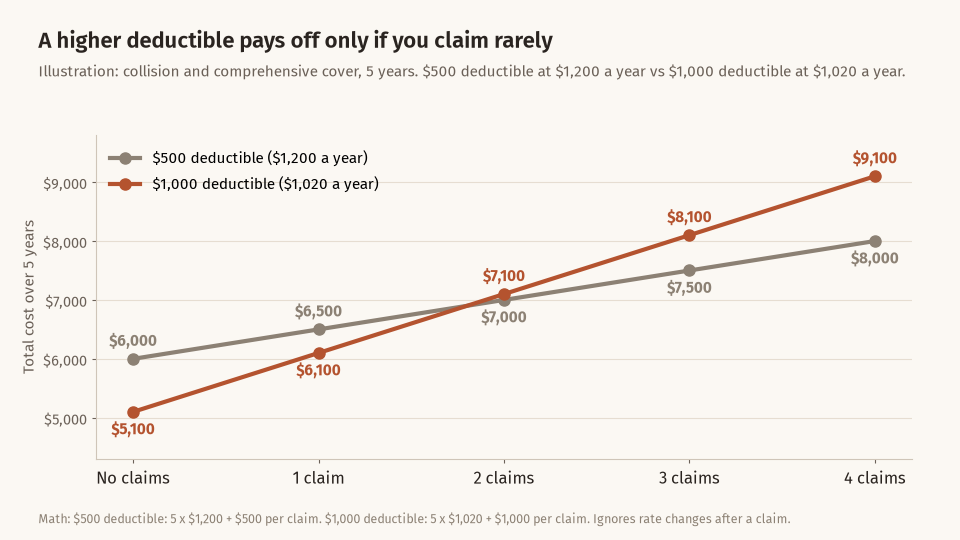
The lesson is the NAIC’s own caution: a higher deductible is a good way to save, but only if you can afford it if you have a loss. Keep that amount in an emergency fund. Also remember that real insurers may raise your rates after a claim, which makes frequent claims more expensive than this simple example shows.

Ways to lower the cost
- Shop around and compare like for like. The NAIC says companies charge different rates for the same coverage. Ask each for the same coverages and limits, and get quotes in writing. MoneyHelper suggests using at least two comparison sites, because not every insurer appears on every one.
- Ask about discounts. The NAIC lists bundling home and auto, insuring several vehicles, anti-theft devices and airbags, defensive driving courses (particularly for drivers 55 and over), and membership of certain organisations.
- Pick the right deductible and limits. Higher liability limits often cost little extra. A higher deductible lowers the premium but raises your claim cost.
- Reconsider collision and comprehensive on an old car. The NAIC suggests asking whether you need collision and comprehensive at all and comparing the premium to what your car is worth. If your lender requires them, you have no choice.
- Pay annually if you can afford it. MoneyHelper says the annual cost is usually a bit lower than paying monthly.
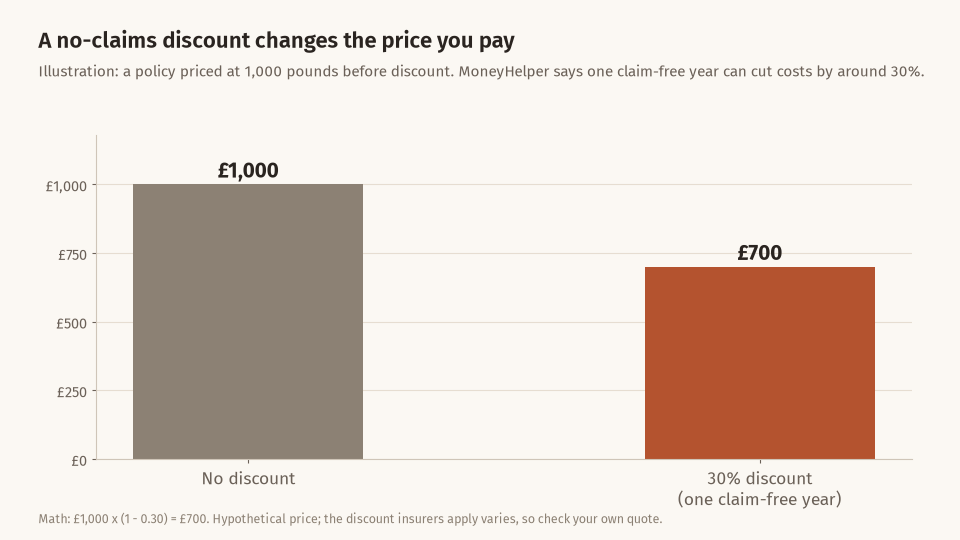
- Protect and transfer your no-claims discount (UK). MoneyHelper says even one year of no-claims bonus can lower your costs by around 30%, and you can usually take it to a new insurer.
- Trim add-ons. Windscreen cover, courtesy cars and legal expenses can be removed if you do not need them. Moneysmart warns that some add-on insurances can be hard to claim on or expensive compared with fixing the problem yourself.
- Keep your mileage accurate. MoneyHelper notes lower mileage usually lowers cost, but if you exceed the mileage you declared and claim, your cover could be invalid.
- Keep the car secure and your record clean. Parking off the road, in a secure place, can lower UK quotes. A clean driving record helps everywhere.
- Do not auto-renew blindly. In the UK, FCA rules stop insurers charging existing customers more than new ones, but that does not mean your renewal is the best deal.
Be careful with extreme cost-cutting. Dropping to the legal minimum can leave you paying for your own car after a crash you cause. MoneyHelper notes that comprehensive cover can sometimes cost less than lower cover, because insurers price risk, so compare all levels before you decide.
Penalties for driving uninsured
Driving uninsured is expensive. In the UK, police can issue a fixed penalty of £300 and 6 penalty points. A court can impose an unlimited fine and disqualify you, and the vehicle can be seized and in some cases destroyed. Under the UK’s continuous insurance rules, even a parked vehicle that is not declared off the road (SORN) can lead to a £100 fine, or up to £1,000 in court. In the US, the rules are set state by state, so check with your state insurance department.
Common mistakes
- Buying only the legal minimum without thinking. A serious accident can cost far more than the minimum limits cover.
- Comparing prices without comparing coverage. A cheaper quote may have lower limits, a higher deductible or fewer protections.
- Understating mileage or hiding drivers. If you give wrong information, your premium may rise after the quote and a claim could be affected. In the UK, listing yourself as a named driver when you are the main driver is “fronting”, which is illegal.
- Skipping gap cover on a new financed car without understanding that insurance pays market value, not what you owe.
- Letting cover lapse. The NAIC says most US insurers charge more if you have no prior insurance.
- Choosing a deductible you cannot pay. If you have no cash to cover it, a claim can still hurt.
Frequently asked questions
Is liability insurance enough?
It meets the legal requirement in most places, but it does not pay for your own car. If you could not afford to replace your car, consider collision and comprehensive (US) or comprehensive (UK and Australia). If you have a car loan, your lender will likely require it.
Does a higher deductible really save money?
It lowers your premium. Whether it saves money overall depends on how often you claim. In the example above, the $1,000 deductible was cheaper over five years with up to one claim and more expensive with two or more.
What is the difference between comprehensive and collision?
In the US, collision pays for damage to your car from a crash, a pothole or a rollover. Comprehensive pays for damage that is not a collision, such as theft, hail, flood, fire and hitting an animal. In the UK and Australia, “comprehensive” covers both.
Will a claim always raise my rates?
Not always, but insurers record claims in databases and use them when pricing, so a claim can affect what you pay. The NAIC says insurers use claims history as a factor.
Is my car insurance valid in another EU country?
The compulsory third-party liability cover is valid in all EU countries. Optional cover, such as theft or damage to your own car, has no EU-wide rules, so ask your insurer before you travel.
Do I need CTP in Australia?
Yes. Compulsory Third Party insurance is required to register a car, and in some states it is included in the registration fee. It covers injury to people, not damage to property or your own car.
This article is general information, not financial advice. Rules, limits and rates change, and your circumstances are your own. Check the official sources below, and consider speaking to a qualified adviser before making decisions. See our Editorial Policy and Disclaimer pages. Last verified: October 2026.
Sources
- NAIC: A Consumer’s Guide to Auto Insurance
- GOV.UK: Vehicle insurance overview
- GOV.UK: Driving without insurance
- GOV.UK: Uninsured vehicles
- MoneyHelper: How to get cheaper car insurance
- Your Europe: Car insurance validity in the EU
- Moneysmart (ASIC): Car insurance
- Moneysmart (ASIC): Choosing car insurance