

Last verified: October 2026. Figures and rules below were checked against the official sources listed at the end of the article.
To build credit from scratch you need three things: an account that reports to the credit bureaus, a run of on-time payments, and a balance that stays small compared with your limit. A secured card or a credit-builder loan is the usual way to get the first one. The other two are habits, and they take months, not days. This guide walks through each step and explains where the US, UK, EU and Australia differ.
Key takeaways
- Lenders judge you on your credit history. With no history there is nothing for them to see, which can mean a refusal or a higher price.
- Debit cards, prepaid cards and cash do not build credit. You need borrowing that gets reported to the bureaus.
- Common starting points: a secured card, a credit-builder loan, or a low-limit card. Ask the lender whether it reports before you apply.
- Pay on time, every time, and keep your balance well below the limit. A widely quoted guideline is no more than 30%.
- In the UK, register on the electoral roll. In Australia, repayment history is now part of your report. Check your free report first in every country.
- Avoid paid “credit repair” and expensive “credit-building” products. You can do the useful parts yourself for free.
What “building credit” actually means
A credit report is a record of how you have handled borrowing. A credit score is a number that a lender or credit agency calculates from it. The US Consumer Financial Protection Bureau (CFPB) describes a score as a prediction of how likely you are to pay a loan back on time, and says lenders use it for mortgages, cards and car loans, and also for tenant screening and insurance. A higher score usually makes it easier to qualify, and can bring a better rate.
If you are new to credit, you may have a “thin” file with very little in it, or no file at all. That is not the same as a bad score. It means a lender has no evidence either way, so it may say no, or offer expensive terms. Building credit is the process of creating that evidence.
Three quick facts shape everything else:
- Only borrowing that is reported counts. The CFPB says the payments on a debit card, cash or a prepaid card are typically not reported, since you are not borrowing.
- Each country has its own system. The same behaviour (borrow a little, repay on time) works everywhere, but who keeps your file, what they record and what is free to see differ. The sections below cover this.
- It is slow. Nobody can promise a score by a particular date. What you control is the habit, and the record builds as the months pass.
For a deeper look at how the number itself is worked out, see our guide to how credit scores work and how to improve yours.
Step 1: Check what is already on your file
Before you open anything, see what the bureaus hold on you. You may find nothing, or you may find an error, an old address, or an account opened by someone else.
| Region | Who holds it | Free report |
|---|---|---|
| United States | Equifax, Experian, TransUnion | Weekly at AnnualCreditReport.com (all three bureaus) |
| United Kingdom | Experian, Equifax, TransUnion, Crediva | Free statutory report from each of the four agencies |
| Australia | Experian and Equifax | Free every 3 months from each |
| European Union | National registers and bureaus | Varies by country, check your national rules |
United States
The three nationwide bureaus (Equifax, Experian and TransUnion) keep your reports. The FTC says all three have permanently extended a program that lets you check your report from each once a week for free at AnnualCreditReport.com, and that federal law also requires each to give you a free copy once every 12 months on request. That is the only website authorised to fill these orders, so ignore look-alike sites that sell “free” reports or monitoring. The three files can differ, so look at each one.
United Kingdom
MoneyHelper lists four credit reference agencies: Experian, Equifax, TransUnion and Crediva. Check your free statutory report with each of them, because they may hold slightly different information. If you find an error, MoneyHelper says disputes should take no longer than 28 days to resolve, and you can add a Notice of Correction to your file.
Australia
Moneysmart says you can get a free credit report every three months from each of the two main bodies, Experian and Equifax. Your report shows two years of repayment history, and fixing a genuine error is free: you can ask either the credit reporting body or the lender, and both must help.
European Union
There is no single EU credit file. Credit registers and bureaus are set up country by country, and what they record and how you request a copy depends on where you live. Look up your national consumer or data-protection authority for the right route. One change to know about: the European Commission says the new Consumer Credit Directive (EU) 2023/2225 applies from 20 November 2026. Lenders must check that you can repay before they lend, and if that check is automated you can ask for a human to review it. Check your own country’s rules for how it applies.
Step 2: Get one account that reports
This is the step that creates your history. You are looking for something low-risk that you can keep up with comfortably.
Common options in the US
The CFPB lists these as ways to start:
- Secured credit card. You put down a cash deposit that is held as security, and the CFPB says the larger the deposit, the higher the limit. The CFPB’s checklist says deposits can range from $50 to $300, and its Ask CFPB page gives $500 as an example. The CFPB also warns that you should ask the issuer whether it reports to the credit bureaus, and that secured cards can carry fees, so compare them with a basic unsecured card you might qualify for.
- Credit-builder loan. The lender holds the amount you borrow in a savings account while you repay it, usually over 6 to 24 months. The CFPB’s checklist says these loans are often $300 to $1,000. Your payments are reported along the way. Read the interest and fees, and ask when and how you get the money back, because the loan costs you something.
- Store or retail card. Limits are often low and approval can be easier. The same warning applies: confirm it reports.
| Product | Builds credit history? | Why (per the CFPB) |
|---|---|---|
| Secured credit card | Usually yes | Payments are reported; ask the issuer to confirm |
| Credit-builder loan | Yes | You repay over about 6 to 24 months; payments are reported |
| Store or retail card | Often yes | Lower limits, often easier to get |
| Debit card or cash | No | You are not borrowing, so nothing is reported |
| Prepaid card | No | You spend only money you loaded first |
| Payday loan | No | Payments are not reported, even if on time |
| Buy here, pay here car loan | Often no | Dealers often report only late payments |
The same CFPB page lists things that typically do not help: debit or cash, prepaid cards, and payday loans. It also says some “buy here, pay here” car dealers report only missed payments, which can hurt you without helping.
A hypothetical credit-builder loan: you borrow $600 over 12 months. The principal alone is $600 ÷ 12 = $50 a month, before whatever interest and fees the lender charges. After 12 on-time payments you have a year of reported history, if the lender reports each payment.
Authorized users, joint accounts and cosigners
Some people borrow credit from family. Three things to know, all from the CFPB’s teaching guide on the subject:
- Authorized user. You can use someone else’s card, but only the account owner is legally responsible. Being added does not necessarily build your own history, because not every issuer reports authorized users’ payments. Both of you would need to confirm that it does. If the owner misses payments or uses most of the limit, your record can suffer too.
- Joint account. Both people are equally responsible for repayment no matter who spent the money, and the account appears on both reports.
- Cosigner. The cosigner is responsible for the whole balance and their credit can be harmed if you pay late. Do not ask or agree to this lightly.
United Kingdom
MoneyHelper’s suggestions for a first credit history include:
- Register on the electoral roll at your current address. MoneyHelper says registering could improve your score within eight weeks.
- Get rent reported. Services such as CreditLadder and Canopy can add rent payments to your file, and MoneyHelper notes both have free versions.
- Consider a low-limit credit card from a regulated provider. MoneyHelper points to this as one option, so use it lightly and repay on time.
- Be careful with “credit-building” products that charge a lot. MoneyHelper warns against expensive ones.
- Use eligibility checkers. A soft search does not affect your score, while a hard search from a full application can. Many lenders let you check your chances with a soft search first.
Australia
Australia now uses comprehensive credit reporting. CreditSmart explains that credit reports used to show mainly “bad” events such as defaults, and now also show positive information like your repayment history. It says most lenders are now sharing this data. In practice, your on-time payments on a credit card or loan count in your favour. Two cautions from Moneysmart: applications for cards, loans and even Buy Now Pay Later products trigger a credit check, and applications stay on your report for five years, so do not apply for several at once. If you are considering BNPL, our guide on buy now, pay later explains the trade-offs.
European Union
Because the systems differ by country, the practical first step is to ask a bank or the national credit register what counts as a positive record where you live. The general rule holds everywhere: borrowing must be reported to count, and you need to repay on time.
Step 3: Pay on time, every time
Payment history is the part you can least afford to get wrong. Set up an automatic payment for at least the minimum so a busy week cannot cost you a missed due date. Our guide to making a budget that sticks shows how to line up due dates with payday.
Know what counts as “late” where you live. In Australia, Moneysmart says a missed payment is one not made within 14 days of the due date, and it records payments on credit cards, loans and some bills over two years. Serious arrears go further. A payment of $150 or more that is 60 days or more overdue can become a default, which stays on the report for five years even after it is paid.
If you cannot make a payment, contact the lender before the due date. CreditSmart notes that lenders may be able to help you restructure repayments if you are in difficulty.
Step 4: Keep your balance low
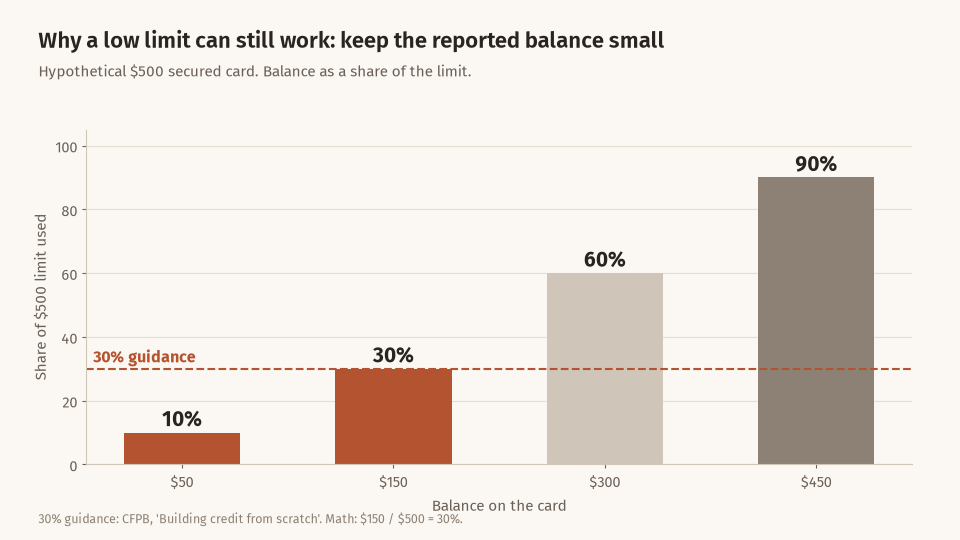
How much of your limit you use matters alongside paying on time. The CFPB’s checklist says experts advise using no more than 30% of your credit limit. This is a rule of thumb, not a law, and a lower share is generally better.
A worked example
Say your secured card has a $500 limit. The share of the limit you have used is the balance divided by the limit:
| Balance | Calculation | Share of limit used |
|---|---|---|
| $50 | $50 ÷ $500 | 10% |
| $150 | $150 ÷ $500 | 30% |
| $300 | $300 ÷ $500 | 60% |
| $450 | $450 ÷ $500 | 90% |
If you put a $60 phone bill on the card each month and clear it every time, you use about 12% of the limit ($60 ÷ $500) and, in most cases, pay no interest. The CFPB explains that most cards give a grace period on purchases: if you pay the balance in full by the due date, you may not be charged interest, but if you carry a balance you lose the grace period. Card companies are not required to offer one, so check yours.
Carrying a balance does not help your record, and it costs money. The Federal Reserve’s G.19 release for August 2026 shows an average card rate of 22.36% on accounts that were charged interest. If a $300 balance sat at that rate for a year, the interest would be roughly $300 × 0.2236 = $67, about $5.59 a month. Your card’s rate may differ, so look at your own agreement.
Step 5: Add new credit slowly
Each application leaves a mark. The CFPB lists new applications for credit among the factors that scoring models typically take into account. In the UK, a hard search from a full application can affect your score, which is why MoneyHelper recommends soft-search eligibility checkers first. In Australia, Moneysmart says too many applications in a short time can lower your score and that they stay on your report for five years.
A calm pattern looks like this:
- Check your reports.
- Open one account that reports.
- Use it lightly and pay it in full for several months.
- Only then consider a second product, such as an unsecured card with a better rate.
Keep your oldest account open if it costs nothing. The CFPB’s teaching guide notes that closing a long-standing card can lower a score, both by shortening your history and by raising the share of your limit you are using.

How long does it take?
The official sources we checked give no fixed timetable, and you should be wary of anyone who does. Your score reflects what is on your file, so it moves as reported months of good behaviour accumulate. The one timing MoneyHelper gives is for UK voter registration, which could help within about eight weeks. Beyond that, think in terms of months of reported payments rather than weeks, and keep going.
If you have been turned down
A refusal is common when you have little history. Do not respond by applying for five more cards. In the UK, MoneyHelper points to soft-search eligibility checkers as a way to gauge your chances without a hard search. Instead:
- Ask the lender why, or check your reports for errors.
- Look at a secured card or credit-builder loan, where your own money backs the account.
- Think carefully before asking someone to cosign. They are fully responsible if you fall behind.
- Skip payday loans. In the US they are typically not reported, so even on-time repayment does not build your history.
Common mistakes
- Choosing a product that does not report. Always ask which bureaus the lender reports to, and how often.
- Relying on a debit card. It is safer for spending, but it does not build credit.
- Carrying a balance “to build credit”. Interest is a cost. On-time payment is what the file records.
- Using almost the whole limit. A $450 balance on a $500 card is 90% used.
- Paying a credit repair company. MoneyHelper advises avoiding credit repair firms, and Moneysmart says you do not need to pay a company to correct genuine errors and that doing so may not improve your score. Errors can be disputed for free with the credit reporting body or the lender.
- Joining accounts with someone whose record is poor. A joint account links your files.
- Closing your oldest card out of habit. It can shorten your history and raise your usage ratio.
- Skipping basic security. The CFPB says a credit freeze restricts access to your file and makes it harder for identity thieves to open accounts in your name. See how to freeze your credit if you are in the US.
Frequently asked questions
How long does it take to build credit?
There is no official timeline. Your record grows as reported months of on-time payments pile up. Voter registration in the UK could help within about eight weeks, according to MoneyHelper. Treat any promise of a specific score by a specific date as a red flag.
Do I need a credit card to build credit?
No. A credit-builder loan, rent reporting in the UK, or a small loan or card in Australia can all create a history. A card is simply the most common route because it is easy to use lightly and repay in full.
Does becoming an authorized user build credit?
Not necessarily. The CFPB says not all issuers report authorized users’ payments to the bureaus, so check first. The main account holder stays legally responsible, and their habits can affect your record.
Is it good to carry a balance on a card?
Nothing in the official guidance says you need to carry a balance. Paying the full statement balance by the due date lets you avoid interest on purchases if your card has a grace period, as most do. Carrying a balance costs interest, at an average of 22.36% on US accounts that were charged interest in August 2026.
Is a secured card worth it?
It can be, if the issuer reports to the bureaus and the fees are fair. The CFPB suggests asking the issuer about reporting and comparing fees, and checking whether you could qualify for a regular card instead.
Does checking my own credit report hurt my score?
In the UK, MoneyHelper says soft searches, such as eligibility checkers, do not affect your score and a full application leaves a hard search. In the US, the FTC encourages you to check your reports regularly, and weekly free access is available. Look at your own report whenever you need to.
This article is general information, not financial advice. Rules, limits and rates change, and your circumstances are your own. Check the official sources below, and consider speaking to a qualified adviser or a free debt charity for decisions about your own money. See our Editorial Policy and Disclaimer pages for how we research and update articles. Last verified: October 2026.
Sources
- CFPB: What are some ways to start or rebuild a good credit history?
- CFPB: Building credit from scratch (credit invisible checklist, PDF)
- CFPB: Cosigning loans and sharing credit (Building Blocks teacher guide, PDF)
- CFPB: What is a grace period for a credit card?
- CFPB: What is a credit score?
- FTC: Free Credit Reports
- Federal Reserve: Consumer Credit, G.19 (August 2026 release)
- MoneyHelper: How to improve your credit score
- Moneysmart (ASIC): Credit scores and credit reports
- Moneysmart (ASIC): Credit repair
- CreditSmart: Comprehensive credit reporting
- European Commission: Consumer protection in financial services