

Last verified: October 2026. Figures and rules below were checked against the official sources listed at the end of the article.
Term life insurance pays out only if you die within a set period, such as 20 years. Whole life insurance pays out whenever you die, as long as you keep paying the premiums, and it builds a cash value along the way. For most people who are insuring against the loss of income while a mortgage or children depend on them, term cover is the simpler and cheaper fit. Whole life is a different tool, with a higher price, and it suits a narrower set of needs.
This guide explains how each works, what to compare, how to size a policy, and where the US, UK and Australian terms differ. It is general information, not a recommendation to buy a policy.
Key takeaways
- Term life covers a fixed period. If you outlive it, the policy ends and pays nothing. Most term policies build no cash value.
- Whole life covers your lifetime and builds cash value. It costs more, and the NAIC advises asking for an illustration of future values and benefits.
- Match the length of cover to the years your family would need it, such as the rest of a mortgage or until children are independent.
- Work out the gap first: what your family would need, minus savings, work cover and other resources.
- Renewal can cost more. The NAIC says renewed term premiums are higher, and some policies lose renewal rights at a certain age.

What term life insurance is
Term life insurance runs for a fixed period known as the term. MoneyHelper gives examples of five, ten or 25 years. If you die within the term, your beneficiaries get the death benefit. If you outlive the term, the policy ends. The NAIC describes term insurance as intended to provide lower-cost coverage for a specific period, and notes that most term policies do not build cash values that you can use in the future.
In Australia the same product is called life cover, also known as term life insurance or death cover. Moneysmart says it pays a lump sum when you die and may also come with terminal illness cover.
Renewable, level, decreasing and increasing
Terms differ by country, but the ideas repeat.
- Renewable term (US). The NAIC says most term coverage can be renewed at the end of the term even if your health has changed, but the new premiums are higher. Ask what they will be before you renew, and ask whether you lose the right to renew at a certain age. A non-renewable term policy cannot be continued, so you would need to apply for a new one.
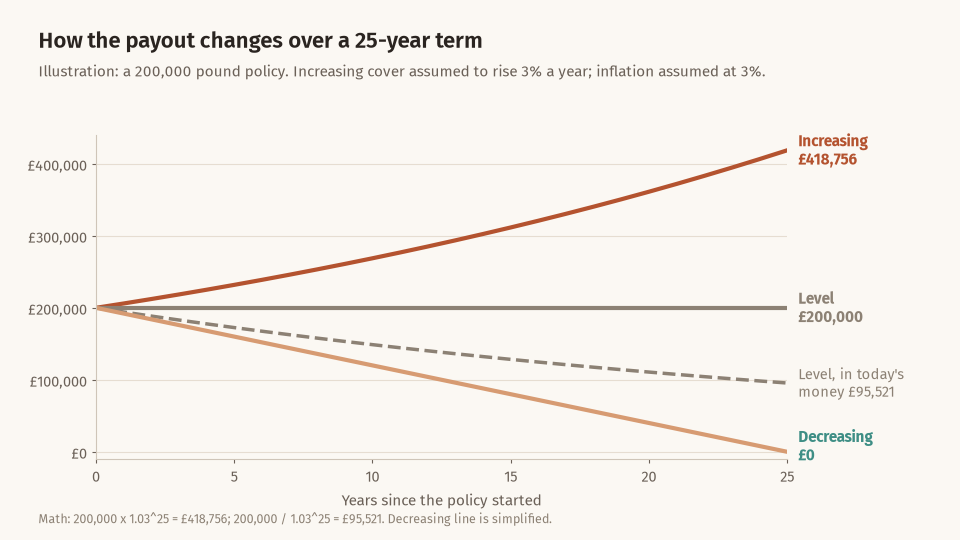
- Level, decreasing and increasing term (UK). MoneyHelper lists three kinds. Level pays the same lump sum throughout the term and is the simplest and most affordable option. Decreasing cover falls each year and is designed to be used with repayment mortgages, where the loan shrinks over time. Increasing cover rises over the term so that the payout keeps pace with the cost of living.
- Stepped and level premiums (Australia). Moneysmart describes variable age-stepped premiums, which are recalculated at each renewal based on your age, and variable premiums, which cost more at the start but whose increases are not based on your age and generally happen more slowly. Premiums are not guaranteed and may change annually.
What whole life insurance is
Whole life insurance covers you for your lifetime. In the US, the NAIC calls whole life and universal life “cash value insurance”. You typically pay whole life premiums on a set schedule. The policy has a cash value that builds over time, and in some policies the values are low in the early years and build later. The NAIC advises asking for an illustration of future values and benefits, and asking which parts of the premium or policy value are not guaranteed. It also notes that variable life policies have the greatest potential to build cash value but also the greatest risk of losing it.
MoneyHelper describes UK whole of life as paying out no matter when you die, as long as you keep up the premiums. It says such policies are often used for inheritance tax planning, are typically more expensive than shorter-term policies, and are usually reviewed every five or ten years, when premiums can rise and become unaffordable. It also warns that if you live longer than expected you could pay in more than you get out.
| Term life | Whole life | |
|---|---|---|
| Lasts | A fixed period, such as 10, 20 or 30 years | Your whole life, if premiums are paid |
| Pays out | Only if you die within the term | Whenever you die |
| Cash value | Most term policies have none | Yes; builds over time and varies by policy |
| Cost | Lower per year of cover | Higher; UK policies reviewed every 5 or 10 years |
| Main risk | Cover ends or costs more at renewal | Paying in more than you get out if you live long |
| Often used for | Mortgage, income, children’s costs | Lifelong needs, estate planning |
Which one fits? Start with the need
The NAIC says how much life insurance to buy depends on the financial needs that continue after your death, such as supporting your family, paying for education and paying off a mortgage. Moneysmart says life cover helps when people depend on your income or you have large debts or a mortgage, and that you may not need it if nobody depends on you financially. MoneyHelper adds that it might not suit you if you are single or your partner earns enough for your family to live on.
Ask these questions in order:
- Does anyone depend on my income? If not, you may not need life cover yet.
- For how long? Until the mortgage ends? Until the youngest child can support themselves? A fixed need points to term.
- Is there a permanent need? For example, an estate-planning goal that will exist whenever you die. That is the case where cash value or whole of life cover is used.
- Can I afford it for the whole period? A policy you cannot keep paying for does not protect anyone.
For many households the need is temporary, which points to term. The NAIC puts it this way: if you want coverage for a longer period, such as for your lifetime, cash value insurance may be more cost effective. That is a statement about lifetime needs, not a reason to buy it by default.
A worked example: how much cover?
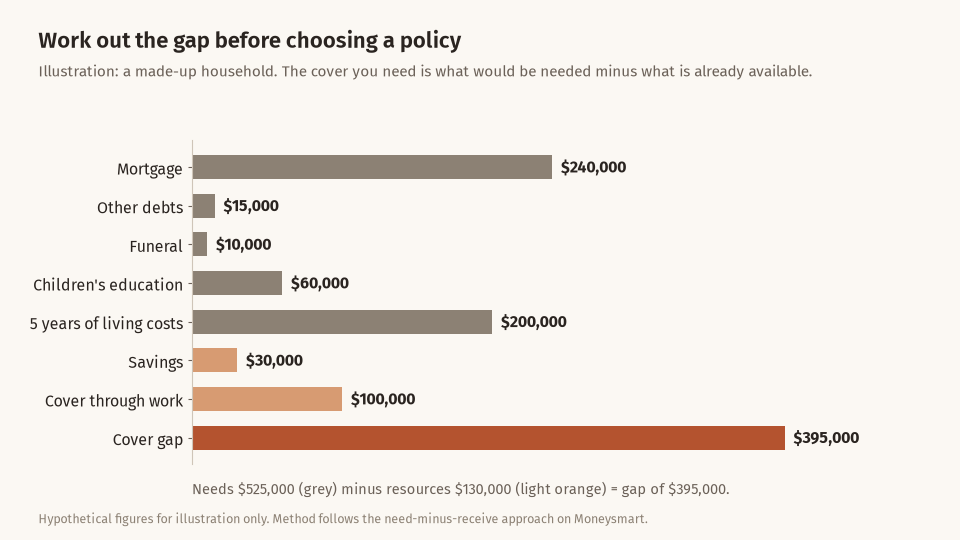
Moneysmart describes the method: consider how much money your family would need and how much they would receive. The difference is the amount of cover to get. Here is an illustration with made-up figures, in dollars:
| Item | Amount |
|---|---|
| Mortgage | $240,000 |
| Other debts | $15,000 |
| Funeral | $10,000 |
| Children’s education | $60,000 |
| Five years of living costs | $200,000 |
| Total needed | $525,000 |
| Savings | $30,000 |
| Cover through work | $100,000 |
| Total available | $130,000 |
| Gap | $395,000 |
$525,000 − $130,000 = $395,000. That is the cover this household might look for. It also shows why a quote for “a round $500,000” is not a plan. Moneysmart also offers a free life insurance calculator, and says to speak to a financial adviser if you need help deciding.
Match the length to the need
Continuing the example: suppose you are 35, your mortgage has 25 years left, and your child is 2 and will be dependent until 20.
- The mortgage ends at 35 + 25 = age 60.
- The child is dependent until you are 35 + (20 − 2) = age 53.
A 25-year term would run to 60 and cover both. A 20-year term would end at 55, which covers the child but not the last five years of the mortgage. A 30-year term would run to 65, costing more for five years you may not need. These are made-up ages, but the logic works for any family: write down when each need ends, then choose the term.
Cash value and the trade-offs
Whole life’s cash value is the feature people pay extra for, so understand what it is. The NAIC says that in some cash value policies, the values are low in the early years and build later on, while in others they build up gradually over the years. That is why it recommends asking for a written illustration of future values and benefits. Ask the insurer which parts of the premium or policy value are not guaranteed.
The trade-offs to weigh:
- Price. Whole of life is typically more expensive than shorter-term policies (MoneyHelper), and term is described by the NAIC as lower-cost coverage.
- Flexibility. Term gives you a large amount of cover for a limited time. Whole life gives you permanent cover but a higher fixed commitment.
- Review risk (UK). MoneyHelper says whole of life premiums are typically reviewed every five or ten years and can rise.
- Living longer than expected. MoneyHelper notes you could pay in more than the policy pays out.
- Ending the policy. MoneyHelper says there are usually no cancellation fees, but you get no refund of premiums paid, and replacement cover may cost more because prices increase with age. Do not cancel an existing policy until a replacement is in place; both the NAIC and MoneyHelper advise this.
If you are being sold whole life, ask for the illustration, ask what is guaranteed, and compare it against a term policy for the same need. Our guide to how much to save for retirement covers how to think about long-term savings separately from protection.
Tax on payouts
In the US, the IRS says life insurance proceeds you receive as a beneficiary because the insured died generally are not part of your gross income and you do not have to report them. Interest you receive is taxable. If the policy was transferred to you for cash or other valuable consideration, the exclusion can be limited. In the UK, MoneyHelper says a policy written in trust can be paid outside the estate, without going through probate or inheritance tax. Rules in your country may differ, so ask a tax professional about your own case.

Buying and reviewing a policy
- Check what you already have. The NAIC says employer cover is usually less than you need and you may not be able to take it with you if you leave. MoneyHelper notes death-in-service benefits stop if you leave the employer. In Australia, check whether you have default cover through super so you do not pay twice.
- Be honest on the application. MoneyHelper says that if you did not answer truthfully or did not disclose something, the insurer might not pay out. Moneysmart notes that if an insurer does not ask for your medical history, the policy may have more exclusions or narrower definitions.
- Name beneficiaries. The NAIC advises against naming a minor child as a beneficiary, because companies will not pay a minor. Consider an estate or trust instead. In Australia, Moneysmart reports that ASIC’s 2025 review of super death benefit claims found almost 60% of members had no beneficiary nominated.
- Use the cooling-off period. The NAIC says you can usually return a US policy for a full refund within about 10 days of receiving it. MoneyHelper says UK buyers have 30 days.
- Review every few years. The NAIC suggests reviewing after life events such as birth, adoption, marriage, job change or divorce. Premiums and needs change.
Life insurance sits alongside other cover. Our guides to health insurance and car insurance explain how those work, and an emergency fund covers the smaller shocks no policy will.
Common mistakes
- Buying a number, not a need. A round figure without a gap calculation can leave your family short, or you overpaying.
- Choosing a term that is too short. If cover ends before the mortgage or the children’s dependence does, renewal can be costly.
- Relying only on cover through work. It may be too small and may end if you leave.
- Cancelling before the new policy starts. Get the replacement approved first. MoneyHelper notes you cannot reinstate a cancelled policy.
- Skipping the illustration on a cash value policy. The NAIC recommends asking for future values and benefits in writing.
- Forgetting to name or update beneficiaries. Without a nominated beneficiary, money can take longer to reach the right people.
- Hiding health information. It can lead to a claim being refused.
Frequently asked questions
Is term or whole life better?
Neither is better for everyone. Term is designed for a defined period of need and costs less. Whole life suits lifetime needs and comes with a higher price and a cash value. Decide on the need first, then compare policies.
What happens at the end of a term policy?
The coverage stops. In the US, the NAIC says most term policies can be renewed even if your health has changed, but the new premiums are higher, and you may lose the right to renew at a certain age. Check the details before you buy.
Does term life insurance have cash value?
The NAIC says most term policies do not build up cash values you can use in the future. Cash value is a feature of products such as whole life and universal life.
Is a life insurance payout taxed?
In the US, the IRS says proceeds paid to a beneficiary because the insured died are generally not included in gross income, though interest is taxable. Other countries have different rules, so check locally.
How much life insurance do I need?
Subtract your family’s available resources from what they would need. The NAIC and Moneysmart both frame it this way. Moneysmart offers a free calculator, and a financial adviser can help.
Can I change or cancel a policy later?
Yes, though cancelling may mean higher prices for new cover as you age, and MoneyHelper says you cannot reinstate a cancelled policy. Never cancel until replacement cover is confirmed.
This article is general information, not financial advice. Rules, limits and rates change, and your circumstances are your own. Check the official sources below, and consider speaking to a qualified adviser before making decisions. See our Editorial Policy and Disclaimer pages. Last verified: October 2026.
Sources
- NAIC: Life Insurance Buyer’s Guide (2026)
- IRS: Life insurance and disability insurance proceeds
- MoneyHelper: What is life insurance?
- Moneysmart (ASIC): Life insurance cover
- Moneysmart (ASIC): How life insurance works
- Moneysmart (ASIC): Life insurance calculator