

Last verified: October 2026. Figures come from the CFPB, HUD, GOV.UK, GOV.WALES, Revenue Scotland and the Australian Government’s first home buyers website. Schemes and thresholds change, so check the linked pages before you rely on a number.
Buying a first home is a sequence of steps, and the deposit is only one of the costs. You need to know your budget, secure finance, make an offer, pay for surveys, legal work and taxes, and complete the sale. The rules differ by country. This guide covers the US, the UK (with notes on its separate nations) and Australia, and explains where EU rules differ.
Key takeaways
- Budget for more than the deposit. Closing costs, taxes, legal fees and moving costs come on top.
- US: FHA loans allow down payments as low as 3.5%, and mortgage insurance is required on all FHA loans. Lenders must give you a Loan Estimate and, three business days before closing, a Closing Disclosure.
- UK (England and Northern Ireland): first-time buyers pay no stamp duty up to £300,000 and 5% on the part from £300,001 to £500,000. Above £500,000 the relief is lost.
- UK Lifetime ISA: a 25% bonus on up to £4,000 a year, but a 25% charge on withdrawals that do not meet the rules.
- Australia: the 5% Deposit Scheme lets eligible first home buyers buy with a minimum 5% deposit and no Lenders Mortgage Insurance. State grants and duty relief are separate.
- EU: there is no single scheme. Taxes, notary fees and support depend on the country.

The home buying process, step by step
The order varies by country, but the stages are similar everywhere.
- Check your finances. Look at your credit report, your savings and your monthly budget. A budget based on your real spending, as our budgeting methods guide explains, shows what payment you can sustain.
- Get pre-approved or get an agreement in principle. A lender looks at your income, debts and credit and tells you roughly how much it would lend.
- Search and make an offer. Compare homes against your budget, including taxes and running costs.
- Apply for the loan and arrange checks. Surveys, inspections and a valuation by the lender are common.
- Do the legal work. This is done by a solicitor or conveyancer in the UK and Australia, and by a closing or title process in the US.
- Complete the purchase. You pay the balance, sign the documents and receive the keys.
United States
How the US process works
The CFPB’s home buying hub lays the process out in four stages: prepare to shop, explore loan choices, choose a loan offer and get ready to close. Two disclosure forms matter:
- Loan Estimate. The lender must give you this within three business days of receiving your application. It shows the estimated interest rate, monthly payment and closing costs, and all lenders use the same form so you can compare offers. It is not an approval.
- Closing Disclosure. Lenders must provide this three business days before your scheduled closing. The CFPB advises comparing it with your Loan Estimate and asking about any differences, especially the loan amount, interest rate, monthly payment, closing costs and cash to close.
| Step | What happens | Key document |
|---|---|---|
| 1. Prepare | Check credit, savings, budget | Credit report |
| 2. Pre-approval | Lender reviews income and debts | Pre-approval letter |
| 3. Shop and offer | Find a home within your budget | Purchase contract |
| 4. Apply | Lender gives terms within 3 business days | Loan Estimate |
| 5. Get ready to close | Compare final costs 3 business days before | Closing Disclosure |
| 6. Close | Pay cash to close, sign, get keys | Closing documents |
The CFPB also warns that scammers target homebuyers in the days before closing, so read the CFPB’s mortgage closing scam guidance before you send any money.
What you pay besides the deposit
The Closing Disclosure explainer defines closing costs as the upfront costs you pay to get your loan and transfer ownership of the property, excluding the down payment. Items include lender origination charges, taxes and government fees, prepaid items such as interest and the first year’s homeowner’s insurance, and an initial escrow payment. The amount you must bring to closing, cash to close, is shown separately.
The CFPB notes that mortgage insurance is typically required if your down payment is less than 20% of the price.
FHA loans
An FHA loan is a loan from a private lender that is insured by the Federal Housing Administration, which is part of HUD. According to the CFPB, FHA loans:
- allow down payments as low as 3.5%
- allow lower credit scores than most conventional loans
- have a maximum loan amount that varies by county
- require mortgage insurance on every loan
HUD’s handbook sets the credit score rule: a score of 580 or above is eligible for maximum financing, a score from 500 to 579 is limited to a 90% loan-to-value ratio (a 10% down payment), and below 500 is not eligible. HUD also sets an upfront mortgage insurance premium of 1.75% of the base loan amount, which can be financed into the loan. An annual premium is paid in monthly instalments. The amounts depend on the loan, so check your Loan Estimate.
For 2026, HUD’s limit for a one-unit home ranges from a floor of $541,287 to a ceiling of $1,249,125, depending on the county.
The CFPB says that for borrowers with good credit and a larger down payment, FHA loans tend to be more expensive than conventional loans, and for borrowers with lower credit scores or smaller down payments they can often be the cheapest option. Ask lenders for quotes on both and compare total costs.
Worked example: cash needed with an FHA loan
This is a hypothetical illustration. The closing costs and interest rate are assumptions, not typical or current figures.
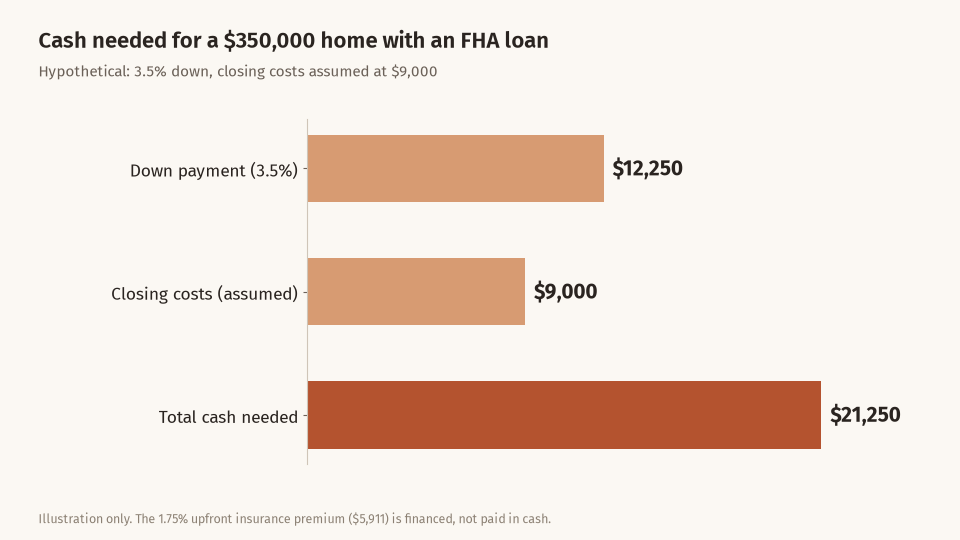
Sam buys a $350,000 home with an FHA loan and the minimum 3.5% down.
- Down payment: $350,000 × 3.5% = $12,250
- Base loan: $350,000 − $12,250 = $337,750
- Upfront mortgage insurance premium: $337,750 × 1.75% = $5,910.63, financed into the loan
- Total loan: $337,750 + $5,910.63 = $343,660.63
- Assumed closing costs: $9,000
- Cash needed at closing: $12,250 + $9,000 = $21,250
At an assumed rate of 6% over 30 years, the monthly principal and interest payment on $343,660.63 would be about $2,060. That excludes the annual mortgage insurance premium, property taxes and homeowner’s insurance, so the true monthly cost would be higher.
If you are also saving for retirement and tax-advantaged accounts, our guide to the Roth IRA rules covers how contributions work. Check how any withdrawal rules would apply before using retirement money for a home.
United Kingdom
Stamp Duty Land Tax (England and Northern Ireland)
In England and Northern Ireland you usually pay Stamp Duty Land Tax (SDLT) on portions of the price. For a home that will be your only residential property, the standard rates are:
| Portion of price | Rate |
|---|---|
| Up to £125,000 | 0% |
| £125,001 to £250,000 | 2% |
| £250,001 to £925,000 | 5% |
| £925,001 to £1.5 million | 10% |
| Above £1.5 million | 12% |
First-time buyers get relief if you and anyone you buy with are all first-time buyers. You pay no SDLT up to £300,000 and 5% on the portion from £300,001 to £500,000. If the price is over £500,000, you cannot claim the relief and the standard rates apply. If you buy another residential property, you usually pay a 5% surcharge on top, and non-UK residents usually pay an extra 2%.
Illustration using the published bands:
| Price | First-time buyer | Standard | You save |
|---|---|---|---|
| £250,000 | £0 | £2,500 | £2,500 |
| £300,000 | £0 | £5,000 | £5,000 |
| £400,000 | £5,000 | £10,000 | £5,000 |
| £500,000 | £10,000 | £15,000 | £5,000 |
| £520,000 | £16,000 | £16,000 | £0 |
For example, at £400,000, a first-time buyer pays 5% × £100,000 = £5,000. The standard calculation is £2,500 + 5% × £150,000 = £10,000, so relief saves £5,000. At £520,000 there is no relief, and the tax is £2,500 + 5% × £270,000 = £16,000.
Scotland and Wales do not use SDLT. Scotland has Land and Buildings Transaction Tax and Wales has Land Transaction Tax, each with its own rates, so check Revenue Scotland or GOV.WALES for your purchase.
The Lifetime ISA
A Lifetime ISA lets you save up to £4,000 a year until age 50, and you must make your first payment before you turn 40. The government adds a 25% bonus of up to £1,000 a year. The £4,000 counts towards your overall ISA limit, which is £20,000 for 2026 to 2027.
To use it for a first home, GOV.UK says all of these must apply:
- the property costs £450,000 or less
- you buy it at least 12 months after your first payment into the Lifetime ISA
- you use a conveyancer or solicitor, who is paid directly by the ISA provider
- you are buying with a mortgage
Any other withdrawal before age 60 costs a 25% charge. GOV.UK points out that this recovers the government bonus and applies to the whole amount, so taking out the whole pot means paying 25% of it. For example, £1,000 becomes £750.
Illustration: saving £4,000 a year for three years gives £12,000 of your own money plus a maximum bonus of £3,000, which is 25% of £12,000. That is £15,000, before any interest or investment growth.
Australia
The 5% Deposit Scheme
The Australian Government 5% Deposit Scheme (formerly the Home Guarantee Scheme) means the government guarantees part of your loan so you can buy with a smaller deposit. From 1 October 2025:
- first home buyers need a minimum 5% deposit, and single parents or legal guardians need a minimum 2%
- there are no income caps and no waitlist
- you do not pay Lenders Mortgage Insurance
You cannot apply directly. You apply through a participating lender, and once pre-approved you have 90 days to find a home and sign a contract. Both the purchase price and the lender’s valuation must be within the price cap for your location, and caps vary by state and area. For example, the government’s table shows $1,500,000 for the New South Wales capital city and listed regional centres but $800,000 for other NSW areas, and $950,000 against $650,000 in the same split for Victoria. You must meet ongoing obligations, such as living in the property as an owner-occupier, or the guarantee may no longer apply and your lender may require you to pay Lenders Mortgage Insurance or other costs. You remain responsible for all repayments.
Other Australian support
- First Home Super Saver Scheme: voluntary contributions to your super fund that can be used for a first home. The government site says you can save up to $50,000 plus earnings.
- Help to Buy: a shared equity scheme with a minimum 2% deposit, where the government contributes up to 30% or 40% of the purchase. Applications opened on 5 December 2025.
- State schemes: First Home Owner Grants and stamp duty (transfer duty) concessions are run by each state and territory, so check your state revenue office.
The European Union
There is no EU-wide first-time buyer scheme. Taxes, notary and registration fees, deposit norms and any state support are set by each country, so use your national consumer or housing authority and a local legal adviser. Treat any figure from another country as not applicable to yours.
| Country | Main support | Key limits |
|---|---|---|
| US | FHA loan: 3.5% down | Mortgage insurance on every loan |
| UK | Stamp duty relief; Lifetime ISA 25% bonus | Relief ends above £500,000; ISA home cap £450,000 |
| Australia | 5% Deposit Scheme; First Home Super Saver | Price caps by location; state grants vary |
| EU | No single scheme | Rules differ by country |
Costs to budget for beyond the deposit
- Taxes and government fees: SDLT in England and Northern Ireland, state duty in Australia, and recording and transfer taxes in the US.
- Lender fees: origination and valuation charges.
- Legal or closing costs: solicitor or conveyancer fees, or US title and closing services.
- Surveys and inspections.
- Insurance: mortgage insurance (US, if your down payment is under 20%, and always for FHA loans), plus homeowner’s or buildings and contents insurance.
- Moving and set-up costs.
- Ongoing costs: property taxes in the US, council tax in the UK, and maintenance.
If you are buying with a partner, our newlywed money checklist covers joint finances.

Common mistakes
- Budgeting for the deposit only. Closing costs and taxes can be substantial.
- Shopping for the home before the loan. Get pre-approved so you know your range.
- Not comparing loan offers. The CFPB suggests comparing Loan Estimates, and quotes for FHA and conventional loans.
- Ignoring the monthly total. Mortgage insurance, taxes and insurance add to principal and interest.
- Missing a threshold. In England, a £520,000 purchase loses stamp duty relief altogether.
- Withdrawing from a Lifetime ISA incorrectly. Failing the 12-month rule or the £450,000 cap triggers the 25% charge.
- Skipping the final check. Compare your Closing Disclosure with your Loan Estimate, and read the CFPB’s closing scam guidance before you wire money.
- Assuming schemes never change. Check the official page before relying on a limit.
Frequently asked questions
How much deposit do I need to buy my first home?
It depends on the country and loan. An FHA loan in the US allows as little as 3.5% down, and Australia’s 5% Deposit Scheme allows a minimum 5% deposit for eligible first home buyers. Many lenders set their own requirements, so ask.
What credit score do I need for an FHA loan?
HUD’s handbook says a score of 580 or higher is eligible for maximum financing, while 500 to 579 is limited to a 90% loan-to-value ratio. Lenders can set stricter requirements.
Do first-time buyers pay stamp duty in the UK?
In England and Northern Ireland, first-time buyers pay no SDLT up to £300,000 and 5% on the portion from £300,001 to £500,000. Above £500,000, standard rates apply to the whole price. Scotland and Wales have their own taxes.
Can I use a Lifetime ISA for any home?
No. The home must cost £450,000 or less, you must use a conveyancer or solicitor, and you must have held the account for 12 months, among other conditions. Other withdrawals before age 60 cost 25%.
Does the Australian 5% Deposit Scheme have an income cap?
Not since 1 October 2025, according to the government site. There are property price caps by location, and you must apply through a participating lender.
What is the difference between a Loan Estimate and a Closing Disclosure?
The Loan Estimate comes within three business days of your application and shows expected terms. The Closing Disclosure shows the final terms and costs, and you must receive it three business days before closing.
This article is general education about home buying, not financial, legal or tax advice. Rules, limits and schemes change and your situation is your own. Check the official sources below, and consider talking to a qualified adviser, lender or solicitor before making decisions. See our Editorial Policy and Disclaimer pages for how we work.
Sources
- CFPB: Buying a house, tools and resources
- CFPB: What is a Loan Estimate?
- CFPB: Closing Disclosure explainer
- CFPB: FHA loans
- HUD: Mortgagee Letter 2025-23, 2026 FHA loan limits
- HUD: FHA Single Family Housing Policy Handbook 4000.1
- GOV.UK: Stamp Duty Land Tax residential property rates
- GOV.UK: Lifetime ISA overview
- GOV.UK: Withdrawing money from your Lifetime ISA
- Revenue Scotland: Land and Buildings Transaction Tax, residential property
- GOV.WALES: Land Transaction Tax rates and bands
- Australian Government: 5% Deposit Scheme
- Australian Government: First Home Buyers programs overview
- Australian Government: 5% Deposit Scheme property price caps