
Last verified: October 2026. The guidance quoted here was checked against the pages listed at the end of the article, and the worked example was recalculated.
We overspend because spending is driven by feelings, habits and marketing as much as by price. Stress, boredom, fear of missing out, the way we mentally label our money and how easy it is to pay all push us to buy things we did not plan. The official guidance suggests the fix is mostly about adding a pause and some friction, not about more willpower.
This guide explains the main drivers described by UK and Australian consumer agencies and the US CFPB, then walks through practical ways to stop impulse buying, with a worked example.
Key takeaways
- Not every impulse purchase is a problem. Moneysmart says it becomes one when unplanned spending turns into a habit that makes it harder to keep to your budget.
- Emotions and mental accounting matter. MoneyHelper describes how stress, boredom, ads and the “pot” we put money into change what we spend.
- Pausing works as a tool. Both MoneyHelper and Moneysmart recommend waiting at least 24 hours before unplanned, non-essential buys.
- Make spending slightly harder. Delete saved card details, unsubscribe and unfollow.
- Watch buy now, pay later. The CFPB found that most BNPL borrowers in its 2022 data had overlapping loans at some point.

Why we overspend
Money has meaning, and it starts early
MoneyHelper cites research from the Money and Pensions Service showing that attitudes to money start forming before the age of seven, and that they are often wrapped up in feelings like envy, shame or fear. That may help explain why two people on the same income can spend very differently, and why a new flatmate or partner with a different spending style can cause friction.
Mental accounting
MoneyHelper describes a concept psychologists call “mental accounting”: we sort money into pots in our heads, and the pot changes how we spend it. Its example is that if we win £50 we may think it is time to treat ourselves, but if we earn £50 working extra hours we are more likely to spend it on the gas bill.
MoneyHelper also notes that money can feel different when we use credit rather than cash. That is one reason it suggests using cash to make spending feel real.
Emotional spending
Some people admit they overspend when stressed or bored. For others it is glossy ads or social media. MoneyHelper is blunt about “retail therapy”: shopping is not the way to long-term happiness, and it says most things that give us real joy do not come with a receipt. It suggests asking whether you would feel better going for a walk, calling family or meeting a friend.
Marketing and the fear of missing out
MoneyHelper says marketing often plays on our fear of missing out. Moneysmart adds that sales, discounts, social media recommendations and personalised advertising can encourage quick decisions before you have had time to think. It lists tactics worth recognising:
| Tactic | What it can do | Ask yourself |
|---|---|---|
| Limited-time offer | Creates urgency to act quickly | Would I want it without a deadline? |
| Discount or sale | Can tempt you to buy what you do not need | Was I already planning to buy it? |
| Scarcity message | Triggers fear of missing out | Does it meet my needs and budget? |
| Reviews, influencers | Can influence what you buy | Would I still buy it tomorrow? |
Moneysmart also makes a point worth underlining: a discount saves money only if you were already planning to buy the item. Buying something you do not need because it is on sale can leave you worse off.
Easy payment and pay-later credit
Buy now, pay later (BNPL) is a particular risk because it lowers the barrier to spending. The CFPB defines BNPL loans as generally zero-interest loans repaid in four or fewer instalments. In a January 2025 report using data from six large BNPL firms, it found:
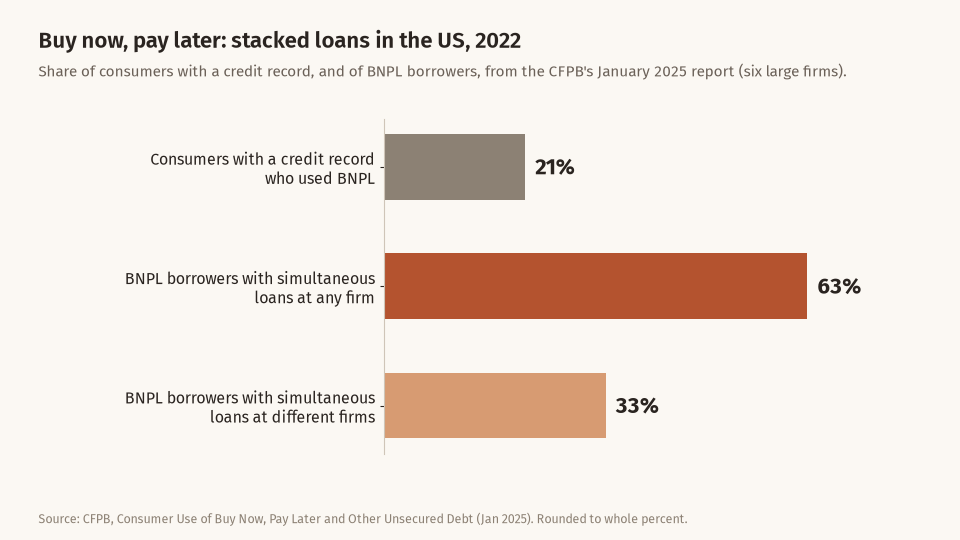
- 21% of consumers with a credit record used BNPL at least once in 2022.
- About 63% of borrowers took out overlapping loans at some point that year, and about 33% did so across more than one firm.
- Most of these loans did not appear in credit records, because lenders typically do not report pay-in-four loans to the national reporting companies.
- Holding several loans at once became more common during the holiday shopping season.
The report is about the US in 2022, so check current figures for your own country. The practical point is that several small instalment plans can add up to a total you never looked at in one place. MoneyHelper’s own advice is to delete saved BNPL logins along with saved card details.
Signs you might be overspending
MoneyHelper lists some questions that can help you tell whether this is a problem:
- Do you spend more than you have?
- Does money cause you stress?
- Do you feel bad after buying things?
- Are you behind on bills or going into debt to pay them?
- Do you have clothes in the cupboard with the labels still on, or tools still in the box?
If several of these ring true, it is worth working on, and the next section is where to start.
How to stop impulse buying
1. Recognise your triggers
MoneyHelper says recognising what makes you want to shop is the first step. Are you more likely to order a takeaway after a hard day or shop online after an argument? Notice the connection between your feelings and your spending and plan for it.
2. Ask five questions before an unplanned purchase
Moneysmart suggests asking:
- Can I afford it? Will I need BNPL, a credit card or another debt to buy it?
- Do I need it right now?
- Have I compared my options?
- What will it cost in the long run, including subscriptions, maintenance, insurance, fees or interest?
- Will I still want it tomorrow?
3. Use the 24-hour rule
Both agencies recommend waiting. MoneyHelper says not to buy anything non-essential without waiting a full day to decide if it is really worth it, and to save the link in a notes app for later. Moneysmart suggests at least 24 hours for an unplanned purchase.
4. Make spending harder
MoneyHelper’s tips: unfollow and unsubscribe from the brands that tempt you, remove saved card details from your browser and digital wallets, and delete saved PayPal or BNPL login details. Avoid shopping when tired or stressed. It calls late-night browsing when you cannot sleep “vampire shopping” and says it can lead to spending more than you want to.
5. Track what you spend
Moneysmart says many people are surprised when they add up their spending, because small purchases add up fast. It suggests reviewing a few months of statements, grouping spending into categories, and looking for fees and subscriptions you no longer use. Then write down everything you spend for a couple of weeks, including cash. Our budget guide shows how to turn that into a plan.
6. Set a limit for wants
Moneysmart suggests separating needs from wants and setting a weekly or monthly limit for wants. That keeps some room for enjoyment. MoneyHelper says watching your spending does not mean the end of fun, and suggests budgeting for fun things too.
7. Keep a list and redirect the money
MoneyHelper suggests making a list of things you want to buy and looking back at it in a few weeks: when you check the list, you may be surprised at what you do not want any more. It also suggests that if there is something you really want, you put the money you were tempted to spend into a savings pot and enjoy making progress towards that target instead. Our guide to saving money every month has more on building that habit.
A worked example: the two-week wish list
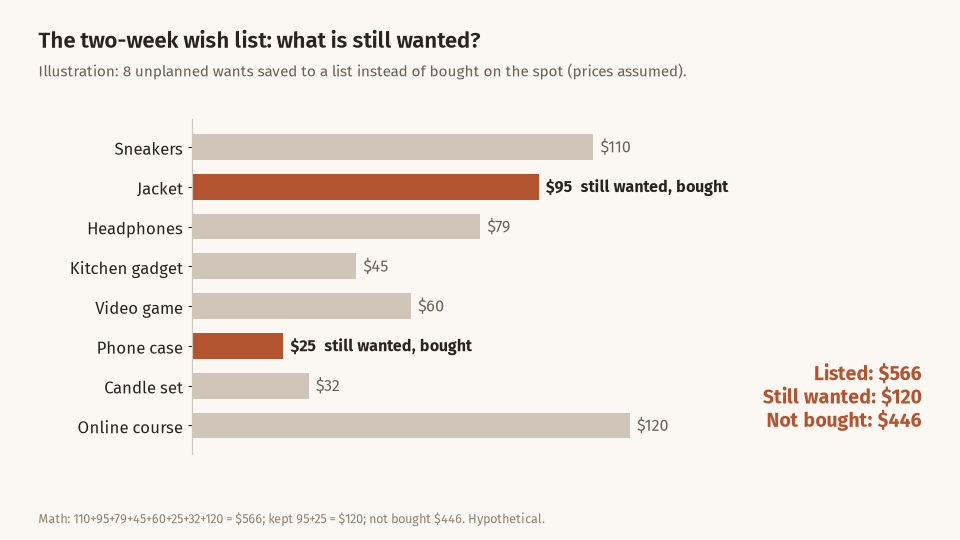
This is an illustration: the items, prices and choices are made up to show the method.
Over one month, you notice eight things you want to buy. Instead of buying, you add each to a list in your notes app with its price:
| Item | Price |
|---|---|
| Sneakers | $110 |
| Jacket | $95 |
| Headphones | $79 |
| Kitchen gadget | $45 |
| Video game | $60 |
| Phone case | $25 |
| Candle set | $32 |
| Online course | $120 |
The total is $110 + $95 + $79 + $45 + $60 + $25 + $32 + $120 = $566.
After two weeks you look at the list and ask the five questions. You decide that only the jacket ($95) and the phone case ($25) are things you still want and have room for in your budget. That is $120 spent and $446 not spent, about 79% of the list. If you move that $446 into a savings pot, as MoneyHelper suggests, it goes toward a goal you chose.
The example does not prove that the method works for everyone. Different people will drop different items, and some will still want most of them. The value is in making the choice deliberately rather than in the moment. If you want a place for the savings, start with a small cash buffer.

When overspending is a bigger problem
If spending is getting out of control, reaching for help is sensible. MoneyHelper points to tips for managing compulsive spending, support groups and debt advisers. For debt help in the US, the CFPB says credit counseling organizations are usually non-profit and can help with budgets and debt management plans. In Australia, Moneysmart says financial counselling is free and confidential, and the National Debt Helpline is 1800 007 007.
Common mistakes
- Shopping when stressed, tired or hungry. MoneyHelper says not to shop when you are hungry or upset.
- Believing a sale is a saving. It only saves money if you were already going to buy it.
- Leaving card and BNPL details saved. Removing them adds a useful moment of friction.
- Never tracking. If you do not know where the money goes, a limit is just a guess.
- Cutting all fun. A budget with no room for enjoyment is harder to keep.
- Stacking small pay-later plans without adding them up.
- Using willpower alone. Change the environment, such as unsubscribing, rather than relying on resisting every time.
Frequently asked questions
Is impulse buying always bad?
No. Moneysmart says not every impulse purchase is a problem. It matters when unplanned spending becomes a habit that makes it harder to stick to your budget, save or stay in control of your money.
What is the 24-hour rule?
You wait at least a day before buying something non-essential or unplanned. MoneyHelper suggests saving the link in a notes app and says you will probably forget about it. Moneysmart recommends the same wait for unplanned purchases.
What is mental accounting?
It is a concept psychologists use for the way we sort money into mental pots, such as “windfall” and “earned”, and spend each pot differently. MoneyHelper’s example is a £50 win versus £50 earned from extra hours.
Is buy now, pay later a bad idea?
It can be fine if repayments fit your budget, but the CFPB’s data shows that overlapping loans were common among borrowers and mostly did not appear in credit records. Because the CFPB defines BNPL as zero-interest, check the terms for late fees before you use it, and add up what you owe across providers.
How do I stop online shopping late at night?
MoneyHelper suggests not shopping when tired or stressed, removing saved card details and unsubscribing from tempting brands. It also suggests saving the link and returning to it the next day.
When should I get help?
If you spend more than you have, feel stressed about money, or are behind on bills or borrowing to pay them, look for free and independent support. In the UK that includes MoneyHelper and debt advisers, in the US non-profit credit counseling, and in Australia financial counselling.
This article is general information, not financial advice. Rules, limits and rates change, and your circumstances are your own. All figures in the worked example are hypothetical. Check the official sources below, and consider speaking to a qualified adviser before making decisions. See our Editorial Policy and Disclaimer pages. Last verified: October 2026.
Sources
- MoneyHelper (UK): The psychology of spending (updated 1 July 2026)
- Moneysmart (ASIC): Avoiding sales pressure (updated 21 October 2026)
- Moneysmart (ASIC): Track your spending (updated 9 October 2026)
- CFPB: Consumer Use of Buy Now, Pay Later and Other Unsecured Debt (Jan 2025)
- CFPB: Consumer Use of Buy Now, Pay Later and Other Unsecured Debt, full report (PDF)
- Moneysmart (ASIC): Financial counselling
- CFPB: What is credit counseling?