

Last verified: October 2026. Figures and rules below were checked against the official sources listed at the end of the article.
A 401(k) is a retirement plan you get through your employer. An IRA (individual retirement arrangement) is an account you open yourself at a bank, broker or fund company. For 2026 you can put up to $24,500 into a 401(k) and up to $7,500 into an IRA, and you are allowed to use both. The 401(k) has the higher limit and often comes with an employer match. The IRA usually has more investment choices and, if you pick Roth, a way to take tax-free income later.
This guide covers how each account works in 2026, how traditional and Roth versions differ, when the 10% early-withdrawal tax applies, and what the closest equivalents are in the UK, Australia and the EU.
Key takeaways
- 2026 limits: $24,500 for a 401(k) (plus $8,000 if you are 50 or over, or $11,250 at 60 to 63) and $7,500 for an IRA (plus $1,100 at 50 or over).
- Employer match is part of your pay. If your plan offers one, you generally want to contribute enough to receive all of it before you look at other accounts.
- Traditional vs Roth is a tax-timing choice. Traditional gives a tax break now and taxes withdrawals. Roth gives no break now and, if the rules are met, tax-free withdrawals.
- Withdrawing before 59½ usually costs an extra 10%, with a short list of exceptions.
- UK: the workplace pension and personal pension cover the 401(k) and IRA roles, and an ISA acts a little like a Roth. Australia: superannuation covers both roles, with a 12% employer contribution.
What a 401(k) is and how it works
A 401(k) is a workplace plan. You choose a percentage of your pay to contribute, and your employer sends it to the plan and invests it in the options the plan offers. Because the money comes straight from your paycheck, saving is automatic.
The IRS sets the maximum you can contribute from your own pay each year. For 2026 that is $24,500. If you are 50 or older you can add a catch-up of $8,000, for a total of $32,500. People aged 60 to 63 can add a larger catch-up of $11,250, for a total of $35,750. There is also an overall cap on all money going in, including employer contributions, of $72,000 in 2026 (before catch-ups). Your own plan can set a lower limit than the IRS maximum, so check the plan documents.
There are two tax flavours, if your plan offers both:
- Traditional 401(k): contributions come out of your pay before income tax, so your taxable income is lower this year. Withdrawals in retirement are taxed as income.
- Roth 401(k): contributions are made from pay that has already been taxed. Qualified withdrawals later are tax-free. The IRS notes that a Roth 401(k) has no income limit for contributing, unlike a Roth IRA.
One newer rule matters for higher earners. From 2026, if your wages from your employer in the prior year were above $150,000, any catch-up contribution you make to a plan with Roth features must be a Roth contribution.
The employer match
Many plans add money when you contribute. The IRS gives one example formula: the employer matches 50% of your contributions up to 5% of your salary. The plan document states the conditions for receiving it, and matching money is taxable when you withdraw it. A match does not reduce the amount you can put in yourself.
What an IRA is and how it works
An IRA is not tied to an employer. You open it, fund it and choose its investments. The limit for 2026 is $7,500, or $8,600 if you are 50 or older. It is the lesser of that limit and your taxable compensation for the year. Traditional and Roth IRAs share this one limit: you could put $4,000 in one and $3,500 in the other, but not $7,500 in each. There is no age limit for making regular contributions as long as you have earned income. A spouse with little or no income can generally also contribute based on a working spouse’s income, subject to the same limit.
Putting more than the limit in has a cost: the IRS taxes excess contributions at 6% for each year they stay in the account.
Traditional IRA
Contributions may be tax-deductible, but whether they are depends on your income and whether you (or your spouse) are covered by a workplace plan. For 2026, if you are covered at work, the deduction phases out between $81,000 and $91,000 of income for a single filer and $129,000 to $149,000 for a married couple filing jointly. Withdrawals are taxed as income.
Roth IRA
You get no deduction going in. A qualified withdrawal comes out tax-free, and the original owner has no required minimum distributions. Whether you can contribute depends on income: for 2026 the Roth IRA limit phases out between $153,000 and $168,000 for single filers and $242,000 to $252,000 for married couples filing jointly. To be “qualified”, a withdrawal must come after a five-year period and after age 59½ (or because of disability or death). Our Roth IRA guide goes deeper on the rules.
401(k) vs IRA side by side
| 401(k) | IRA | |
|---|---|---|
| Who sets it up | Your employer | You |
| 2026 limit | $24,500 (+$8,000 at 50+, +$11,250 at 60 to 63) | $7,500 (+$1,100 at 50+) |
| Employer match | Possible | None |
| Roth option | Only if your plan offers it; no income limit | Yes; income limits apply |
| Investment choices | The plan’s menu | Usually much wider |
| Income limits for tax break | None for contributing | Deduction (traditional) and eligibility (Roth) phase out with income |
| Required minimum distributions | Traditional from age 73 | Traditional from age 73; none for Roth IRA owners |
Traditional vs Roth: a worked example
The choice comes down to whether your tax rate is higher now or in retirement. Here is an illustration with made-up numbers, not a forecast. Suppose you pay 22% tax on your top dollars today and your money grows at a hypothetical 6% a year for 10 years.
- Traditional: you contribute $5,000 before tax. It grows to $5,000 × 1.06¹⁰ = $8,954.24. You pay tax when you withdraw it.
- Roth: the same take-home cost is $5,000 × (1 − 0.22) = $3,900 of after-tax money. That grows to $3,900 × 1.06¹⁰ = $6,984.31, and comes out tax-free.
If your tax rate in retirement is also 22%, the traditional account leaves you with $8,954.24 × 0.78 = $6,984.31, identical to the Roth. If your rate in retirement falls to 12%, traditional leaves $7,879.73. If it rises to 32%, traditional leaves $6,088.88 and the Roth wins.
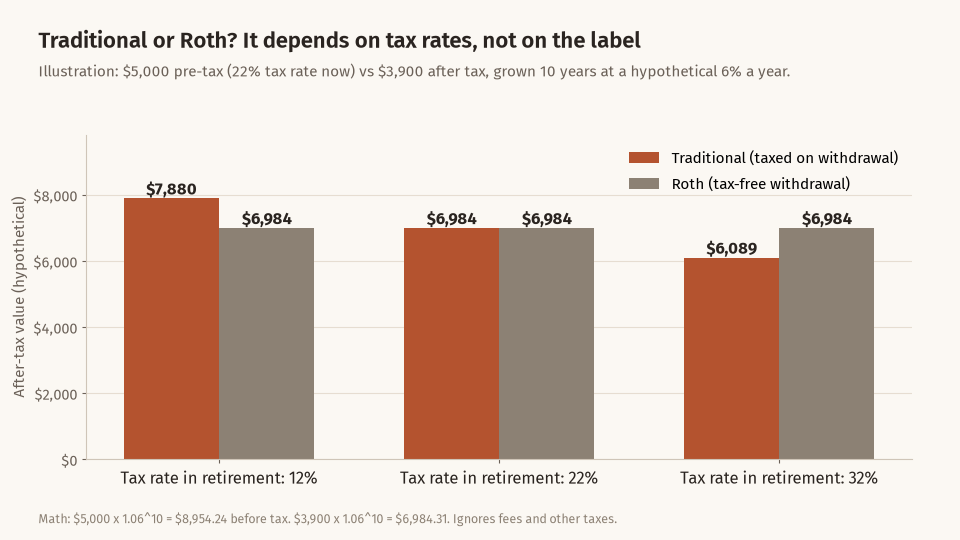
What that tells you: neither type is automatically better. A Roth gives you tax certainty, because you already paid. A traditional account is a bet that your rate will be lower later. Many people split between the two because nobody knows future tax rates.

Using both: a sensible order
Which account first is a judgement call, not a rule, and it depends on your plan. A common sequence is:
- Contribute enough to your 401(k) to get the full match. It is the only place where an employer adds money for you.
- Then consider an IRA for its wider investment choice, using traditional or Roth depending on the income limits above.
- Then go back to the 401(k) for more, up to the $24,500 limit, if you have room in your budget. Our guide on how much to save for retirement helps you size the total.
First make sure you have a cushion for emergencies. Our guide to the emergency fund explains how much to keep in cash so that you are not forced to dip into retirement money early.
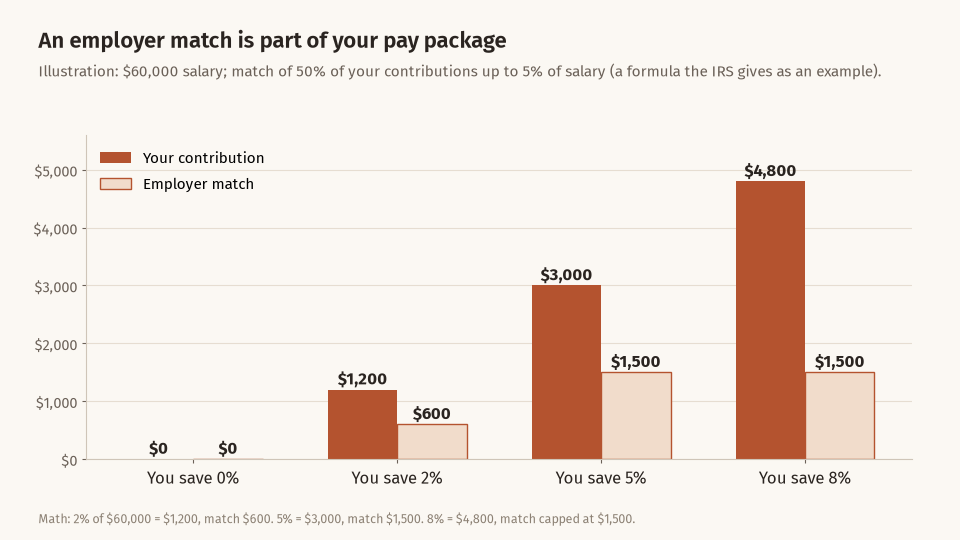
Match example
Take an illustrative salary of $60,000 and the IRS example formula of a 50% match on contributions up to 5% of salary. At 2% ($1,200) you get $600 from your employer. At 5% ($3,000) you get $1,500. At 8% ($4,800) the match stays at $1,500, because it stops at 5% of salary. Saving the extra 3% beyond the match is still worthwhile, but it no longer earns extra employer money.
Taking money out: early withdrawals and RMDs
Money in these accounts is meant for retirement. Take it out before age 59½ and the IRS generally adds a 10% additional tax on top of regular income tax, unless an exception applies. Exceptions that apply to both 401(k)s and IRAs include up to $5,000 for a birth or adoption, one emergency personal expense of up to $1,000 a year, and domestic abuse (the lesser of $10,000 or 50% of the account). An IRA also has exceptions for a first home (up to $10,000) and qualified education costs. A 401(k) also has an exception if you leave your employer at age 55 or later. Exceptions remove the 10%; ordinary income tax can still apply.
At the other end, traditional accounts have required minimum distributions (RMDs) starting at age 73. If you take too little, the excise tax is 25% of the shortfall, or 10% if you fix it within two years. Roth IRAs have no RMDs for the original owner.
The UK equivalents
The UK has no 401(k) or IRA, but the roles are covered.
- Workplace pension (like a 401(k)): employers must enrol eligible workers automatically. The minimum is 8% of qualifying earnings (the band between £6,240 and £50,270), made up of at least 5% from you and 3% from your employer. GOV.UK’s own example: you pay £40, your employer £30, and tax relief adds £10, for £80 in total.
- Personal pension or SIPP (like an IRA): you open it yourself. You get tax relief on contributions up to 100% of your annual earnings. If relief is added at source at 20%, a £800 payment becomes £1,000 in the pension. Higher-rate taxpayers claim the extra relief through Self Assessment.
- Annual allowance: £60,000 across all your pensions in a tax year, with a taper for very high incomes and the option to carry forward unused allowance from the previous three years.
- ISA (a bit like a Roth): you can save up to £20,000 a year, and there is no tax on interest, income or gains. It is not a pension, but you can use it before retirement.
- Access: you can usually take pension money from 55, rising to 57 from April 2028. You can take 25% tax-free, up to a lifetime maximum of £268,275.
The Australian equivalent: superannuation
Australia uses one system, superannuation, rather than two account types.
- Employer contributions: employers must pay the super guarantee, which is 12% of your pay, on top of your salary. As an illustration, on an $80,000 salary that is $9,600 a year. Contributions are taxed at 15% in the fund, so about $8,160 of it ends up invested.
- Your own contributions: you can add before-tax money (concessional) or after-tax money (non-concessional). For 2026–27 the concessional cap is $32,500 and the non-concessional cap is $130,000. Unused concessional cap can be carried forward in some cases.
- Higher incomes: Division 293 tax adds another 15% on concessional contributions if your income plus those contributions exceeds $250,000.
- Access: the preservation age is 60 for people born from 1 July 1964. After 60, withdrawals from a taxed fund, as a lump sum or an account-based pension, are tax-free. That works like a Roth outcome, though the tax is paid earlier, inside the fund.
| United States | United Kingdom | Australia | |
|---|---|---|---|
| Through work | 401(k) | Workplace pension: minimum 8% in total | Super guarantee: employer pays 12% |
| On your own | IRA (traditional or Roth) | Personal pension or SIPP | Voluntary super contributions |
| Annual limit | 401(k) $24,500, IRA $7,500 (2026) | Annual allowance £60,000 | Concessional cap $32,500 (2026–27) |
| Tax-free option | Roth 401(k), Roth IRA | Stocks and shares ISA, £20,000 a year | After 60, taxed-fund withdrawals are tax-free |
| Access | 59½ without the 10% extra tax | 55 (57 from 6 April 2028) | Preservation age 60 (born from 1 July 1964) |
The EU
There is no single European retirement account. Pensions are mainly national, and tax rules, contribution limits and withdrawal ages vary by country, so check your own country’s pension authority. The EU did create the Pan-European Personal Pension Product (PEPP) under Regulation (EU) 2019/1238, a voluntary, portable personal pension. Member States still decide the tax treatment, so what you get depends on where you live.
Common mistakes
- Missing the match. Contributing less than the match threshold leaves free money on the table.
- Assuming your plan allows the full IRS limit. The plan can set its own lower cap.
- Contributing to a Roth IRA when you are over the income limit. Excess contributions are taxed at 6% a year until fixed.
- Treating retirement accounts as the emergency fund. Early withdrawals can cost the 10% additional tax plus income tax.
- Splitting the IRA limit twice. Traditional and Roth IRAs share one limit.
- Ignoring fees. Compare the cost of the funds in your plan and in an IRA. Our ETF guide explains how fund costs work.
Frequently asked questions
Can I have both a 401(k) and an IRA?
Yes. The limits are separate. Having a workplace plan can reduce or remove your traditional IRA deduction at higher incomes, and Roth IRA eligibility depends on income, but you can still contribute.
Is a Roth or traditional account better?
It depends on whether your tax rate is higher now or in retirement. If you expect it to be lower later, traditional can leave you with more. If higher, Roth can. The worked example above shows the break-even point at equal rates.
What happens to my 401(k) if I change jobs?
Usually you can leave the money in the old plan, move it to your new employer’s plan, or move it to an IRA. Rules and options depend on the plan and its balance, so ask the plan administrator before you move anything.
Can I withdraw money early without the 10% tax?
Only if an exception applies, such as the ones listed above. Regular income tax can still apply. The IRS lists the exceptions on its early distributions page.
Are RMDs required from a Roth IRA?
No, not for the original owner. Traditional IRAs and traditional 401(k)s have RMDs starting at age 73.
Is a UK ISA the same as a Roth IRA?
Not exactly. An ISA has no tax on interest, income or gains, and you can use the money at any time. A Roth IRA has US-specific rules about age, five-year periods and income limits.
This article is general information, not financial advice. Rules, limits and rates change, and your circumstances are your own. Check the official sources below, and consider speaking to a qualified adviser before making decisions. See our Editorial Policy and Disclaimer pages. Last verified: October 2026.
Sources
- IRS news release: 401(k) limit increases to $24,500 for 2026, IRA limit increases to $7,500
- IRS: 401(k) and profit-sharing plan contribution limits
- IRS: IRA contribution limits
- IRS: Roth IRAs
- IRS: Roth comparison chart
- IRS: Catch-up contributions
- IRS: Matching contributions help you save more for retirement
- IRS: Exceptions to tax on early distributions
- IRS: Required minimum distributions (RMDs)
- GOV.UK: Tax on your private pension contributions (annual allowance)
- GOV.UK: Tax relief on pension contributions
- GOV.UK: Workplace pensions: what you, your employer and the government pay
- GOV.UK: How ISAs work
- GOV.UK: Tax on your private pension: tax-free lump sum
- MoneyHelper: How much should I save for retirement?
- ATO: Contributions caps
- ATO: Super guarantee
- ATO: Tax on super benefits
- ATO: Super withdrawal options
- Moneysmart (ASIC): Tax and super
- EUR-Lex: Regulation (EU) 2019/1238 on a pan-European Personal Pension Product (PEPP)