
Last verified: October 2026. This article covers US federal income tax only. Figures come from IRS sources listed at the end and were checked in October 2026.
A tax refund is your own money coming back to you. During the year your employer holds back federal income tax from each paycheck, and when you file, the IRS compares what was withheld with what you actually owe. If more was withheld, you get the difference as a refund. If less, you pay the rest. You control the size of that gap through your Form W-4, the form that tells your employer how much to withhold.
This guide is about US federal taxes only. Rules for UK, EU and Australian taxpayers are different, and we do not cover them here.
Key takeaways
- A refund is overpaid tax returned, not a bonus. A big refund means you lent the government money at 0% interest for a year.
- Your Form W-4 drives withholding. Check it after any life change (new job, marriage, a child, a second income) and at least once a year.
- The IRS Tax Withholding Estimator is the most reliable way to set it. It takes about 25 minutes and does not save your data.
- If you owe more than $1,000 at filing, you may face an underpayment penalty unless you paid at least 90% of this year’s tax or 100% of last year’s (110% for higher earners).
- The typical e-filed refund takes about three weeks; returns claiming the Earned Income Credit are held until mid-February.
How withholding works
Withholding is a pay-as-you-go system. The tax law says you owe tax on income as you earn it, and your employer collects that tax for you. It is done in three steps:
- You fill in Form W-4 when you start a job. It records your filing status, any extra jobs in the household, children or other dependants, and any adjustments.
- Your employer uses the IRS withholding tables and your W-4 to estimate your yearly tax, then spreads it across your paychecks.
- After the year ends, you file a return. Your tax is compared with the total already paid. The result is either a refund or a balance due.
The estimate is only as good as the information on the W-4. If you have a second job, or a spouse who works, or income that has no withholding at all (side income, interest, dividends), the standard table can under-withhold. If you claimed adjustments you no longer qualify for, or you are generous with extra withholding, it can over-withhold.
A worked example (illustration only)
The figures below are a hypothetical example to show the arithmetic, not a forecast for any real person. It uses the 2026 tax rates and standard deduction published by the IRS in Rev. Proc. 2025-32 for a single filer with $60,000 of wages, no children, no other income and no credits.
- Standard deduction for a single filer in 2026: $16,100
- Taxable income: $60,000 − $16,100 = $43,900
- Tax: 10% on the first $12,400 = $1,240, plus 12% on the next $31,500 ($43,900 − $12,400) = $3,780
- Total federal income tax: $5,020
Now compare two ways the year could end, depending on what the employer withheld:
| Scenario | Withheld | Tax owed | Result |
|---|---|---|---|
| Over-withheld | $6,200 | $5,020 | Refund of $1,180 |
| Under-withheld | $4,300 | $5,020 | Balance due of $720 |
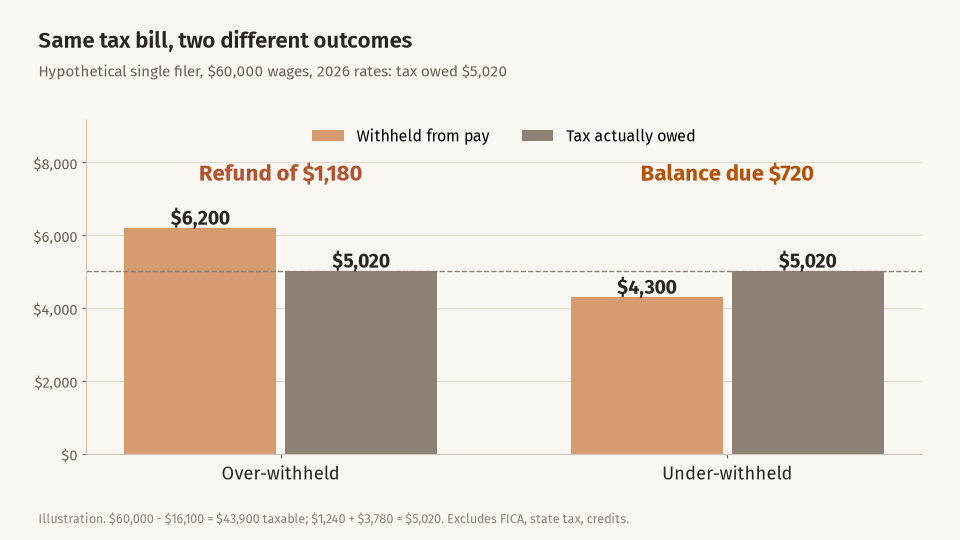
In the first scenario the $1,180 refund looks like a nice gift. It is also $98.33 a month ($1,180 ÷ 12) of take-home pay that was held back all year. You could have used it for rent, an emergency fund or debt payments. In the second scenario, the $720 bill may arrive at a bad time, and if it is large enough it can trigger a penalty (see below).
Neither result is a mistake in itself. The goal is a result close to zero, with a small cushion if that makes you comfortable.
Why average refunds changed in 2026
The IRS reported that through the week ending 8 May 2026, the average refund was $3,276, compared with $2,939 at the same point of the 2025 filing season. For the full 2026 season, the National Taxpayer Advocate’s mid-year report gives an average refund of $3,275 across 90.411 million refunds.
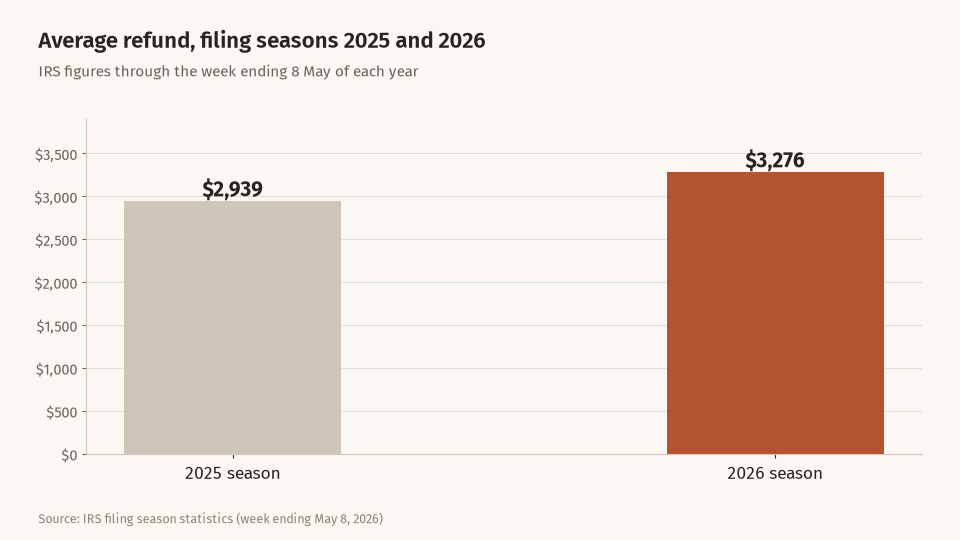
The IRS linked the increase to new deductions from the 2025 tax law, including those for tips and overtime. That is a useful reminder that tax law changes affect your refund even when your pay does not. A bigger refund because of new deductions also means you could have had more in each paycheck. The 2026 W-4 now has a worksheet for several of these deductions (see below).
How to check your Form W-4
The 2026 Form W-4 has five steps. Step 1 (your details) and Step 5 (your signature) are always needed. The IRS says to complete Steps 2 to 4 only if they apply to you.
| Step | What it covers | Needed when |
|---|---|---|
| 1. Personal details | Name, address, filing status | Always |
| 2. Multiple jobs | Second job or working spouse | You have more than one income |
| 3. Dependents | $2,200 per child under 17, $500 per other dependent | You expect to claim these credits |
| 4. Other adjustments | Other income, deductions, extra withholding | Side income, itemizing, or you want more withheld |
| 5. Sign | Certify the form is correct | Always |
Step 2: more than one job
If you have two jobs, or you and your spouse both work, each employer withholds as if that job is your only income. That usually under-withholds. The form offers three ways to correct it: the IRS Tax Withholding Estimator, the multiple-jobs worksheet, or (for exactly two jobs with similar pay) a checkbox on both W-4s. The estimator is the most accurate of the three.
Step 3: children and other dependants
On the 2026 form, Step 3 uses $2,200 for each qualifying child under 17 and $500 for each other dependent. These reduce your withholding to match the credits you are expected to claim. You are only meant to claim them if your income is $200,000 or less ($400,000 if married filing jointly). See our guide on tax credits and how they differ from deductions for more on the credits themselves.
Step 4: other adjustments
- 4(a) adds other income that has no withholding, such as interest or dividends.
- 4(b) lowers withholding if you expect deductions above the standard deduction. The 2026 form has a Deductions Worksheet that now covers tips, overtime, vehicle loan interest, the deduction for seniors, state and local taxes, medical expenses and charitable gifts.
- 4(c) adds a flat extra amount to each paycheck. This is the simplest lever if you want to withhold more.
Use the IRS estimator
The Tax Withholding Estimator asks for your most recent pay stubs (and your last return if you have other income or plan to itemize) and then produces a pre-filled W-4. The IRS says it takes about 25 minutes, does not ask for your name or Social Security number, and does not save your answers. The IRS advises checking your withholding every January and after a major change: a new job, a big income change, marriage, divorce, a new child, or buying a home.
Once you have the results, the estimator can fill in a new Form W-4 for you to give to your employer. Check your next pay stub to confirm the change has taken effect.

What if you work for yourself or have side income?
If you have no employer to withhold tax, you generally pay through estimated tax payments. The IRS says you generally need to if you expect to owe $1,000 or more after withholding and credits. Our guide to self-employed taxes covers estimated payments, and the side hustle guide covers what is taxable. If you have a job and a side income, one shortcut is to raise withholding at your job using Step 4(c) instead of making quarterly payments.
The underpayment penalty
If you do not pay enough tax during the year, through withholding or estimated payments, the IRS charges an underpayment penalty, which works like interest on the shortfall. The IRS explains the main exceptions in Topic 306 and Publication 505. You can generally avoid the penalty if:
- You owe less than $1,000 after subtracting withholding and credits, or
- Your withholding and credits cover at least 90% of this year’s tax or 100% of last year’s tax, whichever is smaller. If last year’s adjusted gross income was above $150,000 ($75,000 if married filing separately), the prior-year safe harbor rises to 110%.
If you realise late in the year that you are short, a new W-4 with extra withholding in Step 4(c) is one way to catch up, and the IRS estimator can tell you how much. If you make estimated payments instead, the 2026 the due dates are 15 April, 15 June, 15 September 2026 and 15 January 2027.
Getting your refund
The IRS says your refund status is available 24 hours after you e-file a current-year return, or four weeks after you file on paper. The typical time to receive an e-filed refund is three weeks, and six or more weeks for a mailed return. Refunds that include the Earned Income Credit are held until mid-February by law, and the IRS notes that the Additional Child Tax Credit also needs more review time. A refund can be reduced to pay prior taxes owed or a past-due debt such as child support, a federal agency nontax debt or state income tax. You can track it with the IRS refund tracker, the IRS app, or your online IRS account; without signing in you need your exact refund amount, Social Security number or ITIN, filing status and tax year.
Common mistakes
- Treating a big refund as a good result. It is a sign that too much was withheld. If your finances are tight, a smaller refund and a bigger paycheck can help more. See our guide to breaking the paycheck-to-paycheck cycle for practical steps.
- Never updating the W-4 after a life change. A new job, a marriage or a second income can all change what you owe.
- Claiming dependants on a W-4 that you cannot claim on your return. This under-withholds and can lead to a bill.
- Ignoring income with no withholding. Freelance income, interest, dividends and unemployment benefits are all taxable.
- Claiming “exempt” without checking. Exemption from withholding is only for people who had no federal income tax liability last year and expect none this year, and it must be renewed every year. The 2026 form says you must submit a new W-4 by 16 February 2027.
- Choosing withholding to reach a refund target. The goal is accuracy, not a refund.
FAQ
Is a tax refund good or bad?
It is neutral. A refund means you overpaid during the year and are getting the money back, without interest. A balance due means you underpaid. Both are fine in moderation, but a large refund every year suggests your paychecks are smaller than they need to be.
How often should I update my W-4?
At least once a year, ideally in January, and whenever your income, family or deductions change. The IRS recommends using its Tax Withholding Estimator for these checks.
Can I change my W-4 at any time?
Yes. You can give your employer a new Form W-4 whenever your situation changes. They will apply it to upcoming paychecks, not past ones.
What is the best way to avoid owing at tax time?
Use the IRS Tax Withholding Estimator, update your W-4, and check your pay stubs through the year. If you have side income, add extra withholding at your job (Step 4(c)) or make estimated payments.
How do I check the status of my refund?
Use the IRS refund tracker, the IRS app or your IRS online account. Without signing in you will need your Social Security number or ITIN, your filing status, the tax year and the exact refund amount from your return. Status is available 24 hours after you e-file.
What if I made a mistake on my return?
You can file an amended return on Form 1040-X. The IRS says you can generally e-file an amended return for the current year and the two prior years. Do not wait for a refund to arrive before correcting an error.
This article is general education about US federal tax, not individual tax advice. Tax rules and thresholds change and your situation is your own. Check the IRS sources below, and consider talking to a qualified tax professional before making decisions. See our Editorial Policy and Disclaimer pages for how we work.
Sources
- IRS: Tax Withholding Estimator
- IRS: About Form W-4, Employee’s Withholding Certificate
- IRS: 2026 Form W-4 (PDF)
- IRS: Refunds
- IRS: Topic no. 152, Refund information
- IRS: Topic no. 306, Penalty for underpayment of estimated tax
- IRS Publication 505, Tax Withholding and Estimated Tax
- IRS: Tax inflation adjustments for tax year 2026
- IRS: Filing season statistics for week ending May 8, 2026
- National Taxpayer Advocate: 2026 Mid-Year Report to Congress