

Last verified: October 2026. The worked example was recalculated, and the official guidance quoted was checked against the sources listed at the end of the article.
Living paycheck to paycheck means your money runs out before the next payday, and it is often a timing problem as well as a spending problem. The way out usually starts with seeing when money comes in and goes out, lining the bills up with payday, then building a small buffer so one surprise does not knock you over.
This guide walks through that plan in order, with a worked example and where to get free help if debt is part of the picture.
Key takeaways
- Map your cash flow, not just your budget. The CFPB’s cash flow method tracks your balance week by week and shows when you fall short.
- Move due dates to follow payday. The CFPB suggests asking providers to change due dates, split large payments or switch lump sums to monthly.
- A small buffer matters. The CFPB says even a small amount of savings provides some financial security.
- Do not borrow your way through the gap without checking the cost. Interest and fees can make a small bill much bigger.
- Free help exists. Nonprofit credit counselors (US), MoneyHelper (UK) and the National Debt Helpline (Australia) do not charge.

Why the cycle is hard to break
If every payday goes straight to bills and everyday spending, there is nothing left to absorb a surprise. Then a car repair or medical bill goes on a card, and the interest makes next month harder. The CFPB describes this pattern: without savings, a financial shock, even a minor one, can turn into debt that is generally harder to pay off.
Two things can be happening at once:
- You may spend more than you earn, or about the same, with nothing left over.
- You may earn enough overall, but at the wrong times. Rent lands before the second paycheck, or an annual insurance bill arrives all at once.
The CFPB’s guidance treats the second kind as fixable with planning. Its “Improving cash flow” tool says you can avoid large periodic payments by making smaller ones, and you can change the timing of when you pay expenses so that they better match when you get income. You should work out which kind you have first.
Step 1: Build a cash flow budget
A normal monthly budget tells you what you spend. A cash flow budget shows when. The CFPB’s tool is simple:
- Track your income, benefits and spending for at least one month.
- For each week, write your beginning balance, add the money you receive, and subtract what you spend that week (bills, everyday spending and savings).
- The result is your ending balance. Copy it to the beginning of next week.
- If the ending balance goes negative in any week, you are falling short in that week.
The CFPB tool counts benefits that pay for specific things, such as SNAP and TANF in the US, as resources. If you have a lot of different bills, its companion worksheet suggests listing every bill, its due date, the date you actually pay it and any late fees, then setting up reminders. For a deeper look at the numbers behind a budget, see our guide to making a budget.
Step 2: Line up bills with payday
This is often the quickest improvement, because it costs nothing. The CFPB’s “Improving cash flow” tool suggests several strategies:
- Negotiate a new due date so your bills fall due after you receive income. Start with companies where you have a good payment history and a long relationship, because they are more likely to be open to changes.
- Split a large monthly payment into two smaller ones. The CFPB’s example is $700 rent paid as $350 on the 1st and 15th.
- Change lump-sum payments such as car insurance into smaller monthly payments. There may be a small fee, but it can be easier to handle.
- Try level payment plans for utility bills, which average your annual use so you pay the same each month.
- Check energy assistance programs if you are on a low income.
The CFPB’s due-date worksheet adds that you may avoid late fees by mapping your bills and setting up a payment calendar. In the UK, MoneyHelper notes that mobile phone providers should have support such as changing your bill date or setting up an affordable repayment plan.
A worked example
This is a hypothetical illustration, not a typical household. Say someone is paid $1,500 on the 1st and $1,500 on the 15th ($3,000 a month). Their assumed bills and spending are:
| Item | Amount | Due before | Due after |
|---|---|---|---|
| Rent | $1,000 | 1st | 1st |
| Car loan | $300 | 2nd | 16th |
| Car insurance | $140 | 3rd | 16th |
| Phone | $60 | 5th | 16th |
| Credit card minimum | $90 | 12th | 17th |
| Utilities | $150 | 20th | 20th |
| Everyday spending (food, fuel, other) | $450 in the first half, $650 in the second | n/a | n/a |
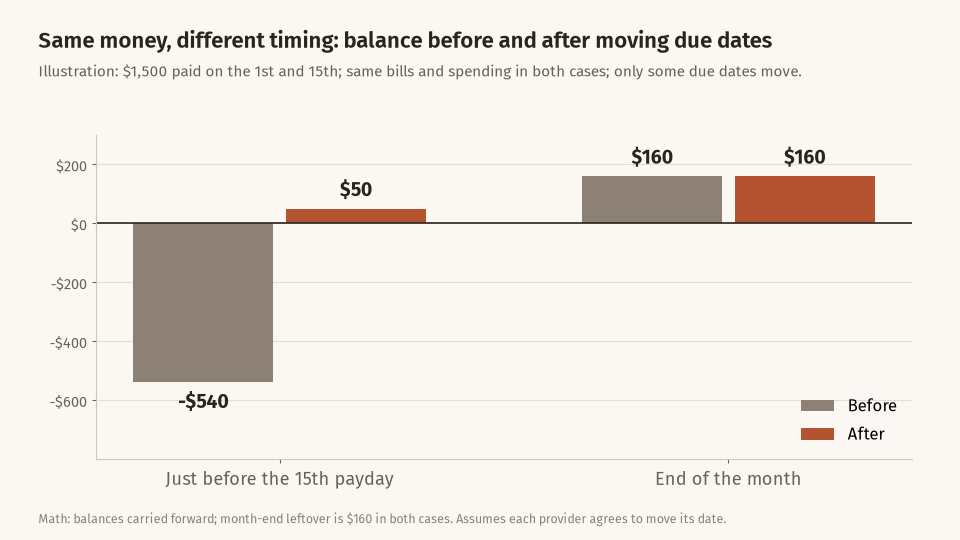
Total bills are $1,740 and everyday spending is $1,100, so the month ends with $3,000 − $1,740 − $1,100 = $160 left over.
Before any changes: by the 14th, the balance is $1,500 − ($1,000 + $300 + $140 + $60 + $90 = $1,590) − $450 = −$540. The shortfall is covered by a card or overdraft, and it only recovers after the second paycheck: −$540 + $1,500 − $150 − $650 = $160.
After moving four due dates to after the 15th, the balance on the 14th is $1,500 − $1,000 − $450 = +$50. At month end it is $50 + $1,500 − ($150 + $300 + $140 + $60 + $90 = $740) − $650 = $160. The month-end number is the same. What changed is that the household no longer needs to borrow to get through the first half.
| Bill (assumed) | Amount | Due before | Due after |
|---|---|---|---|
| Rent | $1,000 | 1st | 1st |
| Car loan | $300 | 2nd | 16th |
| Car insurance | $140 | 3rd | 16th |
| Phone | $60 | 5th | 16th |
| Credit card minimum | $90 | 12th | 17th |
| Utilities | $150 | 20th | 20th |
In real life, not every provider will agree, and some will charge a fee. Rent may be harder to move. If it does not work, the same cash flow budget shows exactly how large the gap is, which helps with the other steps below.
Step 3: Find room in the budget
If the cash flow budget shows you are short even after changing dates, look at spending and income. Moneysmart’s guidance on reviewing your spending includes going through several months of statements, looking for fees you do not recognise and subscriptions you no longer use, and splitting needs from wants. Our guide to how to save money every month has a longer list of recurring costs to review.
On the income side, check you are getting any help you are entitled to:
- UK. MoneyHelper says to claim everything you are entitled to, using its benefits calculator or Citizens Advice.
- Australia. Moneysmart says the Australian Government and state governments offer financial support, concessions and rebates for people on lower incomes or in hardship, and points to Services Australia and state websites to check eligibility.
- US. The CFPB’s cash flow tool counts benefits such as SNAP and TANF as part of your resources. Check your state’s benefits pages for what you may qualify for.
Step 4: Build a small buffer
The CFPB says that if you are living paycheck to paycheck, putting any money aside can feel difficult, but even a small amount provides some financial security. It suggests that managing cash flow, or putting part of a tax refund into savings, are the easiest ways to start if your ability to save is limited. Set up an automatic transfer on payday, even if it is small, and keep it in a separate account. Our emergency fund guide explains how to size and build it.
Using the example above, a $160 monthly surplus would reach $960 after six months and $1,120 after seven. That is an illustration, not a prediction, since real months vary.

Step 5: Handle debt and avoid costly gap-fillers
Borrowing to fill the gap
The CFPB warns that using a credit card or a loan for an emergency can make the bill grow because of interest and fees. MoneyHelper’s cost of living guide suggests, before you borrow:
- Talk to your lender or provider about support, because they may offer help that avoids new borrowing.
- Look for special schemes or tariffs your provider offers.
- Weigh the cost carefully. MoneyHelper says to try to avoid high-cost credit such as payday loans, log book loans or doorstep lending, and mentions credit unions and responsible finance lenders as alternatives worth a look.
- Be careful with employer salary advance schemes. MoneyHelper says most charge fees, which can build up if you use them often, and that they are not regulated by the FCA.
If debt is already building
Contact lenders early. MoneyHelper says to contact your lender or provider as soon as possible if you are worried about missing payments, and to deal first with “priority debts” such as rent, mortgage and debts secured against your home, because the consequences of not paying those can be more serious. Our guide to paying off debt with the avalanche or snowball method explains how to order the rest once you have the basics covered.
Where to get free help
| Country | Where to start | What it offers |
|---|---|---|
| United States | Nonprofit credit counseling (CFPB points to NFCC, FCAA, DOJ list) | Budget help, debt management plans |
| United Kingdom | MoneyHelper: 0800 011 3797 (Mon-Fri 9am-5pm) | Free guidance, debt advice locator |
| Australia | National Debt Helpline: 1800 007 007 | Free, confidential financial counselling |
- US. The CFPB says credit counseling organizations are usually non-profit and can help with a budget and debt management plans, which typically lower monthly payments to creditors and also lower interest charges and fees. It says to look at the Financial Counseling Association of America, the National Foundation for Credit Counseling or the Department of Justice’s approved list. A reputable organization should send free information without asking for details about your situation first.
- UK. MoneyHelper offers free, impartial guidance online and on 0800 011 3797 (Monday to Friday, 9am to 5pm), and a debt advice locator for free confidential debt advice.
- Australia. Moneysmart says financial counselling is free and confidential. The National Debt Helpline is 1800 007 007 (9:30am to 4:30pm, Monday to Friday), with live chat 9:00am to 8:00pm. Moneysmart also warns that businesses that charge fees are debt consolidation and refinancing companies, not financial counsellors.
Common mistakes
- Treating a timing problem as a spending problem, or the other way round. Do the cash flow budget first.
- Ignoring a negative week. A week that ends below zero is the problem to fix, even if the month looks fine overall.
- Moving due dates without checking fees. The CFPB notes some changes can carry a small fee.
- Cancelling a Direct Debit instead of talking to the lender. MoneyHelper warns that cancelling a car finance Direct Debit counts as a missed payment.
- Using costly short-term credit to cover the gap without comparing the full cost.
- Waiting too long to ask for help. Moneysmart says the earlier you get help, the more options you will have.
- Aiming for a large emergency fund before starting. A small first buffer still helps.
Frequently asked questions
Is living paycheck to paycheck always about overspending?
No. It can be, but it can also be about timing, such as bills due before payday or a large annual bill. A cash flow budget helps you tell the difference.
How do I ask a company to change my due date?
Contact the company, ideally one where you have a good payment history, explain that you want the due date to match when you are paid, and ask whether there is any fee. Check the new date carefully, and ask for confirmation of any change in writing.
Should I save first or pay off debt first?
Both matter. The CFPB says savings can stop a shock from becoming debt. MoneyHelper says that if you pay more on borrowing than you earn in interest on savings, it may be worth repaying some debt, as long as you keep some emergency savings. A small buffer plus a plan for the highest-interest debts is common. See our emergency fund and debt payoff guides.
What if my income changes from week to week?
The CFPB’s cash flow tool is built around weekly tracking, which suits irregular income. Its emergency fund guide suggests putting aside part of larger payments when they arrive.
Can a credit counselor really help?
The CFPB says reputable credit counselors are usually non-profit and can help with budgets and debt management plans. Check that the organization is legitimate before you share details, for example through the lists the CFPB points to.
What if I cannot cover essentials even after all this?
Check what financial support is available where you live, and speak to a free counselling service. In the UK, MoneyHelper lists emergency help for money and food. In Australia, the National Debt Helpline can refer you to other services.
This article is general information, not financial advice. Rules, limits and rates change, and your circumstances are your own. All figures in the worked example are hypothetical. Check the official sources below, and consider speaking to a qualified adviser before making decisions. See our Editorial Policy and Disclaimer pages. Last verified: October 2026.
Sources
- CFPB: Creating a cash flow budget (Your Money, Your Goals tool)
- CFPB: Improving cash flow (Your Money, Your Goals tool)
- CFPB: Request a change in your bill due date
- CFPB: An essential guide to building an emergency fund
- CFPB: What is credit counseling?
- MoneyHelper: Help with the cost of living (April 2026)
- Moneysmart (ASIC): Managing on a low income
- Moneysmart (ASIC): Financial counselling