

Last verified: October 2026. Figures and rules below were checked against the official sources listed at the end of the article.
To save money every month, work out what you can afford to put aside, move it to a separate account automatically on payday, and spend what is left. Everything else, such as cutting bills or tracking spending, is about making that monthly amount bigger or easier to keep up.
This guide covers the steps official money-guidance bodies in the US, UK and Australia keep returning to, a worked example with the maths shown, and where savings are protected if a bank fails.
Key takeaways
- Start with where the money goes. Moneysmart suggests reviewing several months of statements and tracking your spending for a couple of weeks, including cash.
- Save on payday, not at the end of the month. MoneyHelper says you are less likely to miss money you set aside straight after you are paid.
- Automate it. The CFPB calls recurring transfers one of the easiest ways to make saving consistent.
- Keep savings separate from the account you spend from.
- Small amounts count. The CFPB says even a small amount provides some financial security.
- Check protection. Deposit protection limits differ by country, and they cover deposits, not investments.

Step 1: Find out what you spend
You cannot decide how much to save without knowing where your income goes. Moneysmart’s guidance is a good practical starting point:
- Review past transactions. Go through several months of bank statements or app history. Group spending into categories such as food, transport, home, health and fun.
- Flag the awkward ones. Highlight bills that come quarterly or yearly, fees you do not recognise and subscriptions you no longer use.
- Track daily spending for a couple of weeks. Write down everything, including cash, which Moneysmart notes is easy to forget.
- Split needs from wants. Needs are essentials such as rent, food, utilities and transport. Wants are things you enjoy but could reduce or delay.
If you have not set up a full budget yet, our guide to how to make a budget walks through it. The aim here is only a clear picture of what comes in, what must go out, and what is left.
Step 2: Set a goal and an amount
Moneysmart and the CFPB both recommend a specific goal. It might be an emergency fund, a holiday, a car or a home deposit. A goal makes it easier to decide how much to save and how long it will take. MoneyHelper suggests writing down what you are saving for, the amount you need each month and the date you aim to reach it.
If you are not sure what amount to pick, start with what you can keep up. The CFPB says that if you are living paycheck to paycheck, putting any money aside can feel difficult, but even a small amount provides some financial security. If money is tight every month, see our guide on how to stop living paycheck to paycheck.
If you have no savings at all, an emergency fund is usually the first goal. The CFPB points out that without savings, a financial shock can turn into debt that is harder to pay off.
Step 3: Save on payday, automatically
Pay yourself first
MoneyHelper’s advice is to pay in straight after payday: wait until the end of the month and the money is far more likely to disappear on everyday spending. Moneysmart’s version is the same: set up a regular transfer when you get paid, so you do not have to decide each time.
There are several ways to do it:
- Recurring transfer. Set up a transfer (a standing order in the UK) from your current or checking account to a savings account. The CFPB says to be mindful of your balances so you do not trigger overdraft fees if the account is short when the transfer happens.
- Split your pay. The CFPB and Moneysmart both mention asking your employer to split your pay between two accounts.
- Round-ups. If your bank offers them, round-ups move small amounts automatically. Moneysmart’s example: a $4.50 coffee is charged as $5, 50 cents goes into savings, and that adds up to $10 a month.
- One-off money. The CFPB suggests putting all or part of a tax refund, bonus or cash gift into savings.
Keep it separate
Moneysmart says to keep your savings in a different account from your spending, which makes it easier to track and harder to dip into. MoneyHelper says the same: if the money stays in your purse or everyday account it is far more likely to get spent. Some people use a second account for bills so that savings and spending do not mix.
Step 4: Make room by trimming recurring costs
Cutting one-off treats rarely adds up to much. Recurring bills are where small changes repeat every month. Moneysmart lists the usual places to look:
- Subscriptions you no longer use. Cancel them.
- Phone and internet plans. Compare plans to see if you can get better value.
- Energy. Compare suppliers where you can.
- Insurance. Moneysmart says the cost of an insurance policy can vary by hundreds of dollars a year. Compare more than price, because you also need to know what you are covered for.
- Food. Planning meals to avoid food waste is one of Moneysmart’s “quick ways to save”.
- Interest on debt. If you carry a balance, review the rate on each card or loan. Moneysmart says to contact your lender about a lower rate or consider refinancing, because even a small reduction can save you a significant amount over time.
A worked example
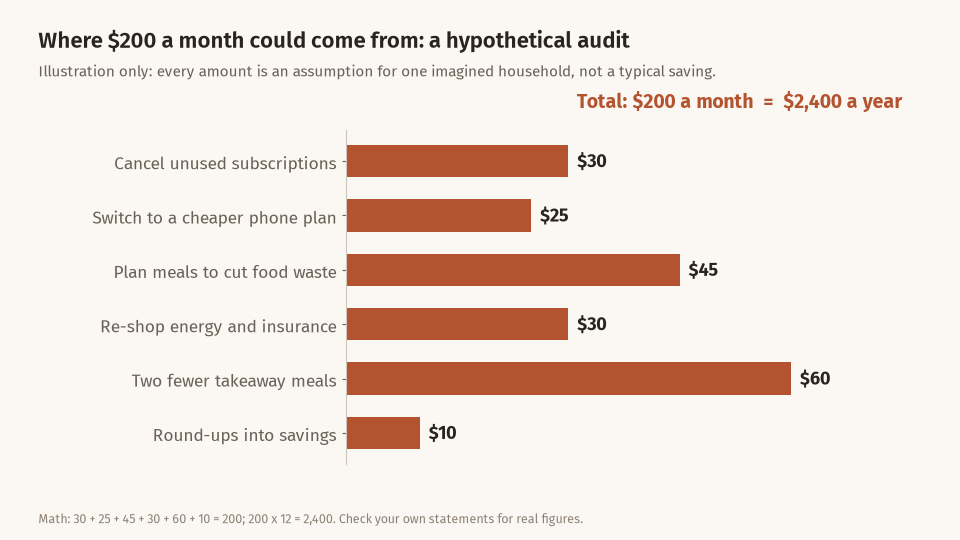
This is a hypothetical illustration. Every amount is an assumption for one imagined household, not a typical saving. Say a household reviews its statements and finds these changes:
| Change | Monthly saving (assumed) |
|---|---|
| Cancel unused subscriptions | $30 |
| Switch to a cheaper phone plan | $25 |
| Plan meals to cut food waste | $45 |
| Re-shop energy and insurance at renewal | $30 |
| Two fewer takeaway meals | $60 |
| Round-ups into savings | $10 |
| Total | $200 |
$30 + $25 + $45 + $30 + $60 + $10 = $200 a month, or $200 × 12 = $2,400 a year. If that is moved automatically to a savings account on payday, the household would have $1,200 after six months. These figures ignore interest, and some of the changes (like re-shopping energy) are not guaranteed to be repeatable every year. The point is that no single item is dramatic, but together they can fund a regular transfer.
What regular saving adds up to
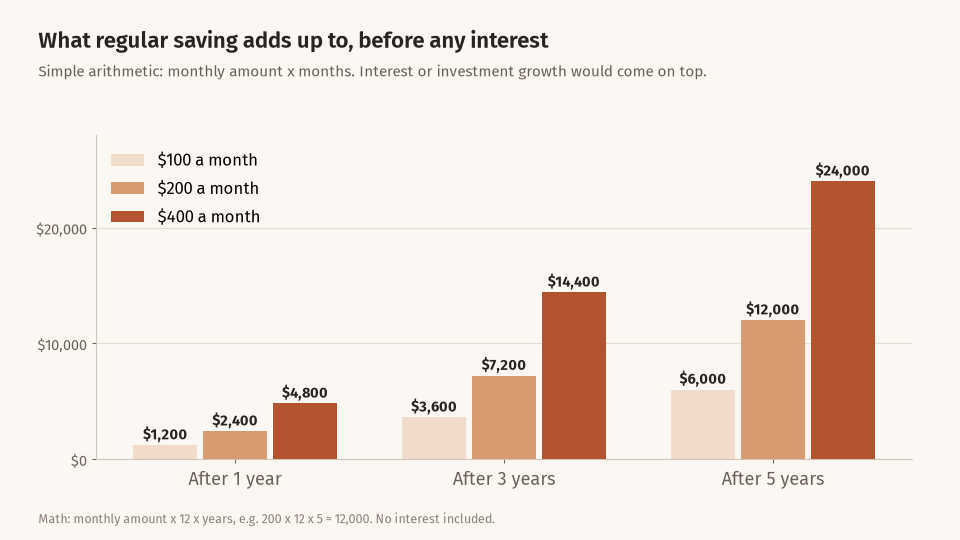
Before interest, the arithmetic is simple: monthly amount × 12 × years. MoneyHelper gives a small example: saving £3 a day adds up to £1,095 over a year.
| Monthly amount | After 1 year | After 3 years | After 5 years |
|---|---|---|---|
| $100 | $1,200 | $3,600 | $6,000 |
| $200 | $2,400 | $7,200 | $12,000 |
| $400 | $4,800 | $14,400 | $24,000 |
Interest or investment growth would come on top. Our explainer on how compound interest works shows how much further regular saving can go with time.
Where to keep your savings
Choose somewhere safe, accessible and out of easy reach of your spending. The CFPB says a bank or credit union account is generally considered one of the safest places to put your money. It also notes that cash can be stolen, lost or destroyed. MoneyHelper says to look at the amount of interest paid, how quickly you can get your money out, and any minimum deposit.
Is it protected if the bank fails?
Deposit protection schemes cover cash in deposit accounts, up to a limit. The limits below were checked against each scheme’s own page:
| Country | Scheme | Limit |
|---|---|---|
| United States | FDIC deposit insurance | At least $250,000 per insured bank |
| United Kingdom | FSCS (since 1 Dec 2025) | £120,000 per person, per authorised firm |
| European Union | National guarantee schemes | €100,000 per depositor (EU rules) |
| Australia | Financial Claims Scheme | $250,000 per account holder, per ADI |
A few details worth knowing:
- US. The FDIC says coverage is automatic at an FDIC-insured bank and covers checking, savings, money market deposit accounts and CDs. It does not cover mutual funds, annuities, life insurance policies, stocks, bonds or crypto assets.
- UK. The FSCS limit rose to £120,000 on 1 December 2025 (it was £85,000 before). Banks that share a banking licence count as one firm, so the limit applies to your total across them.
- EU. The ECB says that under EU rules, €100,000 per depositor is guaranteed through national deposit guarantee schemes.
- Australia. APRA says the Financial Claims Scheme covers up to $250,000 per account holder per authorised deposit-taking institution (ADI). Brands owned by the same institution count together.
The UK also has a tax-free wrapper. MoneyHelper says you can save up to £20,000 across ISAs until the end of the 2026/27 tax year and pay no Income Tax or Capital Gains Tax on the money. From April 2027, under-65s will have a £20,000 allowance with a £12,000 limit for Cash ISAs.

Should you pay off debt first?
It depends on the debt. MoneyHelper’s guidance is that you are unlikely to earn more interest on savings than you pay on borrowings, so aim to pay off expensive debts such as credit cards, store cards and overdrafts before you save. The CFPB makes the other side of the argument: with no savings at all, a small emergency may be put on a card, and the bill can grow because of interest and fees. Many people do both, building a small cushion while they pay down the most expensive balances. Our guide to avalanche vs snowball payoff explains how to order the payments.
Keep going when things change
Moneysmart recommends checking your savings regularly, for example each payday or monthly, so you can see progress. It also says that income, expenses and priorities change, so adjust the amount or the timeline when they do. And if you miss a week or have to dip into savings, start again when you can. The CFPB says not to be afraid to use an emergency fund if you need it; just build it back up afterwards.
Common mistakes
- Saving what is left at the end of the month. There is usually nothing left. Move money on payday instead.
- Leaving savings in your everyday account. Moneysmart and MoneyHelper both say to keep them separate.
- Setting a target you cannot keep. A smaller amount you keep up is better than a large one you abandon. Adjust it when things change.
- Tying up emergency money. MoneyHelper notes you may want an account where you can get at the money when needed rather than locking it away for a long time.
- Overdrawing the account that funds the transfer. The CFPB warns about overdraft fees if the balance is too low when the transfer runs.
- Ignoring annual renewals. Insurance and energy plans are easy to leave unchanged, and Moneysmart notes insurance costs can vary by hundreds of dollars a year.
- Assuming all savings are protected. The limits above cover deposits at covered institutions, and investments are treated differently.
Frequently asked questions
How much should I save each month?
There is no single right figure. Moneysmart suggests using your budget to see what you can save, and the CFPB says even a small amount helps. Start with an amount you can sustain and raise it when you can. Our emergency fund guide explains common targets.
Is it better to save weekly or monthly?
Whichever matches how you are paid. Moneysmart and the CFPB both recommend setting it up around payday. If you are paid weekly or fortnightly, a smaller transfer each pay period works the same way.
What if my income is irregular?
The CFPB suggests managing cash flow and taking advantage of one-off opportunities such as tax refunds or gifts. Moneysmart has a page on managing a casual income. Putting a portion of larger payments into savings when they arrive is one approach.
Do I need a separate savings account?
It is not required, but both Moneysmart and MoneyHelper recommend it because it makes the money easier to track and harder to spend by accident.
Are round-ups worth it?
Moneysmart says small amounts can add up, with an example of about $10 a month from daily coffee round-ups. They are an add-on, not a replacement for a regular transfer, and only work if your bank offers them.
Are my savings safe if my bank fails?
Deposits at covered institutions are protected up to a limit: at least $250,000 per insured bank in the US (FDIC), £120,000 per person per authorised firm in the UK (FSCS), €100,000 per depositor under EU rules, and $250,000 per account holder per ADI in Australia. Investments such as stocks and funds are not covered by these deposit schemes.
This article is general information, not financial advice. Rules, limits and rates change, and your circumstances are your own. Check the official sources below, and consider speaking to a qualified adviser before making decisions. See our Editorial Policy and Disclaimer pages. Last verified: October 2026.
Sources
- CFPB: An essential guide to building an emergency fund
- Moneysmart (ASIC): How to start saving
- Moneysmart (ASIC): Simple ways to save money
- Moneysmart (ASIC): Track your spending
- MoneyHelper: Eight ways to start saving successfully
- MoneyHelper: Getting into the savings habit
- FDIC: Deposit insurance
- FSCS: Deposit protection limit
- ECB: What is a deposit guarantee scheme?
- APRA: The Financial Claims Scheme (FCS)