

Last verified: October 2026. Limits and rules below were checked against the official sources listed at the end of the article. Amounts in the examples are assumed for illustration and are not predictions.
Start by finding out what comes in and what goes out, then follow a rough order: a small cash buffer, any retirement contribution your employer offers, costly debt, a full emergency fund, and only then long-term investing and protection. That order is a starting framework, not a rule. It exists because each step makes the next one safer. A buffer stops a surprise bill from becoming a credit card balance, and paying down a card that charges over 20% a year saves interest at that rate.
The sections below explain each step, show the arithmetic with two worked examples, and point out where the United States, United Kingdom, European Union and Australia differ. If you only have a few minutes, read the key takeaways and the worked example.
Key takeaways
- Know your numbers first. Use your bank statements to list income and spending, because guesses are usually wrong.
- Save a small buffer before anything else. Even a little money set aside helps you recover from a shock without borrowing, according to the US CFPB.
- Take the employer contribution if one exists. It is pay you only receive if you take part. In the US it is a plan match, in the UK the employer must pay at least 3%, and in Australia the employer must pay 12% of ordinary time earnings.
- Clear costly debt before building a large emergency fund. MoneyHelper says credit card debt, unauthorised overdrafts and payday loans are cheaper to clear first. We suggest keeping a small buffer meanwhile.
- A full emergency fund is usually three to six months of essential spending. Moneysmart suggests a good target of three months, and MoneyHelper suggests three to six.
- Review once a year. The order changes as your life does.

The order at a glance
The sequence below is our synthesis of guidance from the CFPB in the US, MoneyHelper in the UK and Moneysmart in Australia. It is not a single official ranking, and each organisation words its advice differently.
Two cautions apply. First, real life is not a staircase. You may be paying a card while also saving a little, and that is fine. Second, if you have a mortgage arrears problem, an unpaid bill that could cost you your home or power, or any debt where you are being chased, deal with that first and get free debt advice. In the UK, MoneyHelper has a debt advice locator for free help. Elsewhere, look for a free non-profit debt advice service in your country.
Step 1: Know your numbers
You cannot plan without knowing what you earn, what you spend and what you owe. Write down four things: your take-home income, your fixed costs such as rent and insurance, your variable costs such as food and fuel, and your debts with their interest rates. Add what you own in savings and investments.
MoneyHelper recommends working from payslips, bank statements and bills, because accurate figures give useful results. If a cost changes through the year, enter it as a yearly amount so the tool can turn it into a monthly average. Moneysmart makes a similar point, saying your results will be skewed if you do not set the right payment frequency for each item. If your pay varies, MoneyHelper suggests budgeting for your lowest monthly income, so the major costs are always covered, and putting any extra into savings in a good month.
Two free tools to start with are the MoneyHelper Budget planner in the UK and the Moneysmart Budget planner in Australia. Both are free, and the Moneysmart one lets you change the currency symbol. For a method you can keep using, see our guide on how to make a budget that sticks.
Step 2: Set one to three clear goals
A goal needs three parts: what it is, how much it costs and when you need it. The time frame matters because it decides where the money should sit. Moneysmart groups goals as short term (0 to 2 years), medium term (3 to 5 years) and long term (5 years or more), and says that goals with a shorter time frame generally suit lower-risk options. Money you need for a deposit in 18 months and money you will not touch for 30 years should not be treated the same way.
- Short term: a starter buffer, a holiday, clearing a small debt.
- Medium term: a car, a home deposit, a career break.
- Long term: retirement, or helping with a child’s education.
Keep the list short. One to three goals are easier to fund than ten.
Step 3: Build a starter buffer
Before you chase any other goal, put a small amount in an easy-access account. The CFPB says setting up a dedicated savings fund is one of the first steps you can take to start saving, and that even a small amount helps you recover faster from an unplanned expense. Without any savings, the CFPB notes, people may rely on credit cards or loans, which can lead to debt that is generally harder to pay off.
How big should the starter buffer be? No official body sets a number, so treat any figure as a judgement. The examples on this page use $1,000, which is our assumption for illustration. Moneysmart gives a sense of the pace: $20 a week into a savings account gives you over $1,000 in a year ($20 × 52 = $1,040). Choose a figure that would cover one typical surprise for you, such as a car repair or a dental bill.
Make the saving automatic. The CFPB says recurring transfers from checking to savings are often one of the easiest ways to be consistent. Moneysmart suggests asking your payroll department to pay a small part of your wage directly into a separate account.
Step 4: Capture the employer retirement contribution
If your employer adds money to your retirement account when you contribute, that is part of your pay package. In the US, the IRS says that if you do not contribute, you may be walking away from free money. The rules differ by country, as the table shows.
| Country | Typical workplace account | What the employer pays |
|---|---|---|
| United States | 401(k) or similar plan | Optional. Many employers match; the formula varies by plan |
| United Kingdom | Workplace pension (auto-enrolment) | Legal minimum 3% from the employer, 8% in total with yours, in most schemes |
| Australia | Superannuation | 12% of ordinary time earnings, from 1 July 2025 |
A worked match example (United States)
This is a hypothetical illustration. The match formula is assumed, and your plan will have its own.
Priya earns $4,000 a month before tax. Her employer matches 50% of her contributions, up to 6% of her pay. The IRS gives a formula of this shape as an example of a typical 401(k) match, and says the plan documents state your actual formula. The maths for one year:
- 6% of $4,000 = $240 a month, or $2,880 a year. This is the most that earns a match.
- 50% of $2,880 = $1,440 of employer money, which is the maximum match.
- If she contributes 3% ($1,440 a year), the match is 50% × $1,440 = $720, so $2,160 goes in.
- If she contributes 8% ($3,840 a year), the match still stops at $1,440, because only the first 6% counts. That is $5,280 in total.
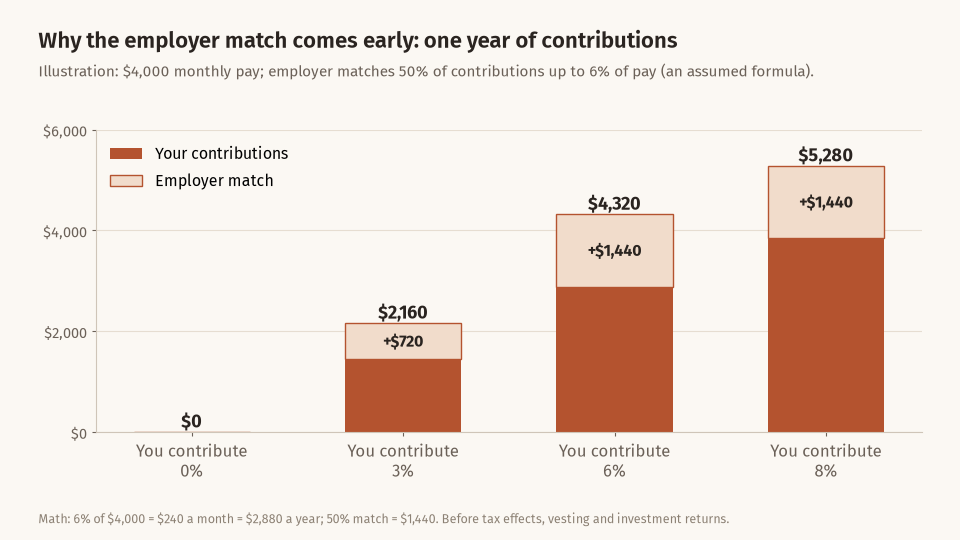
The lesson is that the first dollars you contribute up to the match limit earn an immediate 50% from the employer in this example, before any investment return. That is why the step comes early. Remember the limits of the chart: it ignores tax effects, vesting (the IRS says your plan information will tell you how long you must work before receiving matching contributions) and investment returns. The IRS also notes that matching contributions do not reduce the amount you can contribute from your own salary.
Other countries
- United Kingdom: under automatic enrolment, GOV.UK says the employer minimum is 3% and the total minimum is 8% in most schemes, based on earnings between £6,240 and £50,270 a year. For a £30,000 salary, the band is £30,000 − £6,240 = £23,760, so 8% is £1,900.80 a year, of which the employer pays at least 3% (£712.80). Schemes can require more. The government usually adds tax relief to your contributions if you pay Income Tax.
- Australia: the ATO says the super guarantee is a minimum of 12% of ordinary time earnings from 1 July 2025. On $5,000 of ordinary time earnings in a month, that is $600 paid to your super fund. This is compulsory for eligible employees, so check your payslips to confirm it arrives.
- European Union: workplace pension rules vary by country. Check your national pension authority and your employer’s scheme.
Step 5: Pay down high-interest debt
Credit card interest is typically much higher than the interest a savings account pays. The Federal Reserve’s G.19 release reports an average credit card rate of 22.36% on accounts assessed interest in August 2026, and 21.19% across all accounts. MoneyHelper lists credit card debt, unauthorised overdrafts, payday loans, door-to-door lending and mortgage arrears as debts it would be cheaper in the long run to pay off before building a large emergency fund. It also says that if other credit is low cost, temporary or well under control, adding to your emergency fund is a good idea.
So keep your starter buffer, pay the minimum on every debt, and send the extra to the most expensive one. Our guide to debt payoff: avalanche vs snowball explains the two main ways of ordering the payments. Low-rate debts, such as many student loans or a mortgage, usually come later, but check each rate and any penalty.
Step 6: Grow your emergency fund
When costly debt is gone, build the fund toward a full cushion. MoneyHelper gives a rule of thumb of three to six months of essential outgoings in an instant-access account. Its example is that if you spend £1,000 a month on essentials, you might aim for £3,000 to £6,000. Moneysmart says a good target is enough to cover three months of expenses, and the CFPB says the right amount depends on your situation.
Use essential spending only: housing, utilities, food, transport, insurance and minimum debt payments. Keep the fund somewhere safe and accessible, separate from daily spending. The CFPB lists a bank or credit union account as generally one of the safest options. In the EU, deposit guarantee schemes protect deposits up to €100,000. Our full guide on how much you need in an emergency fund and where to keep it covers protection limits in every region.

Step 7: Invest for the long term, protect and review
With a cushion in place, you can invest for goals more than five years away. A common route is the tax-advantaged retirement account in your country. For 2026, the IRS says the 401(k) employee contribution limit is $24,500 and the IRA limit is $7,500. UK and Australian accounts have their own limits, which are covered in our beginner guide on how to start investing.
Protection is part of the plan too. Insurance and a will do not earn anything, but they stop one event from wiping out years of progress. Depending on your situation this may mean health, car, life or income protection cover. Moneysmart, for example, suggests thinking about income protection in case you are unable to work.
Then review once a year. Check your budget, update your goals, raise your retirement contribution if you can, and confirm your cover still matches your life.
A worked example: where $500 a month goes
This is a hypothetical illustration. The balance and rate are assumed, and the rate is close to the Federal Reserve figure above.
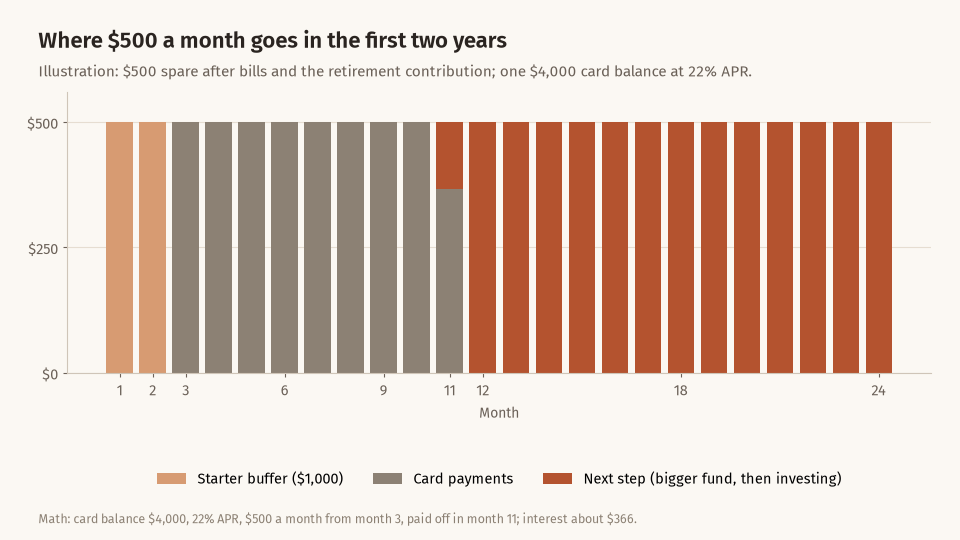
Sam has $500 a month left after bills and the retirement contribution that earns the employer match. Sam has a $4,000 credit card balance at 22% APR and no savings. The plan:
- Months 1 and 2: $500 a month builds a $1,000 starter buffer. Sam pays only the minimum on the card. For simplicity, assume those minimums cover only the interest, so the balance is still $4,000 at the start of month 3.
- Months 3 to 11: $500 a month goes to the card. Interest is 22% ÷ 12 = 1.8333% a month on the balance, so month 3 adds about $73 of interest before the payment.
- Working month by month, the balance falls to $3,573 after month 3, $2,696 after month 5, $1,320 after month 7, $359 after month 10, and reaches zero in month 11, when only about $366 of the $500 is needed.
- Total interest on the card: about $366. Total paid is $4,366 over nine months.
- Month 11 to month 24: the leftover $134 in month 11 plus 13 months of $500 gives about $6,634 for the next step: a larger emergency fund, then investing.
The checks add up: $1,000 + $4,366 + $6,634 = $12,000, which is 24 months × $500. Real life will differ, because minimum payments and daily interest calculations vary by card. Without the plan, a card at 22% on $4,000 costs about $73 of interest in the first month alone.
How the order shifts in your 20s, 30s and 40s
The seven steps stay the same, but the emphasis changes with your life. These are general patterns, not rules, and they are not drawn from any study.
In your 20s
Time is the main asset, so the habit matters more than the amount. Track spending, build the starter buffer, take any employer contribution, and avoid carrying card balances. Contribute whatever you can to retirement early, even if it is small, because contributions made early have the most years to grow.
In your 30s
Costs often rise because of housing, a partner or children. Review insurance and a will, increase the emergency fund as your essential spending rises, and raise your retirement contribution each time your pay increases. Decide how a home purchase fits with your retirement saving instead of treating them as competing goals.
In your 40s
This is a good time for a proper retirement check. Estimate how much you need and whether your current contributions will get you there. In the US, the IRS allows catch-up contributions from age 50, set at $8,000 for most 401(k) plans in 2026. Keep your emergency fund in line with higher spending, and keep insurance up to date.
Common mistakes
- Skipping the numbers. A plan built on guesses breaks quickly. Start with bank statements.
- Missing the employer contribution. Check your plan details for the match formula and any waiting period.
- Putting everything into savings while a card charges over 20%. Keep a small buffer, then attack the costly debt.
- Ignoring vesting. Plan documents state the conditions for employer contributions.
- Keeping the emergency fund in investments. It should be cash you can reach quickly.
- Setting too many goals. Pick the one to three that matter most.
- Never reviewing. Your order of priorities should change when your income, family or debts change.
- Assuming rules are the same abroad. Match rules, tax relief and deposit protection differ by country.
Frequently asked questions
What should I do first with my money?
Find out what comes in and goes out, then start a small buffer. The CFPB describes a dedicated savings fund as one of the first steps you can take to start saving, even if the amount is small.
Should I pay off debt or save first?
Do a bit of both in sequence. Keep a small starter buffer, take any employer retirement contribution, then pay down costly debt such as credit cards. MoneyHelper says clearing debts like credit cards, unauthorised overdrafts and payday loans first is cheaper in the long run, before you build a large emergency fund.
How much should I have in an emergency fund?
MoneyHelper suggests three to six months of essential outgoings in an instant-access account, and Moneysmart says a good target is three months of expenses. If that feels far away, start with a smaller amount and build up.
Is an employer match really free money?
The IRS describes it as free money you may be walking away from if you do not contribute, but the plan sets the formula and conditions. Check your plan documents for the match, the contribution you need to make and how long you must work before you keep it.
Does the order change outside the US?
The steps are the same, but the rules differ. The UK has automatic enrolment with a legal minimum of 3% from the employer, and Australia has a super guarantee of 12% of ordinary time earnings. In the EU, it depends on your country.
How often should I review my plan?
At least once a year, and when something big changes, such as a new job, a move, a partner or a child.
This article is general education about personal finance, not financial, tax or legal advice. Rules, limits and rates change and your situation is your own. Check the official sources below, and consider talking to a qualified adviser before making decisions. See our Editorial Policy and Disclaimer pages for how we work.
Sources
- CFPB: An essential guide to building an emergency fund
- IRS: Matching contributions help you save more for retirement
- IRS: 401(k) limit increases to $24,500 for 2026, IRA limit increases to $7,500
- Federal Reserve: Consumer Credit, G.19 (August 2026)
- MoneyHelper: Budget planner
- MoneyHelper: Emergency savings, how much is enough?
- GOV.UK: Workplace pensions, what you, your employer and the government pay
- Moneysmart (ASIC): Budget planner
- Moneysmart (ASIC): Save for an emergency fund
- Moneysmart (ASIC): Develop an investing plan
- Australian Taxation Office: How much quarterly super to pay
- European Commission: Deposit guarantee schemes